



 Illustration by Diana Duren
Vanderbilt Health has long had close ties with Charité–Universitätsmedizin Berlin — one of Europe’s top university hospitals — including numerous joint research studies.
To further strengthen this cooperation, Vanderbilt Health has signed a memorandum of understanding (MoU) with Charité with the goal of increasing collaboration in medical education, clinical research, digital health and translational science.
“This agreement formalizes and adds structure to the collaborative relationship we have enjoyed with Charité for several years now. By strengthening these ties with such a distinguished international partner, we are advancing our mission to impact health care on the global stage,” said Jeff Balser, MD, PhD, President and Chief Executive Officer of Vanderbilt Health and Dean of Vanderbilt University School of Medicine.
The partnership builds on established exchanges and collaborations, as well as joint working groups between Vanderbilt partners, the Berlin Institute of Health at Charité and the German Heart Center at Charité. As evidence, over the past five years there have been approximately 240 scholarly articles published that include both Vanderbilt Health and Charité faculty as authors.
“This is an exciting development for us, and we are eager to forge new collaborations, initiatives and exchanges with Charité that will greatly benefit our faculty, trainees and students,” said Donald Brady, MD, Executive Vice President for Educational and Medical Staff Affairs at Vanderbilt Health and Executive Vice Dean for Academic Affairs at VUSM. “We had been interested in finding the right international, collaborative partner for quite some time.
“We wanted to take the time to find the right institutional partner with whom we clearly see depth to the relationship and a strong future. This is the right time and the right partner. Our institutions already share a strong relationship built over many years, and by combining our strengths and learning from one another, we will continue to enhance health systems, advance medical education, and drive critical research forward,” Brady said.
The MoU lists possible opportunities for collaboration, including:
- exchanges on medical education and curriculum development;
- joint exchange programs such as clinical and research rotations for students;
- joint interdisciplinary research exchange programs and staff exchange opportunities at all levels;
- best practice exchange for implementing networking models;
- best practice exchange covering digital health; and
- AI-driven projects and more.
In addition to the MoU, Charité leaders and Brady, acting in his role with VUSM, also signed a student exchange agreement enabling clinical rotations abroad for medical students from both institutions. Per the agreement, the purpose of the trans-Atlantic exchange is “to introduce students to the host educational system, its conditions and practices at the host institution, and to strengthen the students’ knowledge and practical skills.” The student exchanges would occur during the participants’ final year of medical education.
“Charité and Vanderbilt not only share a commitment to excellence in research, patient care and education, we also share the conviction that global collaboration is essential for the future of medicine,” said Charité Chief Executive Officer Heyo Kroemer, MD. “At a time when geopolitical uncertainty risks pulling countries apart, this partnership demonstrates that scientific exchange and trust can build important bridges.”
“The signing of the MoU and the student exchange agreement is a significant step toward intensifying our partnership,” said Charité Dean Joachim Spranger, MD. “The education and training of future health professionals will be critical in shaping medical research and patient care on both sides of the Atlantic. Together we will advance biomedical research, support young talent, and strengthen the digital and clinical transformation of our health care systems.”
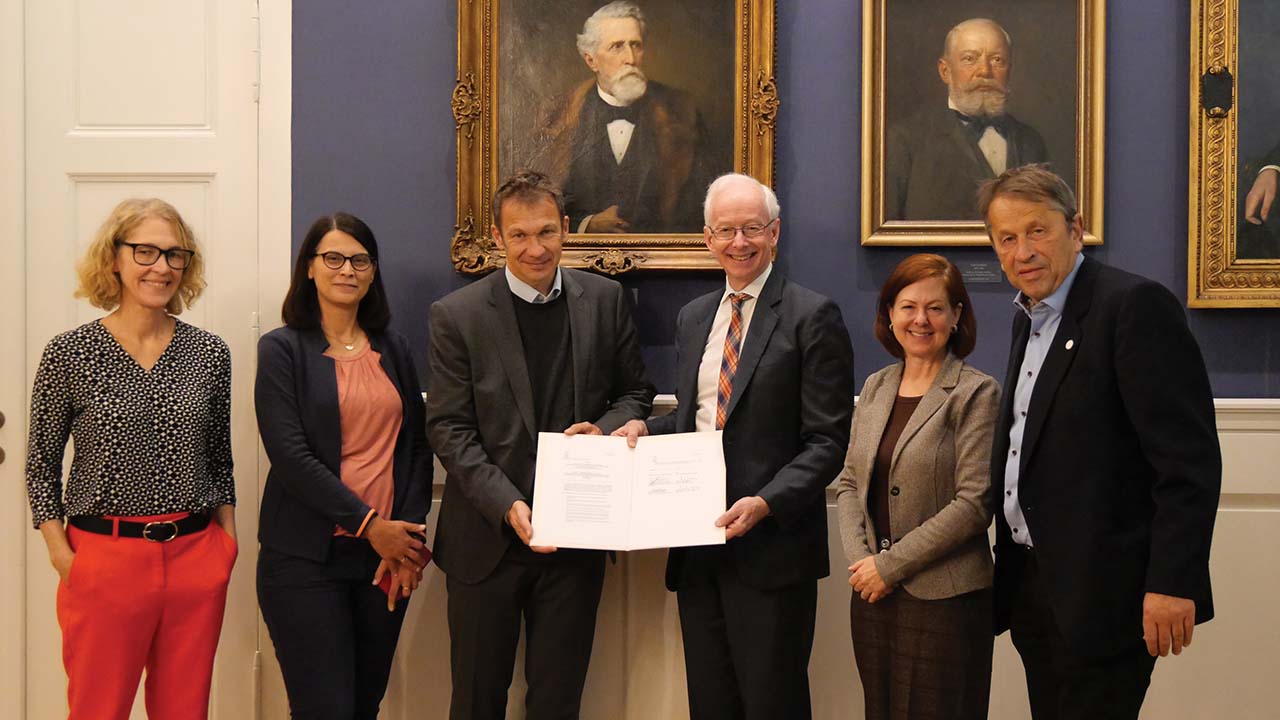
The collaboration was formalized during a visit to Berlin in 2025 by Brady and Marie Martin, PhD, MEd, Associate Vice President of Global Initiatives at Vanderbilt Health. Their visit included meetings with Charité colleagues to discuss strategic initiatives such as curriculum development, joint research priorities and digital health solutions.
In a guest lecture on Vanderbilt’s personalized medical school curriculum, Brady emphasized the shared educational philosophies of both institutions and addressed key questions regarding the future of medical training in the age of artificial intelligence.
“As AI becomes integral to clinical practice, medical education must evolve just as rapidly,” said Brady. “Our partnership with Charité allows us to share approaches to training future physicians in an AI-enabled health care environment and to learn from each other’s innovations as we prepare the next generation for what lies ahead. The commitment of Drs. Kroemer and Balser to this relationship demonstrates its depth.”
Brady noted that the seed for the formal collaborative relationship between the two institutions was planted many years ago when Kroemer and Balser worked together in the lab of leading Vanderbilt Health researcher Dan Roden, MD. In early 2024, executive leaders from Charité came to Tennessee to meet with top Vanderbilt Health leaders in health system operations, research, health policy, IT and informatics.
Prior to the signing of the agreements, virtual meetings involving leaders from the two institutions occurred for several months to investigate shared opportunities in three areas: clinical, research and education.
One of the priorities will be developing new strategies for academic medicine of the future.
Both VUSM and Charité have transformed their medical school curricula in recent years, and there is a commitment from both groups to evolve and innovate as the health care landscape and related technologies continue to shift.
During their recent visit, Brady and Martin also met with leaders from Charité’s research areas to explore opportunities for joint projects. The institutions share strengths in neuroscience, infectious diseases, cardiology, oncology, pulmonology, population health and disease prevention.
“Charité is interested in our electronic heath record system, and there was also great interest around BioVU — what does that look like at Vanderbilt and the possibility of starting a similar database and working together on that,” Brady said. “There was also a lot of interest in biomedical informatics and data science and Vanderbilt’s rich history there and what might be developed together.”
Vanderbilt’s BioVU — one of the world’s largest biobanks — links de-identified biospecimens with electronic health records, offering exceptional potential for collaborative studies in precision medicine, genomics and personalized therapies. Both universities additionally maintain strong programs in global health research and education.
Martin said bringing students from both institutions together for collaborative learning opportunities will allow them to better appreciate and understand different perspectives, provide greater opportunities to innovate, and encourage thinking globally rather than just considering the reality in front of them.
She said ideally, the formal partnership will also plant similar seeds for future international collaborations among participants like the partnership that began years ago with the meeting of two, gifted young men in the Vanderbilt lab of Roden — the genesis for the current partnership.
“With this partnership in place, students can more easily advance their knowledge of the world, their cross-cultural understanding and trans-Atlantic collaborations,” Martin said. “It can be incredibly transformative.
“Our institutions have already achieved a great deal together, but the MoU gives us a framework to think even bigger. By connecting our teams, our students and our research infrastructures, we can accelerate discoveries that improve health not only in the United States and Germany, but globally.”