
When Vanderbilt’s Cancer Center was founded in 1993, the computer age was booming like never before. According to the Census Bureau, 28 percent of U.S. households had a computer and 46 percent of adults used a computer at work. At that time, IBM, Gateway and Apple computers were most popular, and Microsoft Windows became the best-selling operating system.
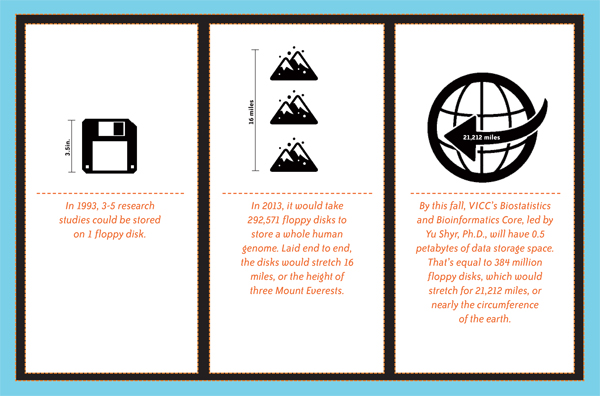
In 1993, the 3.5-inch floppy disk— that square, often colorful piece of plastic that wasn’t actually floppy—was king of data storage. Researchers at the Cancer Center could fit data for 3-5 studies, each having just 100 variables, onto one floppy disk.
Twenty years later, the floppy disk is a relic of a bygone computing era, and data is stored on servers with billions times the capacity of a floppy disk. With today’s genomic sequencing capabilities, research studies have as many as 3 billion variables. A whole human genome is about 400 gigabytes of data, which would fit on about 292,571 of those floppy disks from 1993.