David Calkins Archive — Page 2 of 2

Portrait of a smiling man in a white lab coat, purple shirt, and patterned tie seated in a clinical office; a computer monitor is visible behind him.
September 19, 2013

Team tracking new options to treat glaucoma

Three years ago, a team of researchers led by David Calkins, Ph.D., vice chair and director of Research at the Vanderbilt Eye Institute, showed that the first sign of injury in glaucoma, the leading cause of blindness in the United States, occurs in the brain.

A man in a dark sweater and tie stands with his arms crossed in a laboratory, with shelves and scientific equipment in the background.
January 24, 2013

Calkins lands award from Research to Prevent Blindness

David Calkins, Ph.D., vice chair and director of Research for the Vanderbilt Eye Institute, was recently awarded a Research to Prevent Blindness (RPB) Senior Scientific Investigator Award.

David Calkins stands with his arms crossed in a laboratory, with shelves and scientific equipment in the background.
October 4, 2012

Glaucoma research highlighted at VEI symposium

Vision experts from around the country recently gathered at the 2012 Vanderbilt Eye Institute symposium “Regenerative Medicine in Glaucoma” to discuss the impact that regenerative medicine has on neurobiological diseases.

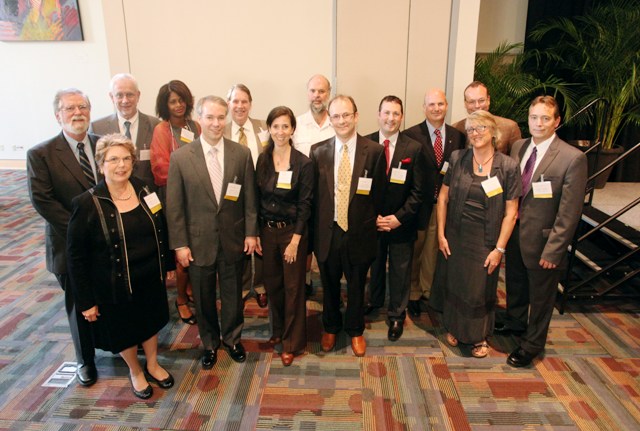
Group portrait of Vanderbilt’s 2012 endowed chairholders, with several people standing in rows in a hotel-like interior.
August 30, 2012

Event celebrates Vanderbilt endowed chair holders

Twelve Vanderbilt University faculty members were honored for extraordinary contributions to their respective fields during an Aug. 28 celebration of endowed chair holders at the Student Life Center.

Close-up of a human eye with a sharply focused black pupil and a rainbow spectrum reflected across the iris; the surrounding face is blurred and grayscale.
July 5, 2011

Grants bolster eye research at Vanderbilt

Research to Prevent Blindness has awarded a grant of $100,000 to Vanderbilt’s Department of Ophthalmology and Visual Sciences to support research into the causes, treatment and prevention of blinding diseases.