Jeremy Veenstra-VanderWeele Archive — Page 1 of 1

Cropped person in a beige shirt and blue jeans clutching their abdomen with both hands against a white background.
January 9, 2014

Brain-gut connection in autism

An association between rigid-compulsive behaviors and gastrointestinal symptoms in autism spectrum disorder may point to a common biological pathway that impacts both the brain and the gut.

Three men in suits stand on a stage; the man on the left shakes hands with the man in the center while the man on the right looks on. A large silver bowl sits at the lower right.
August 22, 2013

Gore, Bernard receive research awards at Faculty Assembly

“Vanderbilt’s Nobel Prize,” the Earl Sutherland Prize for achievement in research, was awarded to John Gore at the Fall Faculty Assembly, while Gordon Bernard received the Thomas Jefferson Award for distinguished service to Vanderbilt.

Blood syringe/vial
May 23, 2013

Blood test for autism could speed diagnosis

Vanderbilt University is part of a multi-site autism clinical study designed to evaluate the effectiveness of a blood test that aims to screen children for referral for autism spectrum disorder evaluation (ASD) earlier and more accurately.

A man wearing glasses interacts with a young child who is holding colorful balls beside a button-activated toy, in a clinical or educational setting.
May 9, 2013

NIH grants bolster autism research, treatment efforts

Researchers at Vanderbilt University have received grant awards from the National Institutes of Health as part of the Autism Centers of Excellence (ACE) research program. The NIH announced grant awards of $100 million over five years to 11 centers nationwide, three of which feature projects from Vanderbilt Kennedy Center investigators, to further studies on autism treatment and intervention.

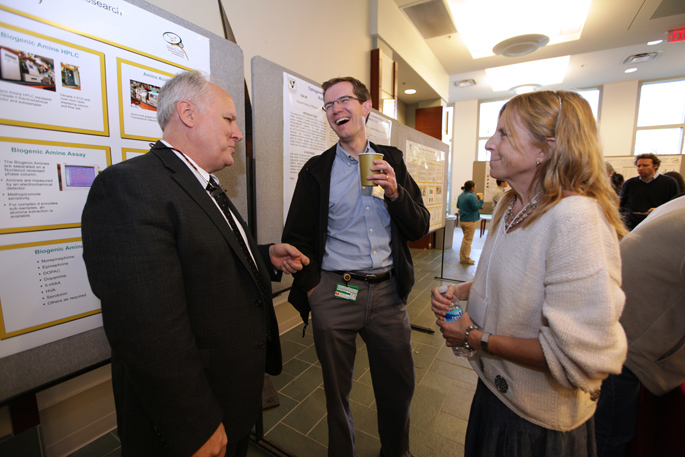
Three adults converse and laugh at a university symposium, with scientific poster displays visible behind them and other attendees in the hallway.
November 15, 2012

Photo: Conte Center Symposium

puzzel pieces, autism
September 24, 2012

Little evidence supports medical treatment options for adolescents with autism

Despite studies that show that many adolescents and young adults with autism spectrum disorders are being prescribed medications, there is almost no evidence to show whether these medications are helpful in this population.