MRI Archive — Page 3 of 3

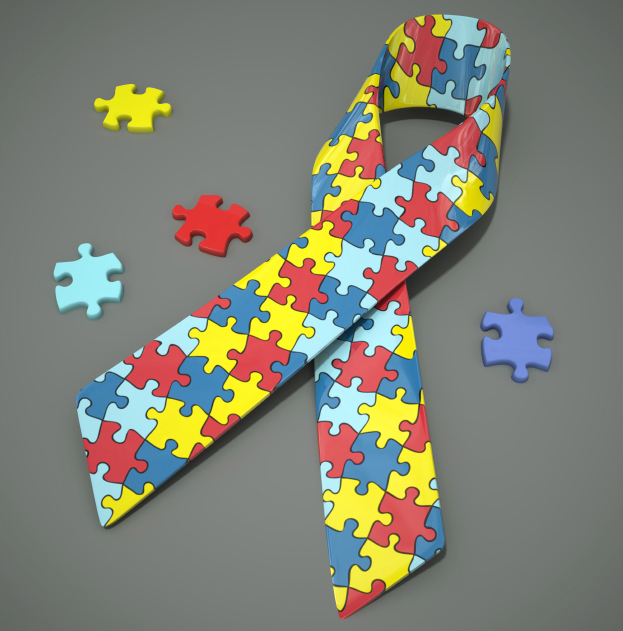
Ribbon covered in multicolored jigsaw-puzzle pieces, with four loose puzzle pieces on a gray background.
November 27, 2013

Autism narrows brain’s reward response

MRI brain scans reveal that children with autism spectrum disorders respond to a narrower range of familiar rewards.

Two adults attend to a young child lying in a foam tube with a device over her face, practicing for an MRI in a child-friendly room decorated with colorful stickers.
October 31, 2013

Program helps children complete MRIs sedation-free

Natalie Ortiz is a typical six-year-old first grader — happy, active and fidgety — the kind of patient often sedated for a lengthy Magnetic Resonance Imaging (MRI) scan.

Three researchers stand beside a Philips MRI scanner in an imaging laboratory: a man in a shirt and tie, a woman in blue, and a woman in glasses and a purple jacket.
September 12, 2013

MRI used as new tool in predicting lymphedema risk

A new Vanderbilt study is the first to use magnetic resonance imaging (MRI) to noninvasively measure lymphatic flow.

Multiple blue-toned sagittal MRI scans of the human brain arranged together, with white technical labels overlaid.
July 12, 2013

Methods for imaging myelin loss

Certain MRI metrics can be used to assess myelin loss in multiple sclerosis, which is important for planning and monitoring therapy.

False-color medical scan showing a side-view, oval-shaped cross-section with a dense multicolored region against a black background.
June 24, 2013

Predicting cancer’s response to therapy

Researchers are developing imaging methods to predict patient outcome early in the course of chemotherapy for breast cancer – to allow clinicians to adjust therapy for patients who are not responding.

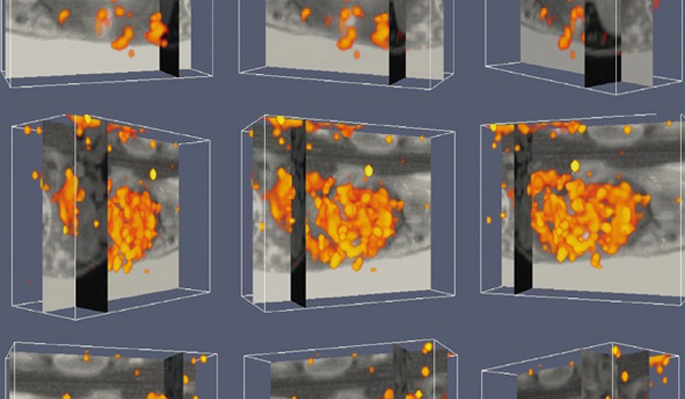
Grid of grayscale 3D medical imaging renderings with orange and yellow highlighted regions shown in transparent box views.
August 9, 2012

Team creates new view of body’s infection response

A new 3-D view of the body’s response to infection — and the ability to identify proteins involved in the response — could point to novel biomarkers and therapeutic agents for infectious diseases.