immunology Archive — Page 9 of 9

Man in a white shirt standing beside large office windows overlooking a cityscape.
June 6, 2013

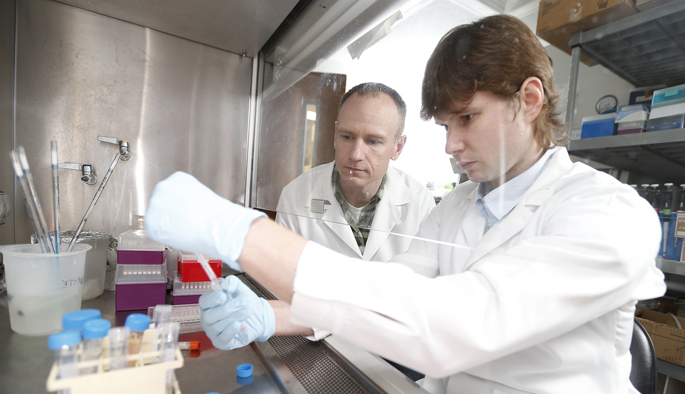
Study tracks skin salt’s role in blood pressure control

Clinical pharmacologist Jens Titze, M.D., and his colleagues have identified a new cast of cells and molecules that function in the skin to control sodium balance and blood pressure.

Two laboratory workers in white coats and gloves handle test tubes and other samples at a laboratory workbench; shelves of lab supplies are visible behind them.
May 30, 2013

Study lays groundwork for rational T cell vaccine design

Vanderbilt University investigators have developed a new strategy for identifying the “bits” of a pathogen that spark a protective immune response.

April 3, 2013

“Silent” B cells trigger autoimmunity

Immune cells that recognize self antigens (e.g. insulin), but are functionally silent, can trigger autoimmune diseases such as diabetes.

Cropped view of a person clutching their lower back, with a red highlighted area indicating pain.
March 1, 2013

Target for inflammatory bowel disease

The factor STAT6 appears to play a role in the pathogenesis of an inflammatory bowel disease, suggesting it may be a promising target for new treatments.

Two researchers stand side by side in a university hallway, one wearing a dark shirt and the other a red shirt.
February 21, 2013

Antibacterial protein’s molecular workings revealed

Vanderbilt investigators report new insights to the workings of calprotectin, an immune system protein that “starves” bacterial pathogens of the metal nutrients they require.

Dark graphic featuring the words “THE FEMINOR DISCOVERY LECTURE SERIES” in white and gold lettering.
January 31, 2013

Nobel laureate explores genomics of immune response

In a wide-ranging lecture that moved from plants to nematode worms to human leukemia, Nobel laureate Andrew Fire, Ph.D., outlined his vision for a genomics-based understanding of how organisms respond to novel information.