Vanderbilt University School of Engineering

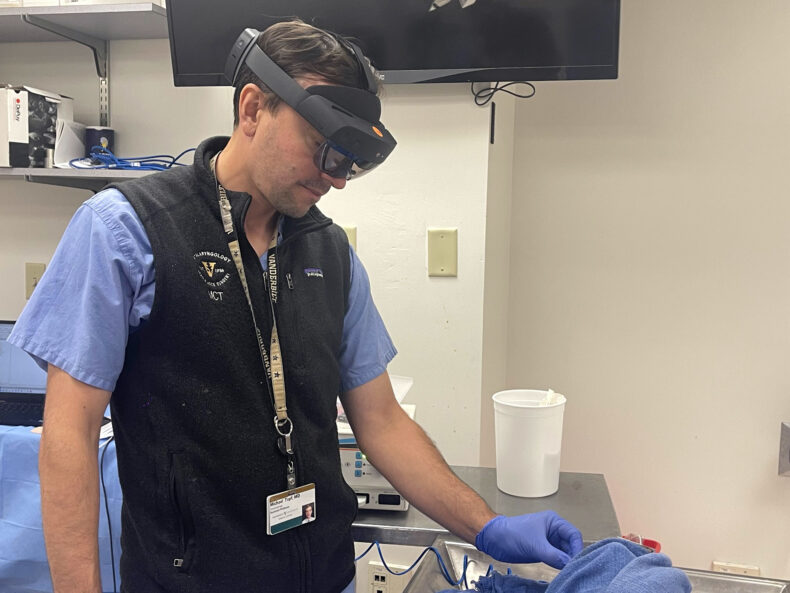
Michael Topf, MD, wears a model of a new head-mounted augmented reality system that can guide surgeons during operations to excise head and neck cancer.

Grant supports development of head-mounted augmented reality system to guide tumor resection 

The technology will allow surgeons to rely less on a fallible mental construction of the resection plane, thereby reducing the risk of human error affecting the procedure. 

Multicenter trial confirms near-infrared autofluorescence increases detection of parathyroid glands

Damage to these glands can cause hypoparathyroidism, a condition that can lead to low levels of calcium and elevated levels of phosphorus in the blood.

Jennifer Herington, PhD, and Todd Giorgio, PhD, during their in-person visit to ARPA-H in July.

VUMC receives $3.3 million ARPA-H award to develop at-home therapy for preterm labor

This project will be the first to apply drug conjugates in the field of obstetrics.

Study tests wearable technology to detect problem behavior before it happens

The goal of the wearable technology is to improve behavioral assessment of children with intellectual and developmental disabilities by predicting the precursors of problem behaviors and using that information to adjust therapeutic approaches.

Waddell Walker Hancock Cancer Discovery Fund names first scholars

A research endeavor that seeks to develop a new cancer immunotherapy utilizing nanobody delivery and targeted heating of tumors has received funding from the Waddell Walker Hancock Cancer Discovery Fund.

New NIH grant funds novel brain network approach to improve epilepsy surgery

Investigators received a $3.2 million grant to develop novel brain network-based measures to guide surgical decisions and improve outcomes in the field of epilepsy surgery. The project builds upon work recently published by VUMC investigators in the journal Brain.

1 2 3