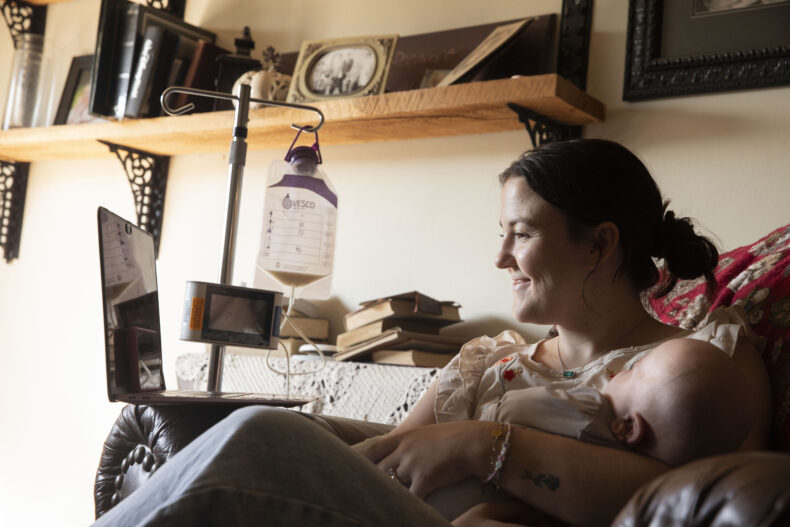
 Brittany Saunders, holding her son, Bennett, talks with Julia Peredo, DNP, APRN, during a telehealth visit. (photo by Susan Urmy)




Bennett Saunders was born three months early March 7, weighing 1 pound, 9 ounces. Considered a micropreemie, he was hospitalized for 103 days in the neonatal intensive care unit (NICU) at Monroe Carell Jr. Children’s Hospital at Vanderbilt.
Before being considered for discharge, there were a few milestones he had to reach — breathing on his own, regulating his temperature, tolerating feeds and gaining weight.
With only two goals left to attain, Bennett’s mother, Brittany Saunders, was introduced to the NICU Bridge to Home program, a remote monitoring and telehealth initiative designed to support families during their transition from the hospital to home.
“It was definitely an easy decision to enroll in the program, but we were a little nervous about it at first,” said Saunders. “They explained every single thing, trained us and made sure we were comfortable.
“By the time we left, we were ready. This program allowed us to come home, which was a huge blessing,” she added.
During the final days in the NICU, Bennett reached another milestone: breathing on his own. He went home June 18 working on the final task of bottle feeding, which typically would have extended Bennett’s hospital stay.
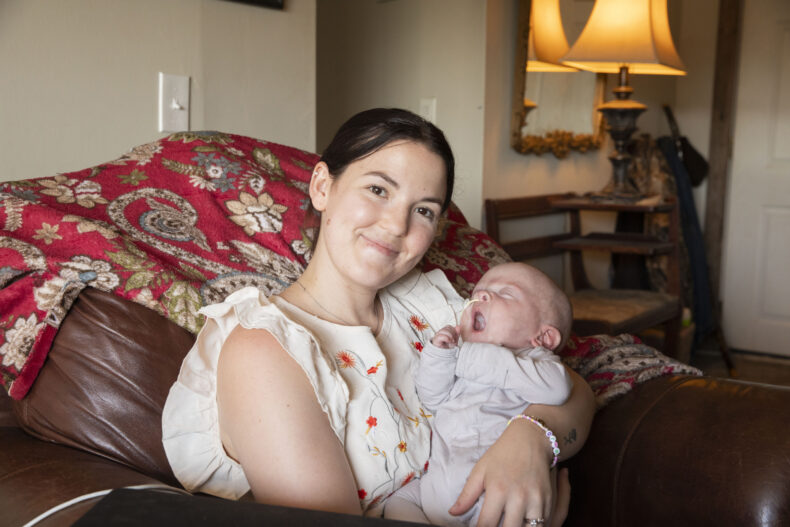
The NICU Bridge to Home team remotely monitored the infant’s weight gain and feeding routine during weekly telehealth sessions.
“He’s inching closer and closer to coming off of the feeding tube,” said Saunders. “In the hospital he was taking an average of 25% of his bottles. Now his normal is 60% and he’s 10 pounds and 10 ounces!”
Since the program’s launch in 2024, there have been 43 patients enrolled. Most participants are infants with feeding challenges, with a few requiring home sedation weaning. The program’s goal is to reduce hospital length of stay while maintaining continuity of care through a customized remote monitoring platform and telehealth follow-ups that allow families to navigate caring for their newborn at home.
“This program is a way to support families as they transition from the hospital to home,” said Julia Peredo, DNP, APRN, the primary advanced practice provider for the service. “Getting a family back into a routine in their own environments is so important. There is less stress. They are able to bond. For many, the NICU journey feels powerless. But this program is empowering as families learn to become the primary caregiver.”
Peredo is joined by a multidisciplinary team that includes Meagan Casey, DNP, APRN, program manager, and Dupree Hatch, MD, MPH, associate professor of Pediatrics and NICU medical director.
Families are loaned an iPad preloaded with the Locus Health application and a Bluetooth scale. The equipment allows the family to log their child’s data into the system including weight and feeding volumes as well as complete weekly telehealth appointments and daily surveys, upload concerns, access educational materials, and review trends associated with their child’s progress.
Prior to discharge, caregivers undergo rigorous training and receive extensive education toward the end of the NICU stay to prepare them to care for their baby at home.
“We want to set our families up for success,” said Casey. “It is important that they feel confident and comfortable. Decreasing that length of stay really has an impact on our families.”

Hailie Carroll, the first parent to enroll in the program, echoed that sentiment. Her daughter, Millie, was born at 25 weeks and spent 95 days in the NICU in 2024 before being discharged.
“Once we were able to come home and I was doing all of her feeds, she seemed to pick it up faster, and there was that consistency,” said Carroll. “I couldn’t be at the hospital 24 hours a day because I had a 3-year-old, and I was juggling my time.
“I really think it helped Millie to come home and be with me and our family. She really thrived after that.”
Millie just celebrated her 1st birthday, and Carroll reports that she eats more than her big sister.
As the NICU Bridge to Home program continues to grow, the team is exploring opportunities to expand.