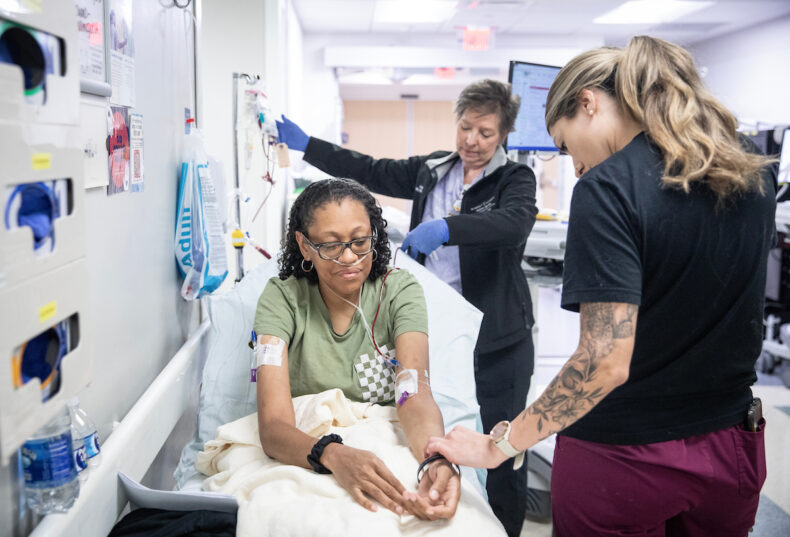
 Sasha Bendolph receives treatment at Vanderbilt University Hospital’s Emergency Department for sickle cell disease. (photo by Erin O. Smith)




On a recent evening, Sasha Bendolph of Clarksville, Tennessee, sought emergent care in Vanderbilt University Hospital’s (VUH) Adult Emergency Department for sickle cell disease. Bendolph, who describes a sickle cell attack as feeling like “shards of glass slicing through your veins, bones and organs,” is representative of the more than 80,000 patients suffering from acute illness, debilitating chronic conditions or traumatic injuries who are cared for in the VUH Adult ED each year.
One day in August, the VUH Adult ED saw an all-time record 283 patients in a 24-hour period. Vanderbilt Health System’s emergency departments, including those in its three Regional Hospitals and the 42-bed pediatric emergency department at Monroe Carell Jr. Children’s Hospital at Vanderbilt, cared for more than 221,000 patients in the fiscal year that ended June 30.
Critically injured or ill patients arrive at VUH from across the region needing care for gunshots, stabbings, motor vehicle accidents, heart attacks, strokes, falls, seizures, organ failure and anything else that can happen to the human body.
Physicians with the Department of Emergency Medicine along with 258 dedicated nurses, paramedics and other support staff provide emergent, urgent and acute care, which frequently requires quickly making critical decisions with limited information about patients’ medical histories.
“Our highly skilled and dedicated teams provide high-quality care to thousands of patients with acute traumatic and medical illness across Middle Tennessee, saving lives every day, often under austere conditions of overcrowding and at great personal cost,” says Erik Hess, MD, MSc, professor and chair of Emergency Medicine and system emergency physician-in-chief. “Our world-class residency and fellowship training programs and innovative emergency care research program are second to none. I’m incredibly proud of our people and feel honored to work alongside such talented colleagues committed to treating each person with dignity, regardless of their personal characteristics. Truly, there is no higher calling.”

According to Lee Ann Liska, MBA, President and Chief Operating Officer for VUH, Middle Tennessee’s booming growth, aging population, growing lack of access to primary care in rural areas, and the fact that VUH is also home to the region’s busiest Level 1 trauma center, all factor into the Adult ED’s patient volumes increasing about 4% year over year. The 116-bed unit located in the heart of Vanderbilt’s downtown Main Campus now sees 11,000 more patients each year compared to five years ago.
“That we’re able to accommodate this growth within a confined footprint is really remarkable,” Liska said. “The biggest challenge we continue to face in VUH is overall capacity, which impacts getting patients who are admitted out of the ED and upstairs into beds.”
Patients arriving by air or ground ambulance are typically sicker and receive a higher emergency severity index. The index is a five-level algorithm, with 1 being the highest, used in all emergency departments to prioritize patient care. Most of Vanderbilt Health’s patients have an emergency severity index of 3 or higher, meaning they are sicker and require prompt attention or immediate lifesaving intervention.
In Bendolph’s case, because she was medically stable, she spent the night in a hallway bed receiving treatment for her symptoms while waiting for a bed to open on one of the hospital’s inpatient units. The ever-growing demand for emergency medical services means that hallway care has become common in emergency departments across the nation. Despite the hallway bed, Bendolph was grateful. “I’m getting the exact care I need to fix the issues I’m facing,” she said.
In June, during the heart of trauma season, over a 14-day period the VUH Adult ED averaged 232 patients per day. To help address the growing demand from lower acuity patients, Vanderbilt Health’s physicians and administrators are constantly innovating to create programs such as post-ED rapid follow-up for patients who can be referred safely to clinics for evaluation and treatment. In its first year the referral program was able to address the needs of more than 750 patients.
Over time, to accommodate rising patient volumes within the existing physical space, leaders have innovated to maximize efficiency. Today, to cohort patients based on their acuity, the VUH Adult ED has two waiting rooms and is subdivided into the A-Pod, a 24-bed area which typically houses Level 1 trauma and critically ill patients; the B-Pod, a 30-bed area that also includes four behavioral health beds for patients who will potentially be admitted; the 48-bed C-Pod, which accommodates patients who need a longer stay in the adult ED to determine their disposition or who may have already been admitted awaiting inpatient beds; along with other smaller areas such as a 6-bed Continuous Flow Unit (CFU) for lower acuity patients. “The goal of the CFU is rapid evaluation and treatment for those patients with minor issues,” Liska said.
Data about patient volumes, wait times, admissions, discharges and other performance metrics is constantly scrutinized. One common metric used by emergency departments across the nation is “Left Without Being Seen” (LWBS), which refers to patients who of their own choice opt to leave an ED after being triaged, but before being seen by a physician. Through continual performance improvement, VUH Adult ED’s percentage of LWBS patients has declined steadily over the past five years and is now at 1.3%, well below the national average of 2%.
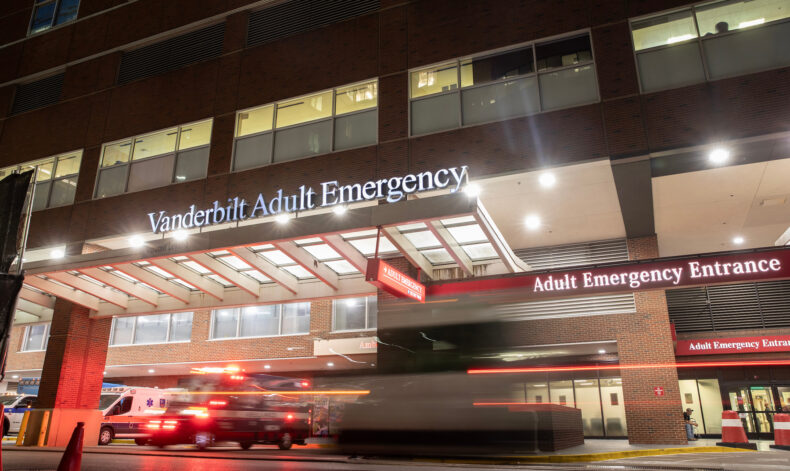
To ensure patients’ needs can continue to be met, the 180-bed Jim Ayers Tower, the newest and largest addition to VUH ever constructed, is opening in October. The tower’s added capacity will help alleviate pressure on the Adult ED.
Liska says there are plans in place for the future to reimagine and expand the Adult ED’s space and services through a major renovation project.
According to national data from the CDC, 2.5 million ED visits stretched into a second day due to overcrowding. If you’re seriously ill and need to seek care at VUH’s Adult ED, please keep in mind that Monday and Thursday tend to be the busiest days of the week.