


 William Schaffner, MD. (photo by Erin O. Smith)




Vanderbilt University Medical Center’s William Schaffner, MD, a nationally recognized advocate of vaccination and rigorous infection control policies, is the 2025 recipient of the Robert Wood Johnson Foundation David E. Rogers Award from the Association of American Medical Colleges (AAMC).
The honor is named for the late David E. Rogers, MD, former chair of Medicine at VUMC and first president of the Robert Wood Johnson Foundation, a leading philanthropy. The award honors medical school faculty members who have made major contributions to improving public health and health care.
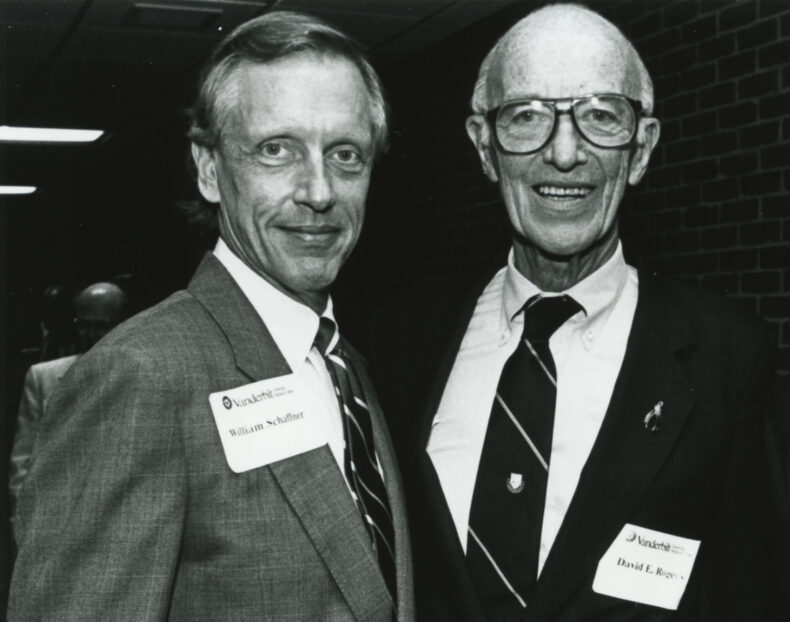
Rogers “was one of my most important mentors,” said Schaffner, professor of Health Policy and professor of Medicine in the Division of Infectious Diseases. “It is especially gratifying and an honor to be recognized with an award in his name.”
At Vanderbilt, Rogers “catalyzed what was a very distinguished but essentially regional medical school to one which could claim a growing national reputation,” he added. “That reputation has grown and grown and grown ever since.”
Schaffner joined the faculty of the Vanderbilt University School of Medicine in 1968 after completing residency and fellowship training at VUMC under Rogers’ guidance, and after a brief stint at what is now known as the Centers for Disease Control and Prevention (CDC).
During a career that spans nearly six decades, Schaffner served as hospital epidemiologist, medical director of the Clinical Microbiology Laboratory, chief of the Division of Infectious Diseases, and chair of the Department of Preventive Medicine, from 1982 to 2013.
When asked to list his accomplishments, he chose three:
- Supporting, promoting and evaluating the use of vaccines to prevent disease across the age spectrum, with a special emphasis on adult immunization
- Helping to lead the establishment of rigorous infection control policies and programs in hospitals and other health care facilities
- Supporting the linkage of academic medical centers, such as Vanderbilt, with public health institutions, including the Tennessee Department of Health, in teaching and research activities
Among many honors, Schaffner has been recognized by the American College of Physicians, the Infectious Diseases Society of America and the American Public Health Association. In 2014, the Tennessee Public Health Association and Tennessee Medical Association established a “Public Health Hero Award” in his name.
Schaffner also is one of the country’s most frequently quoted medical experts on infectious disease, vaccination, and public health and safety. Each week he logs several interviews by various local and national news outlets.
“I regard each interview as an opportunity to teach,” Schaffner said. “There are two opportunities when you work with journalists. The first is to get out as much good information as you can,” and the second is to be an “ambassador” for VUMC to the larger community.
“Vanderbilt has supported me in so many ways and offered me opportunities to do things that sometimes are a little unusual throughout my career,” he said. “For that I am enormously grateful.
“What has made the environment here so special,” Schaffner continued, “are all the people with whom I have had an opportunity to collaborate: colleagues on the faculty and at the Tennessee Department of Health, as well as the bright, curious trainees who have enriched our clinical and research lives.
“All have taught me so much,” he said. “Beyond the professional link, they all are friends — a second family of mentors, students and colleagues.”

