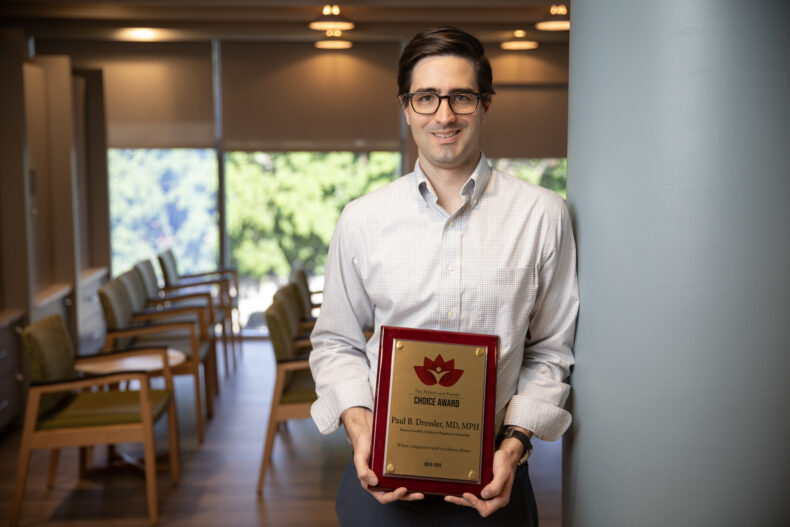
 Paul Dressler, MD, MPH, poses for a photo after being surprised with a 2025 Patient and Family Choice Award. (Photo by Erin O. Smith)

One summer during his undergraduate years, Paul Dressler took a job at a camp for school-age children and adolescents with developmental disabilities, thinking “it sounded like fun.”
“There was a kiddo who had been kicked out of camp the previous few years because he was a pretty big guy and fairly aggressive,” said Dressler, MD, MPH, associate professor of Clinical Pediatrics and medical director of Developmental Medicine. “My job was to make sure he didn’t get kicked out again. The family had some nice behavioral strategies and a therapist who was helpful. The kid did not get kicked out of camp, and I had a lot of fun.”
It wasn’t until he attended medical school at the University of Toledo that Dressler realized the field of developmental medicine existed.
“It’s one of the few fields where there’s still a lot of art to the medicine,” he said. “I can often develop some really nice relationships with the patients and families and follow them through challenging times and good times.
“It’s hard to get bored. In some other fields, it can get so protocolized, going through an algorithm. For me personally, that’s not as fulfilling as trying to figure out unique challenges with every patient. These kiddos will surprise you every day in terms of what they’re able to do.”
Dressler is a recipient of a 2025 Patient and Family Choice Award at Monroe Carell Jr. Children’s Hospital at Vanderbilt.
Nominations are submitted by patients and families. The award honors employees from across Vanderbilt Health who act with compassion and excellence to provide an exceptional experience for patients and their families. This year, Vanderbilt’s patient and family advisory councils bestowed awards on seven individuals from Vanderbilt University Hospital, Monroe Carell Jr. Children’s Hospital at Vanderbilt (two winners), Vanderbilt Psychiatric Hospital, Vanderbilt Adult Ambulatory Clinics, Vanderbilt Wilson County Hospital and Vanderbilt Tullahoma-Harton Hospital.
“My son was diagnosed with Angelman syndrome (a rare genetic disorder that causes severe intellectual disability) in 2013,” one nominator wrote. “Dr. Dressler always makes every visit feel genuine. Although my son is nonverbal, Dr. Dressler begins every visit by … engaging with him. He focuses on my son as a person.
“I have been informed by the Angelman syndrome clinic that I can receive services from them, but because of the relationship my family has with Dr. Dressler, I will not transfer services. Having a son with special needs requires a lot of empathy from others.”
Though he’s honored by and grateful for the recognition, Dressler doesn’t think anything he’s doing is atypical or irregular.
“I think any decent provider should build relationships with patients and families, develop good rapport and work to find the best fit for them,” said Dressler, who runs for self-care and coaches sports teams for his son, 7, and daughter, 5. “It goes back to patient- and family-centered care.”
Dressler knows firsthand how it feels to have a child who needs support: His son was born prematurely at Vanderbilt University Hospital and stayed in the neonatal intensive care unit at Monroe Carell for two months.
“I think what’s scariest is that there are some things you can’t control,” he said. “Coming around to that is hard, and accepting it is hard.”
So, he changes what he can: Another nominator wrote that Dressler’s care in prescribing medication to regulate her son’s emotional imbalance — while making sure he’s still himself — has been “a gift.”
“We’ve seen countless doctors and specialists since we started this autism journey,” she wrote. “Dr. Dressler sees him as the kid he is, and not just another face through the revolving door of people.”