



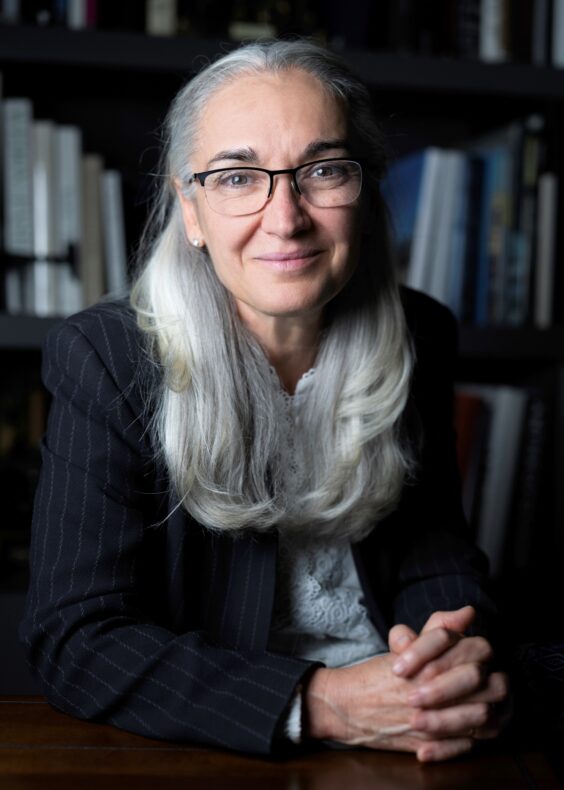
Eva Nogales, PhD, an internationally known structural biologist whose expertise in cryo-electron microscopy and image analysis has produced groundbreaking insights into the function of macromolecules important for gene expression, cell division and disease, is the recipient of the 2026 Vanderbilt Prize in Biomedical Science, officials announced this week.
Nogales is the Distinguished Professor of Biochemistry, Biophysics and Structural Biology at the University of California, Berkeley, and Senior Faculty Scientist in the Division of Molecular Biophysics and Integrative Bioimaging at the Lawrence Berkeley National Laboratory (LBNL). She has been a Howard Hughes Medical Institute Investigator since 2000.
“Dr. Nogales is a visionary scientist whose pioneering work in cryo-electron microscopy has transformed our understanding of fundamental biological processes at the molecular level,” said Jennifer Pietenpol, PhD, Chief Scientific and Strategy Officer and Executive Vice President for Research at Vanderbilt Health, which sponsors the prize.
“Her discoveries have not only advanced basic science but also opened new pathways for understanding disease and developing therapeutic strategies,” said Pietenpol, who holds the Brock Family Directorship in Career Development. “Just as importantly, she exemplifies the spirit of mentorship and collaboration that the Vanderbilt Prize seeks to recognize and celebrate.”
Established in 2006, the Vanderbilt Prize in Biomedical Science recognizes scientists of national reputation who have a stellar record of research accomplishments and are known for mentoring others in science. Two previous honorees subsequently were awarded the Nobel Prize in physiology or medicine.
As a Vanderbilt Prize recipient, Nogales will receive an honorarium, present a special seminar to be announced later, and mentor a Vanderbilt Prize Scholar, a graduate student in biomedical sciences at the Vanderbilt University School of Medicine.
“I am truly honored to receive the Vanderbilt Prize,” Nogales said, “and I thank all those who worked with me over the years and now inspire me with their own research.”
A native of Spain, Nogales earned her Bachelor of Science degree in physics at the Universidad Autónoma de Madrid and, in 1993, a PhD in biophysics from Keele University in Staffordshire, United Kingdom.
Nogales had already begun investigating a new imaging technique, cryo-electron microscopy (cryo-EM), when she began her postdoctoral training at LBNL. By flash freezing samples and probing them with electrons, cryo-EM enables the visualization of biomolecules and cellular structures in their near-native state.
Working with the late Kenneth Downing, PhD, an expert in electron crystallography, and his team at LBNL, Nogales obtained the first structure of tubulin, which forms the microtubules that help make up the cytoskeleton of the cell.
“This success helped me land a faculty position at UC Berkeley” in 1998, Nogales said. From there, “my scientific horizons quickly expanded.”
Over the course of several years, Nogales and a “fearless” group of postdoctoral fellows and graduate students “pushed the limits” of cryo-EM to visualize and describe conformational changes that complex human transcription factors undergo to recognize the start site, recruit the DNA polymerase II enzyme, and transcribe protein-encoding genes.
Her team also determined the structural basis of microtubule dynamic instability, and how it is regulated by other proteins and antimitotic drugs that inhibit cell division.
It is a privilege, Nogales wrote in 2023, to work with “those who have … made my professional life so enjoyable and adventurous. Many of this group of amazing scientists are now running very successful labs of their own. I am immensely thankful for all their efforts, intelligence and drive.”
Nogales has received many honors for her scientific contributions. She is an elected member of the National Academy of Sciences and the American Academy of Arts and Sciences, and a foreign member of the Royal Society.
In 2023 she shared the Hong Kong-based Shaw Prize in Life Science and Medicine with Patrick Cramer, PhD, president of Germany’s Max Planck Society, for “pioneering structural biology that enabled visualization, at the level of individual atoms, of the protein machines responsible for gene transcription, one of life’s fundamental processes.”
The co-author of more than 250 scientific publications, Nogales has lectured widely, serves on numerous advisory boards and committees, and collaborates with scientists around the world.
“Science is a large community effort,” she has written. “Within it, we continue to visualize complex and flexible molecular players in gene regulation, cell division, and neuronal function.” For more information about the Vanderbilt Prize and previous winners, visit the website of Vanderbilt Health’s Office of Research at www.vumc.org/oor, and click on the “awards” tab.


