


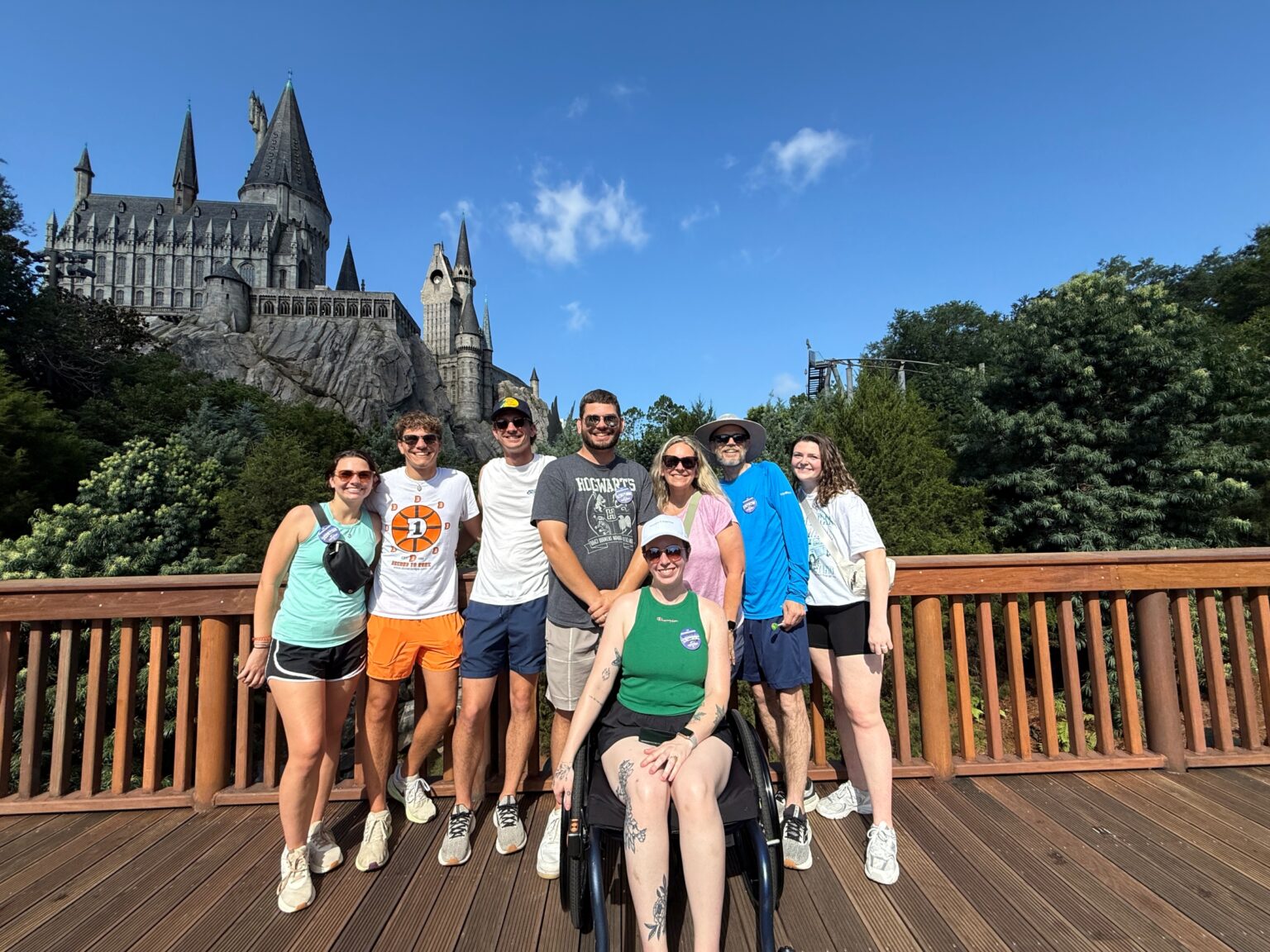
 With the support of Vanderbilt Health Palliative Care, the Guth family made a dream trip to The Wizarding World of Harry Potter. Left to right, Caroline, Daniel, Adam, Nathan, McKenna (sitting), Sara, Mike and Shelby Guth. (submitted photo)

“We’re going home. Then we’re getting on a plane to Orlando. We want to do Harry Potter, all of us.”
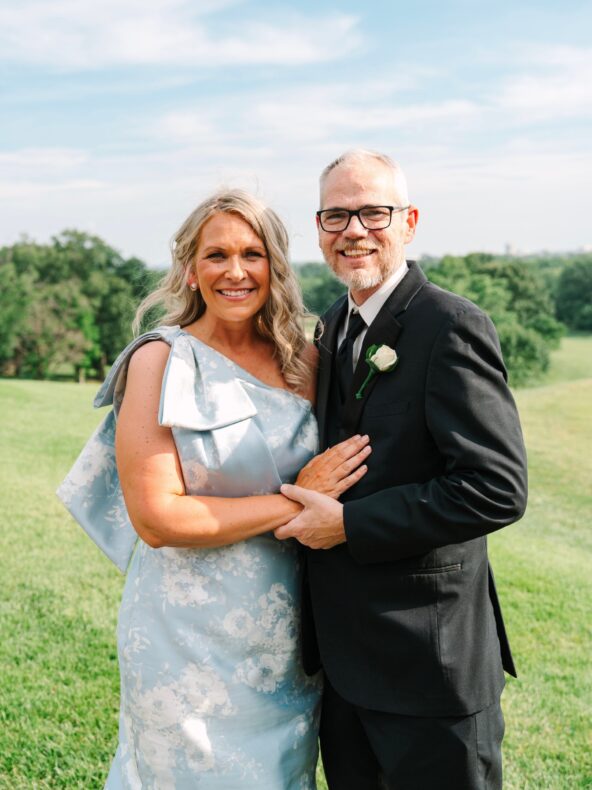
When Mike Guth’s family met with his Vanderbilt Health care team last month, they heard the news that his pancreatic cancer had advanced beyond treatment. After questions were answered and grief settled over the room, Mike’s wife, Sara, made her unexpected announcement.
Mike has always loved the magical lore of Harry Potter, excitedly consuming the books and movies with their children (now adults). Sara was never a huge fan. As they realized a planned family vacation to Yellowstone was now unlikely, Mike perhaps seized inspiration from the plot twists of the fantasy series to say he still longed to visit The Wizarding World of Harry Potter in Orlando, Florida.
With careful planning to manage symptoms and stay on top of hydration, the Vanderbilt Health Palliative Care team surprised the Guths and said his dream was doable. That was Sara’s cue to open her iPad and quickly watch all eight Harry Potter movies in preparation.
“But you know, happiness can be found even in the darkest of times, if one only remembers to turn on the light.”
— Albus Dumbledore, in “Harry Potter and the Prisoner of Azkaban”
Mike, 53, a beloved high school social studies teacher in southern Indiana and father of four, was diagnosed with Stage 2 pancreatic cancer in early 2025. Sara quickly researched top medical centers that specialized in treating this type of cancer. Because one son was a senior in high school and another a college senior, she wanted exceptional care close enough to their home in Santa Claus, Indiana, to minimize the impact on their education.
“I told Mike, ‘We have one shot at this — I don’t want to mess around,’” she said. “We want world-class care. Vanderbilt was consistently ranked among the top centers. And it was two-and-a-half hours away, so it was drivable.
“When I called Vanderbilt, I got a real person. In just half an hour, we had appointments set for the next week to see an oncologist, surgical oncologist, nutritionist and pharmacist. And all the appointments in one day … We sing Vanderbilt’s praises to everyone who asks and even to those who don’t ask.”
Vanderbilt-Ingram Cancer Center medical oncologist Thatcher Heumann, MD, MPH, Assistant Professor of Medicine, started Mike on chemotherapy, which successfully shrank the cancer. Mike and Sara were grateful to be able to attend their sons’ graduations. In August 2025, surgical oncologist Kamran Idrees, MBBS, MSCI, Ingram Professor of Cancer Research, completed minimally invasive surgery to remove part of Mike’s pancreas and his spleen.
By early November 2025, Mike felt well enough to return to teaching. The Guth family gathered for a wonderful Thanksgiving and Christmas, celebrating what they believed was his cure.
“It is a strange thing, but when you are dreading something, and would give anything to slow down time, it has a disobliging habit of speeding up.”
— from “Harry Potter and the Goblet of Fire”
Then, Mike began having back, chest and stomach pain, and they drove back to Nashville. A Vanderbilt-Ingram tumor board reviewed his case, and repeated scans didn’t reveal a clear cause. By February 2026, his symptoms intensified, and they learned tumors were blocking his intestines. The cancer had metastasized and was now Stage 4.
“Mike asked Dr. Idrees if he needed another surgery,” Sara remembered. “The answer was that no surgeries could be done. It set in what that meant, and it was horrible. They wanted us to talk to someone else. I told them, ‘I don’t want to be rude, but I don’t want to talk about this, and I don’t want to see anybody else.’”
Sara now admits that when Palliative Care Section Chief Mohana Karlekar, MD, Associate Professor of Medicine, quietly came in and crouched beside Mike’s bed to speak with them, they had no idea how much they needed the knowledge and compassion of the Palliative Care team. And that this team would ultimately unlock the doors of The Wizarding World of Harry Potter.
“You sort of start thinking anything’s possible if you’ve got enough nerve.”
— Ginny Weasley, in “Harry Potter and the Order of the Phoenix”
Karlekar assured them that the Palliative Care team could better ease Mike’s pain. She also advised that telling their children the news soon would help the couple feel less anxious and burdened by the secret.
Palliative Care nurse practitioner Jill Nelson, MSN, ANP-BC, stepped in. She reviewed Mike’s medications and prescribed an extended-release pain medication that would minimize his breakthrough pain. Nelson also reduced his number of daily medications, allowing the family to be “less tethered to home,” Sara said.
Nelson, who calls palliative care a specialty “combining humanity with science,” said she felt a strong connection with the Guths as she worked to ease his symptoms enough to get Mike back home and hopefully back to work.
“To meet people during, quite frankly, their worst time ever, and then be able to help them is really a great honor,” Nelson said.
Vanderbilt Health surgical oncologist Marcus Tan, MBBS, Associate Professor of Surgery, worked to see if there was any way to safely open the blockages so Mike could have meaningful nutrition and to allow waste elimination. Unfortunately, there was no solution. Mike received a nasogastric tube to pull out fluids and trapped air.
“What’s life without a little risk?”
— Sirius Black, in “Harry Potter and the Order of the Phoenix”
A bit of hope came when one of Mike’s oncologists, Heumann, told them about a new Phase 2 clinical trial on the safety and efficacy of the drug daraxonrasib in treating metastatic pancreatic cancer. Nearby Sarah Cannon Research Institute was a trial site, and Mike was accepted. This research has since shown daraxonrasib doubled overall survival compared to standard chemotherapy for patients with previously treated metastatic pancreatic cancer.
“Within a week or two, his cancer markers were plummeting,” Sara said. “Mike felt better, and we kind of forgot he had cancer for a good six to eight weeks. We are so grateful for this time.”
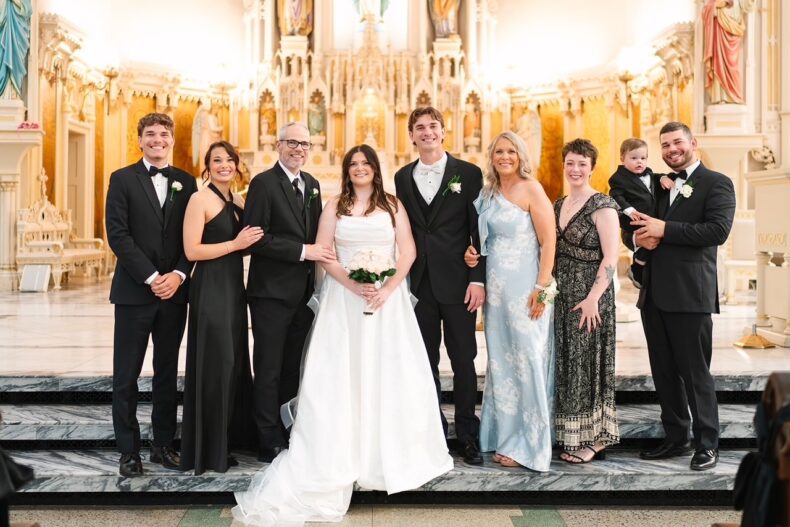
Mike decided to retire from 31 years as an educator in May and was named Teacher of the Year, nominated by his students. The Guths attended their youngest son’s spring college golf match and their middle son’s June wedding. Then, just two days after the wedding, they realized something had shifted. Mike was increasingly fatigued and had no appetite.
“This drug, daraxonrasib, is promising for so many, but unfortunately for Mike, it just wasn’t enough,” Sara said.
Which brings us back to Harry Potter.
Palliative Care physician Zack Watson, MD, Assistant Professor of Clinical Medicine, knew that families can feel abandoned or cut adrift when they learn their medical team has no further medical treatment to offer, so when he met the Guths in June, he made sure that didn’t happen.
Watson, who completed a residency in internal medicine and pediatrics and a fellowship in hospice and palliative medicine at Vanderbilt Health, answered their questions and addressed all concerns. Perhaps just as important for the Guths: He is a massive Harry Potter fan. Watson has pictures of himself at The Wizarding World of Harry Potter saved on his phone and might even have a wand or two tucked away for when magic becomes necessary.
“Let us step out into the night and pursue that flighty temptress, adventure.”
— Albus Dumbledore, in “Harry Potter and the Half-Blood Prince”
Watson and the Guths bonded immediately, and he began crafting a way to get Mike safely to Orlando. After he learned his colleague Nelson and oncologist Tan were also big Harry Potter fans, the plotting became as fast-paced as a game of quidditch (Watch the movies!).
Mike had a PICC line (peripherally inserted central catheter) added so he could easily receive IV hydration, addressing the major concern of dehydration in the summer’s heat. He had a gastrostomy tube (G-tube) placed, and the Palliative Care team taught them how to safely drain built-up gas and fluids. A medication regime was crafted to maximize his hours with his family. The Vanderbilt Health team even helped the Guths apply for an accessibility pass, so they wouldn’t have to stand in long lines for rides and attractions.
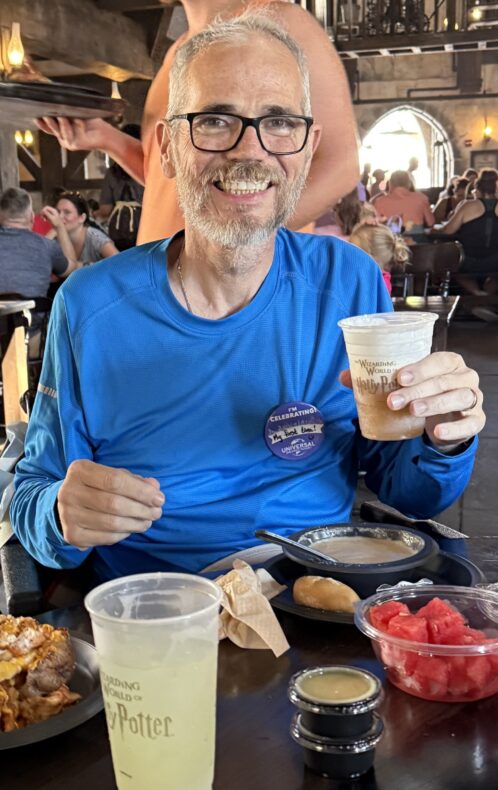
“I felt like I was planning a Make-A-Wish trip,” Watson said. “We pulled together all these logistics in just 48 hours.”
The family relied on other magical tips provided by the Palliative Care team. For instance, it was advised that Mike could certainly enjoy a frozen Butterbeer — a slushy, butterscotch and shortbread-flavored mocktail — and could try any melt-in-your-mouth candies from Honeydukes, an iconic sweets shop. The team also provided a summary of Mike’s medical history in case he needed emergency care while away.
He didn’t. The trip was a success.
“We did it all; we rode every roller coaster,” Sara said. “I told him, ‘If you’re in, I’m in.’ He had such a great time. He loved spending that time focused on fun and his family.”
“To the well-organized mind, death is but the next great adventure.”
— Albus Dumbledore, in “Harry Potter and the Philosopher’s Stone”
When Watson received photos from the family from their Harry Potter adventure, he shared them with everyone involved with the Guth family’s care. In Indiana, Mike transitioned to at-home hospice care with Sara and his family by his side.
“It meant a lot to help facilitate this experience for somebody that has wanted to do it, but who now has a terminal diagnosis with a limited time,” Watson said. “And for him to have that time with his kids and his wife. Hopefully, this gave them an anchor of joy in the midst of this really tough time. That’s why I wanted to be able to make it happen. And fortunately, we were able to.”
On July 14, Mike died peacefully at home, surrounded by his loved ones.


