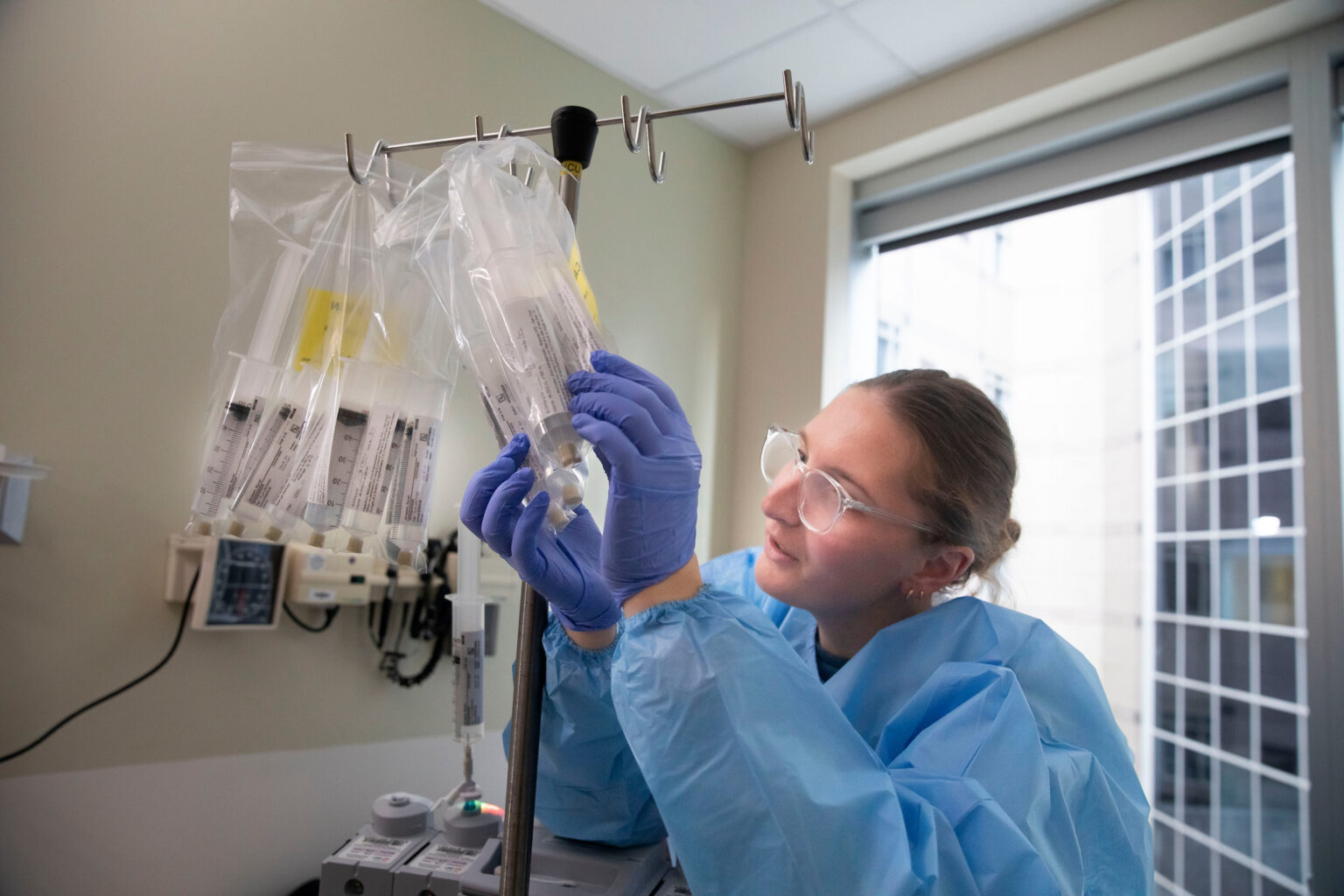
 Mackenzie Sample, RN, prepares an infusion for a Duchenne muscular dystrophy patient at Monroe Carell in 2024. (photo by Susan Urmy)

Monroe Carell Jr. Children’s Hospital at Vanderbilt was awarded a $1.9 million Department of Defense grant in partnership with the Critical Path Institute (C-Path) to advance the study of cardiomyopathy in Duchenne muscular dystrophy (DMD).
The four-year grant will fund a project focused on how heart disease develops and progresses in DMD, a fatal disease with limited therapeutic options and no cure. Cardiomyopathy, the leading cause of death, affects nearly all DMD patients.
Jonathan Soslow, MD, MSCI, Co-Director of the DMD Clinic at Monroe Carell and Director of the Duchenne Muscular Dystrophy Cardiovascular Care Consortium, said the heart condition remains understudied.
“Currently, there are no DMD-specific therapies approved for cardiovascular disease, despite it being the leading cause of mortality in DMD,” said Soslow, Professor of Pediatrics and holder of the Dr. William R. Long Directorship in Pediatric Research. “We are hopeful that this collaboration will lead to advances in DMD cardiac modeling and help investigators craft clinical trials that lead to novel DMD cardiovascular therapies.”
The project will be co-led by Soslow and Ramona Belfiore-Oshan, PhD, Executive Director of the C-Path Duchenne Regulatory Science Consortium.
“The Duchenne Muscular Dystrophy Cardiovascular Care Consortium and Monroe Carell are excited to partner with C-Path,” said Soslow. “They have been a leader in the neuromuscular field for many years, and their modeling has played a significant role in the development of successful clinical trials for DMD skeletal muscle therapeutics.”
One of the major barriers to DMD cardiomyopathy drug development is the difficulty of designing clinical trials.
The project will integrate diverse datasets and advanced quantitative approaches to better define the natural history of cardiomyopathy in Duchenne, identify key biomarkers, and support the development of tools to optimize the design and conduct of clinical trials for candidate drugs. These outcomes are expected to contribute significantly to the broader DMD research ecosystem and inform regulatory decision-making.
Investigators hope the advances will extend beyond Duchenne, supporting cardiac drug development across other neuromuscular diseases as well as removing key barriers to clinical trials and driving faster progress toward disease-modifying treatments.
“This award represents an important step forward in our collective effort to understand and ultimately improve cardiac measures for individuals living with Duchenne,” said Belfiore-Oshan. “By leveraging the collaborative infrastructure of C-Path’s Duchenne consortium, we aim to generate high-quality, regulatory-ready evidence that can inform clinical trials and accelerate the development of effective therapies targeting cardiac disease in DMD.”
According to Soslow, about 40% of patients with DMD die of cardiovascular disease.
“Right now, there are nine approved therapies for DMD skeletal muscle disease and none for cardiomyopathy,” he said. “This study will help model disease progression and allow us to design better trials.
“These trials will take time, so it may well be years before the drugs are available. But it will be an iterative approach — as more trials are performed for DMD cardiomyopathy, those trials will be incorporated into the model. The model will be updated to include those therapies.”
The project is expected to begin in September with a goal of including data from 1,400 patients.