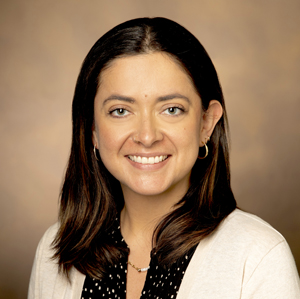
Vanderbilt Health’s Mónica Santisteban, PhD, will be honored this fall by the American Heart Association Council on Hypertension for research that has helped define how high blood pressure can contribute to cognitive impairment and Alzheimer’s disease.
Santisteban is Assistant Professor of Medicine in the Division of Genetic Medicine and Clinical Pharmacology. She will receive the council’s 2026 Harry Goldblatt Award for New Investigators on Oct. 10 during the American Heart Association Hypertension Scientific Session in Arlington, Virginia.
A native of Costa Rica, Santisteban earned her doctorate in Medical Sciences in 2015 under the mentorship of Mohan Raizada, PhD, at the University of Florida.
Costantino Iadecola, MD, who supervised her postdoctoral training and who directs the Feil Family Brain and Mind Research Institute at Weill Cornell Medicine, wrote in his nomination letter that “Dr. Santisteban has rapidly established herself as one of the most innovative and accomplished young investigators in hypertension research.”
“Her work has fundamentally advanced our understanding of how hypertension alters neuroimmune and neurovascular signaling to damage the brain and promote cognitive decline, while her emerging independent program is defining new directions at the intersection of hypertension, vascular cognitive impairment, and Alzheimer’s disease,” Iadecola wrote.
“I am deeply honored to receive this recognition, which wouldn’t have been possible without the unwavering support of my mentors,” said Santisteban, who joined the Vanderbilt faculty in 2023.
“Science is fundamentally a collaborative effort, and I am excited to continue to pursue this critical question of how hypertension ultimately contributes to cognitive decline alongside my talented colleagues,” she said.
Santisteban’s research focuses on mechanisms of neurovascular dysfunction and cognitive impairment produced by hypertension, a leading risk factor for stroke and dementia, including Alzheimer’s disease.
Her studies have revealed distinct vascular and neuroimmune mechanisms involving lymphocytes and other immune cells in the brain that contribute to cognitive impairment in models of hypertension, and her group’s findings have been published in major scientific journals.
She has received several research grants, including the Second Century Early Faculty Independence Award from the American Heart Association, and support from the National Institutes of Health, the Alzheimer’s Association, the Leon Levy Foundation, and the BrightFocus Foundation.
Her latest honor is named for Harry Goldblatt, MD, an American pathologist who established the first animal model of hypertension in 1934. Previous recipients include Annet Kirabo, DVM, MSc, PhD, Professor of Medicine at Vanderbilt Health, who received the award in 2020.