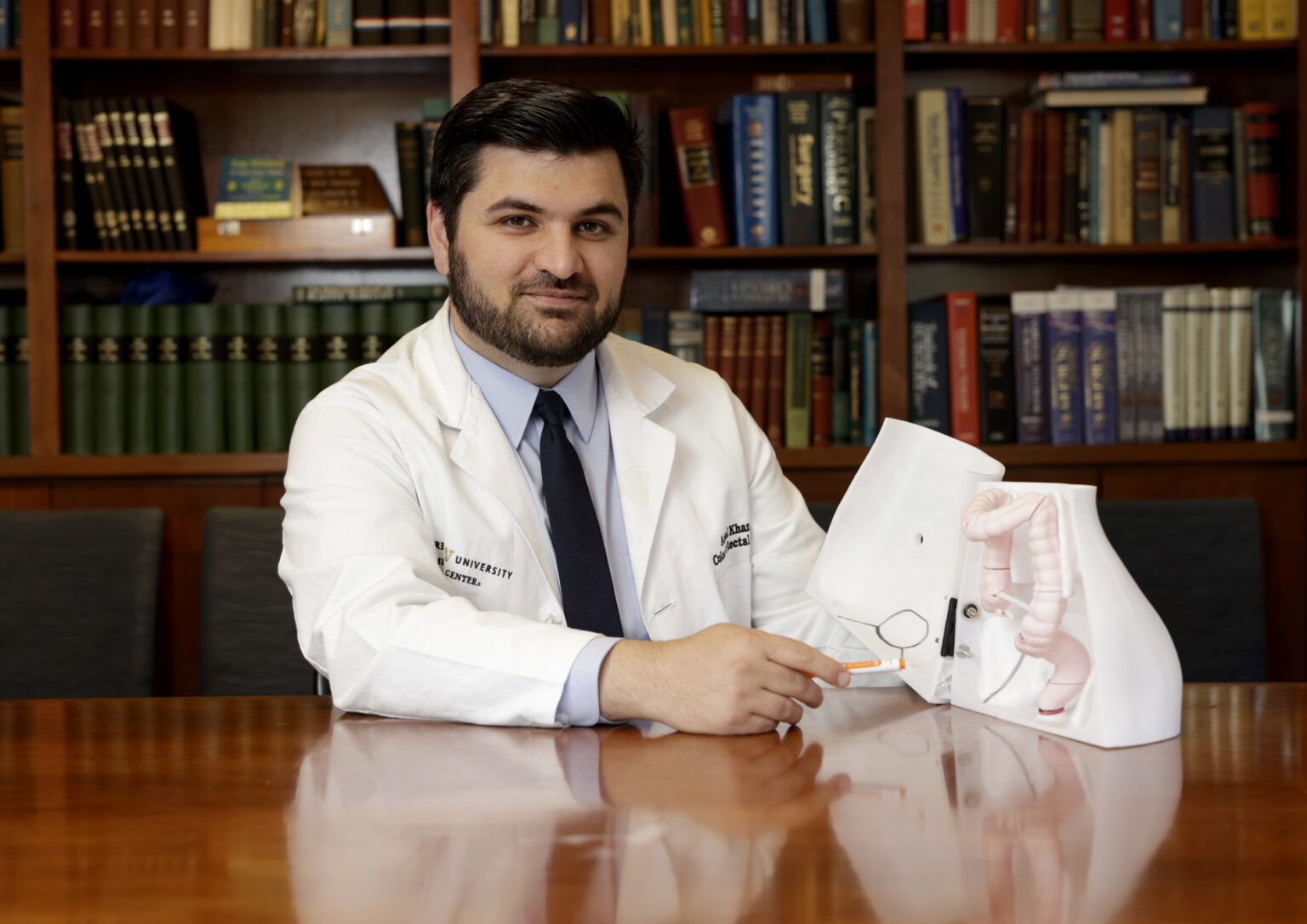
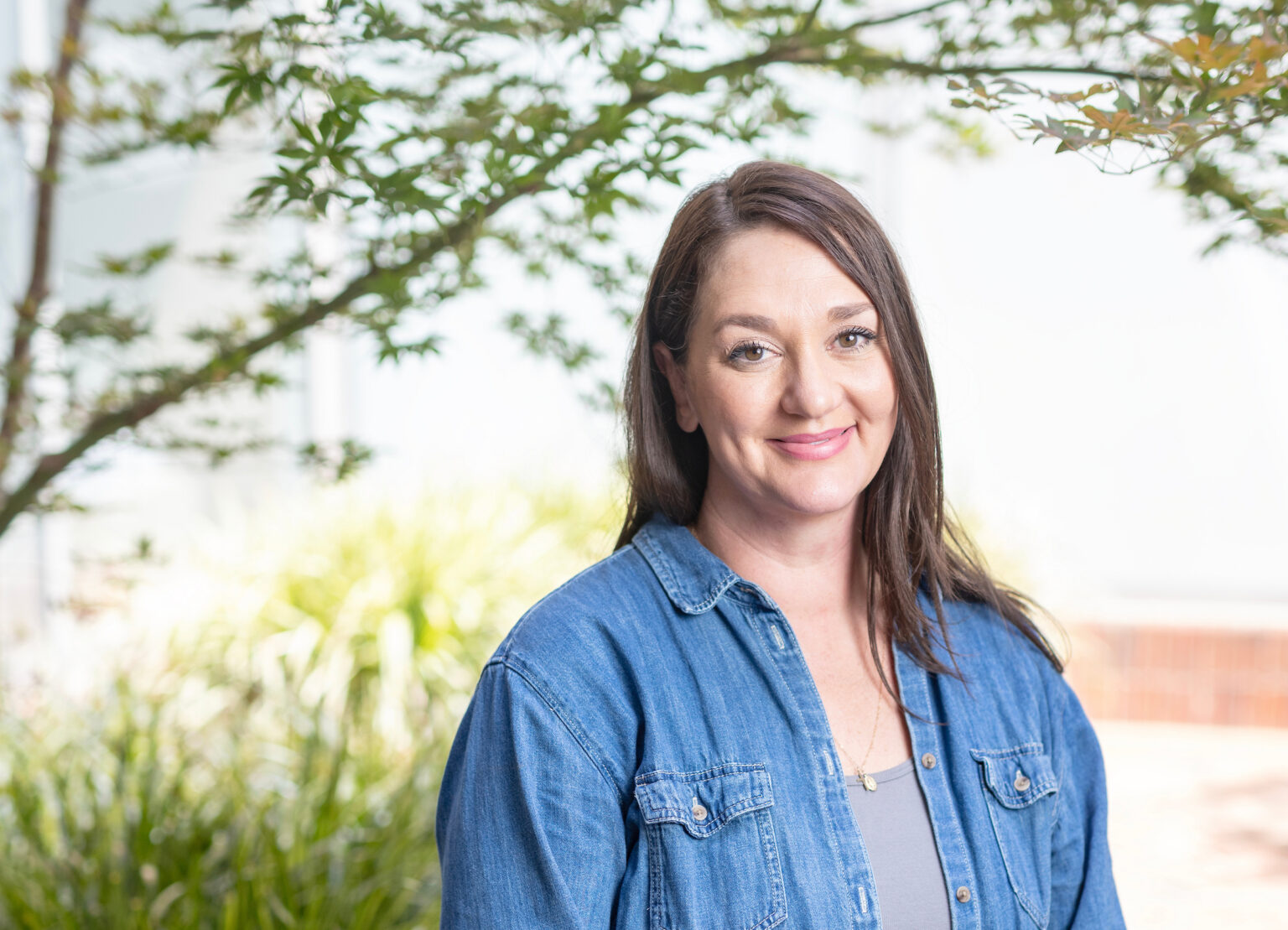
 Melissa Glass of Morgantown, Kentucky, had single-port robotic surgery at Vanderbilt Health to remove a cancerous tumor in her colon. The minimally invasive procedure allowed her to recover more quickly and return to activities she loves. (photo by Erin O. Smith)
When Melissa Glass met with Aimal Khan, MD, Assistant Professor of Surgery at Vanderbilt Health, to make a surgical plan for her recently diagnosed colon cancer, she had one big request.
She wanted to be back home in Morgantown, Kentucky, and healthy enough to participate in an annual event for Butler County Schools students that is close to her heart.
“It was important to me to make it to our Happy Feet program, where we provide free shoes for students who are underprivileged,” she explained. “They get to pick their shoes out before school starts, and I look forward to this event all year. We fundraise for it, and it’s just such a great day.
“I promised my co-workers I would sit and not help set up boxes, so I behaved and didn’t overexert myself. We love our students, and I was just so happy I was there.”
Glass, a family resource coordinator for the school system, was overwhelmed when health symptoms led to a colon cancer diagnosis at age 44. She is among a growing number of young adults diagnosed with early-onset colorectal cancer, a trend that led the American Cancer Society to update their recommendation to begin screenings at age 45 rather than 50.
Glass talked to a friend who had a similar experience, and they recommended Khan, who had been their surgeon. Khan recommended a minimally invasive, robot-assisted approach to remove the sigmoid colon cancer using a newer, single-port (SP) robotic platform.
“Vanderbilt is among the highest volume, single-port robotic colorectal surgery programs in the United States,” Khan said. “The SP platform allows us to complete an entire colon or rectal operation through one small incision, usually hidden at the bikini line or around the belly button, rather than four or five separate incisions required by conventional robotic or laparoscopic surgery. Very few centers in the country have the training and case volume to offer this for complex colorectal disease.”
Minimally invasive, robotic procedures have been in use for more than two decades and have now become common throughout the world. More recent improvements in the size and function of individual surgical tools, and advances in robotic technology, have made single-port surgeries possible, according to Matthew Spann, MD, Associate Professor of Surgery and Chief of the Division of General Surgery at Vanderbilt Health.
Single-port robotic systems feature small surgical instruments and a camera that are inserted through a tube in a single incision. The instruments, such as scissors, forceps and graspers, can pivot 360 degrees, giving surgeons better access to structures during complex procedures.
And while the aesthetics of having just one small incision rather than several is certainly positive, more importantly, SP colorectal surgeries have been proven to have similar outcomes when compared to a conventional surgical approach, Khan said.
“This is what separates a real advance from a cosmetic one,” he explained. “Complication rates are comparable to the conventional approach. For our cancer patients, we removed the same number of lymph nodes and achieved clean margins around the tumor at the same rate, which are the two measures that determine whether a cancer operation provides the best chance for a cure.”
Other results for SP colorectal surgeries at Vanderbilt Health are just as impressive:
- Patients who have these surgeries go home up to 50% sooner. The length of stay after most SP colorectal surgeries is one day, with a significant number of patients going home the same day.
- Patients need substantially less post-surgery narcotic pain medication (25% less), and many go home without an opioid prescription at all. Since every postsurgical opioid prescription is a potential entry point to long-term opioid use, this is important.
- Patients report less interruption to their lives, as well as satisfaction with the procedures overall.
Factors that contribute to the success of SP robot-assisted surgeries are the volume of procedures performed at a health care center, as well as the specialized, intensive training clinicians obtain to perform these procedures, said Spann.
“Training in minimally invasive robotic procedures — now including single-port surgeries — is increasingly being incorporated into specialty-specific surgical fellowships,” he said. “This is certainly the case here at Vanderbilt Health.”
And training opportunities led by Vanderbilt Health surgeons extend to established surgeons at other health care centers.
“We have hosted dozens of surgeons from all over from the country who have come here to learn from our experience in single-port robotic surgery,” Khan said. “The Vanderbilt Health colorectal team is also among the national leaders in research on single-port robotic colorectal surgery.”
M. Benjamin (Ben) Hopkins, MD, who leads the section of Colon and Rectal Surgery at Vanderbilt, shared the team’s experience recently at the summer meeting of the Piedmont Society of Colon and Rectal Surgeons, a regional professional medical organization.
“The level of national interest in what we are doing with the SP robot has been remarkable,” Hopkins said.
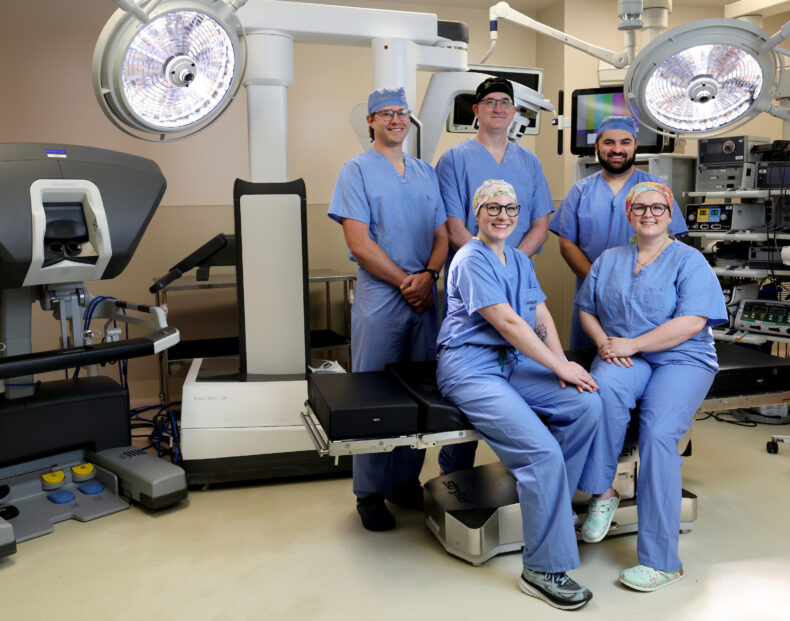
Khan and Hopkins, along with fellow surgeons Shannon McChesney, MD, and Phillip Williams, MD, MSc, have all completed colorectal surgical fellowships and have training in multiport and single-port robotic surgery. Physician assistant Katie Martin, PA-C, was instrumental in getting the program started and now leads training courses for advanced practice providers interested in learning how to use the SP platform. There are plans to train more Vanderbilt Health surgeons on the SP robot.
Single-port robotic surgeries might not be the best surgical approach for every patient, Khan said. Surgical plans are made in collaboration with each patient and depend on the type and location of the cancer, whether previous abdominal surgery has resulted in scarring, anatomy and other conditions.
As for Glass, she spent two nights at Vanderbilt University Hospital. Her recovery following surgery went well, with manageable pain. She credits her family, including her husband, Jon, and their two daughters, and her colleagues at Butler County Schools for supporting her throughout her experience.
Her short recovery time meant she was able to begin chemotherapy treatment at Vanderbilt-Ingram Cancer Center with Cathy Eng, MD, the David H. Johnson Professor of Surgical and Medical Oncology, whom she also praised highly. Glass has just two chemotherapy sessions remaining and is ready to fully return to focusing on her family and the students of Butler County.
“I’m a very private person, so the fact that I’m sharing my story lets you know how I feel about Dr. Khan and the care I received at Vanderbilt,” she said. “I feel like God’s hand was on it because we really didn’t know where to go or what to do. My husband and I quickly knew that we were in the right place.”