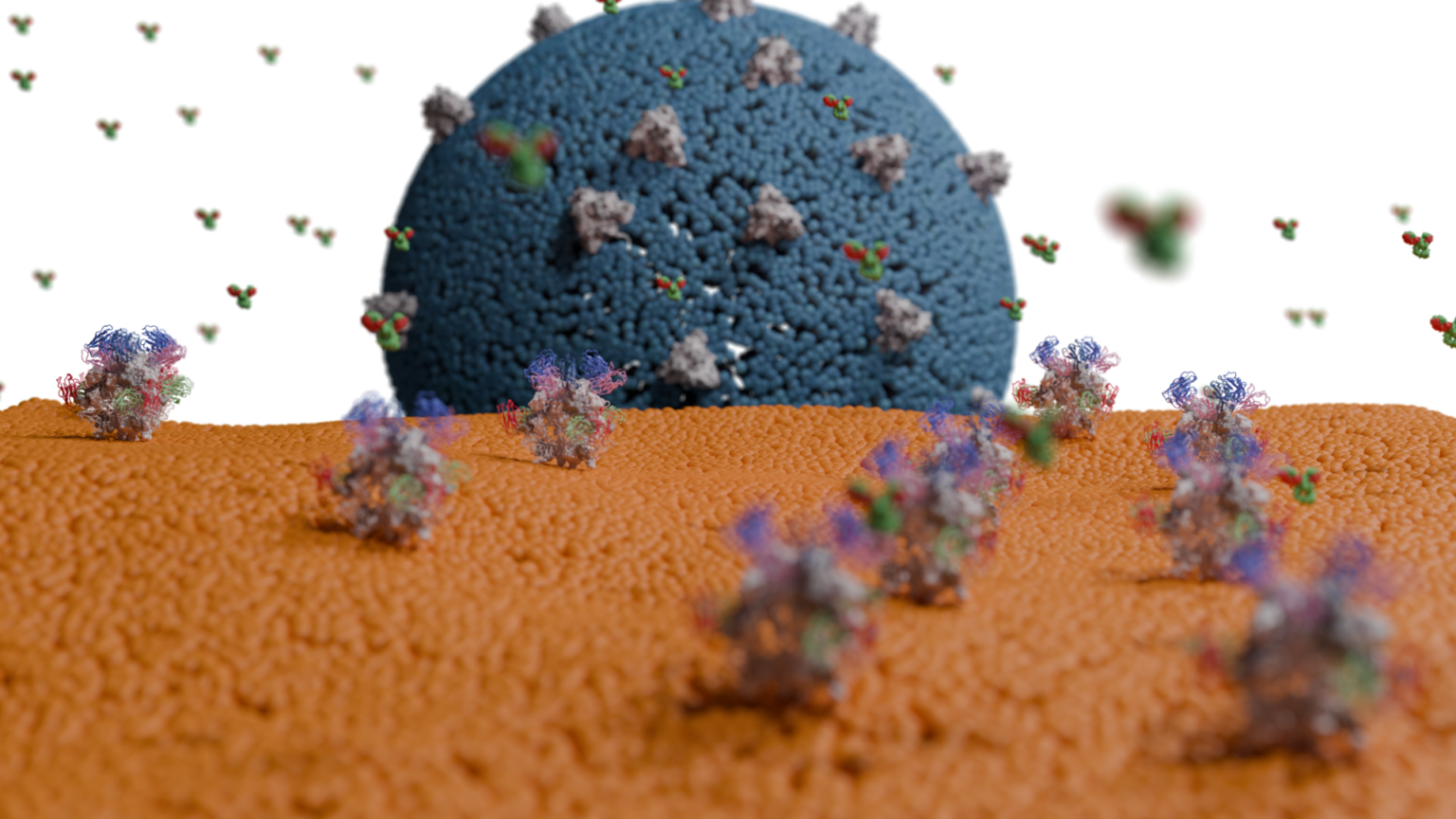
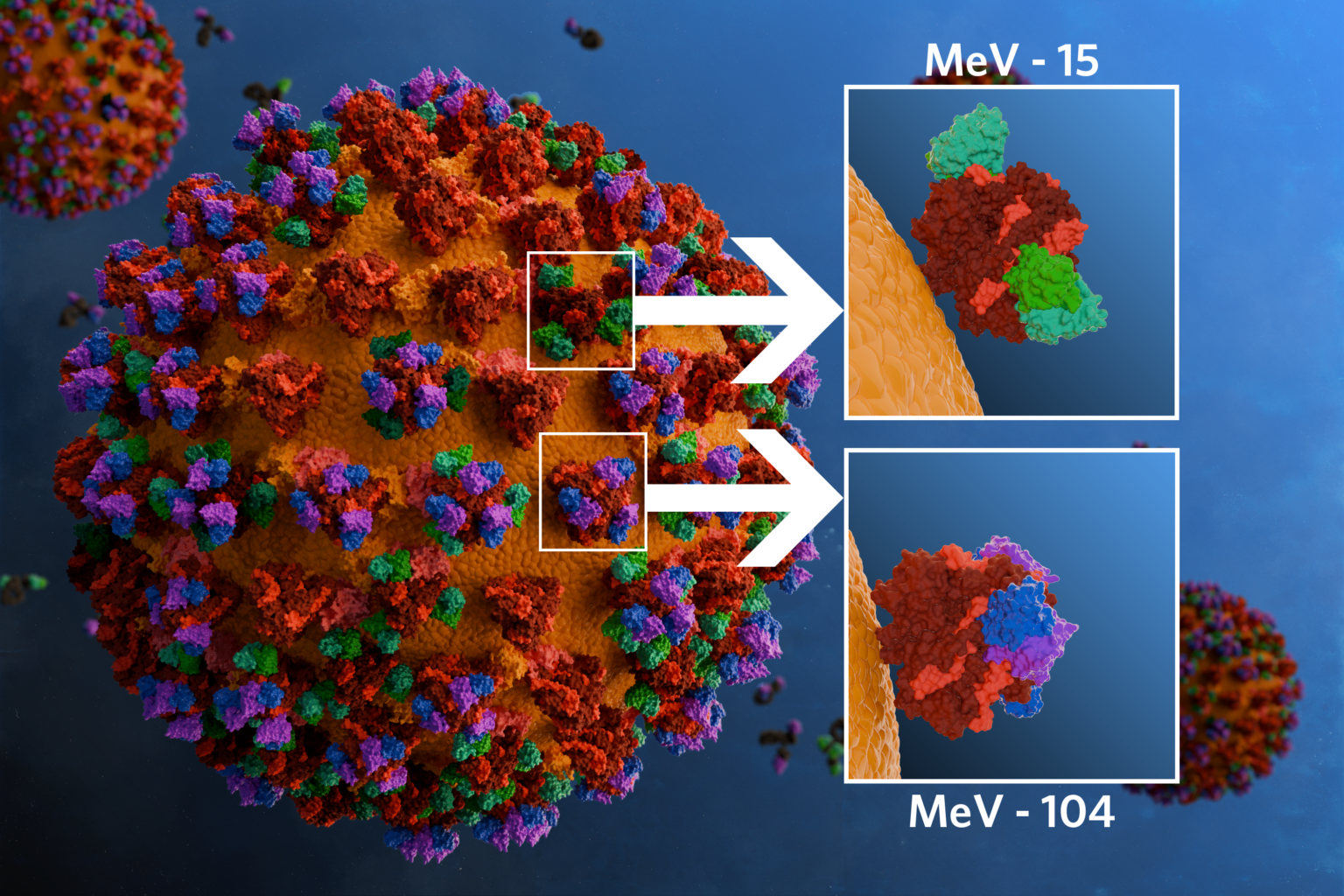
 3D rendering shows human monoclonal antibodies MeV-15 (green and teal) and MeV-104 (purple and blue) binding to different portions of the "F" protein (rust-colored) on the surface of the measles virus to block the virus from infecting cells in the body.
(illustration by Anthony Czelusniak, Crowe lab)
3D rendering shows human monoclonal antibodies MeV-15 (green and teal) and MeV-104 (purple and blue) binding to different portions of the "F" protein (rust-colored) on the surface of the measles virus to block the virus from infecting cells in the body.
(illustration by Anthony Czelusniak, Crowe lab)

Vanderbilt Health researchers and colleagues have isolated human monoclonal antibodies from previously infected individuals that potently neutralized the measles virus in the laboratory and strongly inhibited viral replication in two animal models.
California-based Saravir Biopharma Inc. has licensed the antibodies and is seeking funding for further development and clinical testing that — within 18 months to two years — could lead to the first monoclonal antibody therapy against the highly infectious respiratory virus.
The report of the antibodies, published Sept. 28 in the journal Cell Reports Medicine, comes at a time when measles, driven by a decline in vaccination rates, is surging nationwide. “This could skyrocket into a huge problem,” Saravir Biopharma President and CEO Ron Moss, MD, said in an interview.
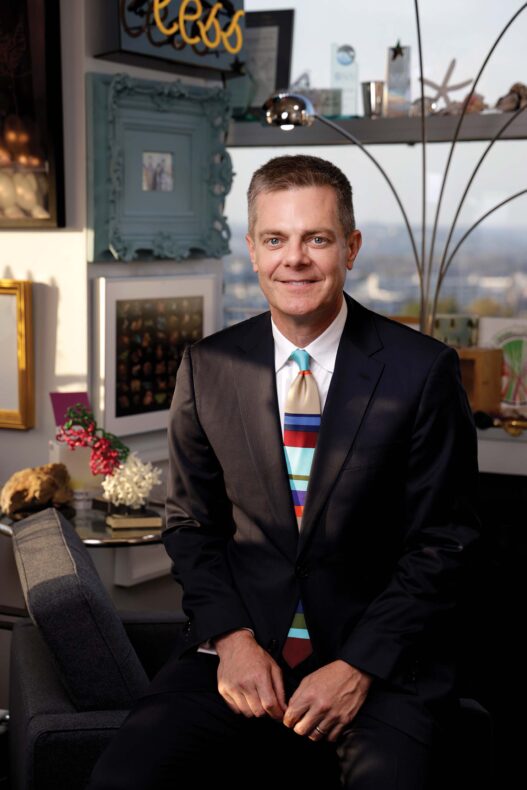
“We fast-tracked this research to discover human antibodies for measles virus because of the emerging outbreaks of infections,” said James Crowe Jr., MD, Director of the Vanderbilt Center for Antibody Therapeutics and the paper’s corresponding author.
“We’re excited to partner with Saravir to bring these medical countermeasures to the clinic to benefit at-risk patients,” he said.
Crowe is internationally known for his group’s development of human monoclonal antibodies against a host of pathogenic viruses. Holder of the Ann Scott Carell Chair, he is a University Distinguished Professor of Pediatrics and Chemistry.
Moss, a physician-scientist who has led several antiviral and vaccine programs from early-stage research through late-stage clinical trials, co-founded Saravir Biopharma in 2025 specifically to develop the first monoclonal antibody therapy against measles.
In previous years, high vaccination rates in the United States nearly eliminated measles. Yet in 2025, the Centers for Disease Control and Prevention reported 2,285 confirmed cases of measles — the most since 1990. As of Sept. 17, this year’s count had risen to 3,471 cases.
As vaccination rates have fallen and the number of measles cases continues to soar, there is an urgent need for an antibody therapy, especially for people who cannot receive live vaccines and who are at risk of serious illness or death if they become infected.
Last month, the Pennsylvania Department of Health reported two measles-associated deaths in unvaccinated people, the first such fatalities in 35 years. Since then, two more deaths have been reported by the state.
While vaccination remains the primary, and most effective, means of preventing measles, proliferating outbreaks have put at risk millions of people who cannot safely receive or gain protection from the current live-virus measles vaccine.
They include pregnant women, infants under 12 months of age who are not old enough to be vaccinated, and people for whom the measles vaccine is not protective because their immune responses have been compromised by drugs they are taking for cancer or autoimmune diseases like rheumatoid arthritis.
Moss said these unprotected groups who cannot receive the vaccine are the focus of Saravir Biopharma’s anti-measles antibody development program.
“We’re very excited to help develop another countermeasure against measles infections,” he said, adding that the Vanderbilt Health antibodies are the most potent he has seen.
“Two years (to the clinic) is a conservative estimate,” he said. “When we get the funding, we think that timeline could be expedited considerably.”
The human monoclonal antibodies, MeV-15 and MeV-104, were isolated from two individuals who had been infected by measles. They target portions of the “F” protein on the surface of the measles virus, thus blocking its ability to attach to and infect cells in the body.
The antibodies potently neutralized the virus in laboratory tests and strongly inhibited viral replication in two animal models, both prophylactically (preventing infection) and therapeutically (after infection had occurred).
These findings suggest that “these human monoclonal antibodies have potential as candidate antiviral drugs to prevent or treat measles virus infection,” the researchers concluded. Further study could contribute to “the next generation of vaccines and therapeutics” against measles and related viruses, they added.
Laura Handal, a graduate student researcher in the Crowe lab, was the paper’s first author. Other Vanderbilt co-authors were Elad Binshtein, PhD, Nurgun Kose, Naveen Suryadevara, PhD, Seth Zost, PhD, Andrew Trivette, Silvia Ravera, PhD, Mark Menghini, Chandrahaas Kona, James Martinez, and Stacey Rutherford. The work was done under contract with the National Institute of Allergy and Infectious Diseases of the National Institutes of Health (NIH), and conducted in specialized facilities using cutting-edge technologies, including flow cytometry and cryo-TEM (transmission electron microscopy), which also were supported by NIH grants.