


Before families gather around the table this Thanksgiving, physicians at the Vanderbilt Burn Center are encouraging parents and caregivers to take a simple step that could help prevent serious injuries: the “Cool Kitchens, Safe Families” pledge.
According to Anne Wagner, MD, Burn Director of the Vanderbilt Burn Center, following a few basic kitchen safety practices can significantly reduce the risk of burns, grease fires, and other cooking-related injuries.
Thanksgiving is the busiest day of the year for home cooking and, unfortunately, one of the most dangerous. According to the National Fire Protection Association, more than 2,300 home fires nationwide occur annually on Thanksgiving Day due to cooking-related incidents.
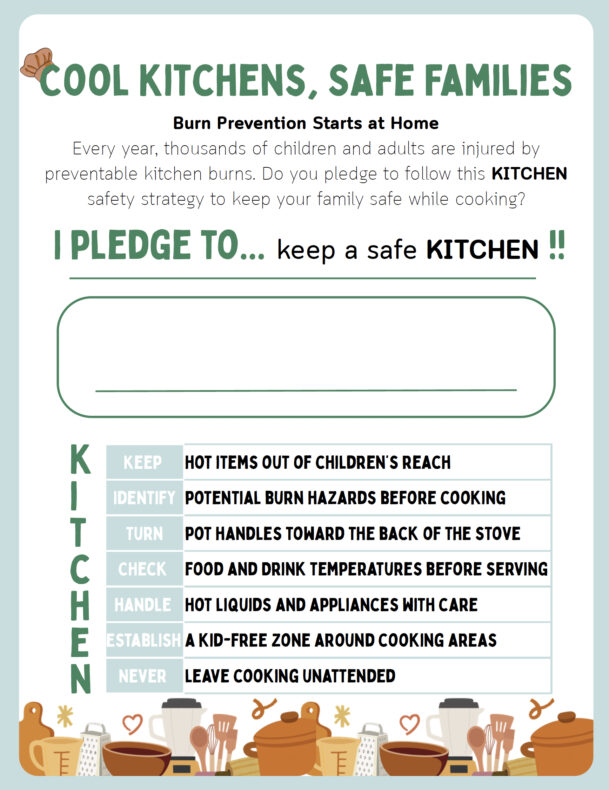
To help families stay safe, the Vanderbilt Burn Center developed its kitchen safety pledge centered around the word KITCHEN:
K – Keep hot items out of children’s reach.
I – Identify potential burn hazards before cooking.
T – Turn pot handles toward the back of the stove.
C – Check food and drink temperatures before serving.
H – Handle hot liquids and appliances with care.
E – Establish a kid-free zone around cooking areas.
N – Never leave cooking unattended.
As holiday preparations get underway, Vanderbilt Burn Center staff encourage families to take the “Cool Kitchens, Safe Families” pledge before cooking begins.
“At our recent community outreach events, we have encouraged families to participate in our ‘Cool Kitchens, Safe Families’ pledge initiative, which invites parents and children to discuss and commit to safe kitchen habits together,” said Burn Outreach Coordinator Annie Mitchell.
“We have a flyer that serves as both a conversation starter and a call to action, encouraging families to take a few moments to review kitchen safety expectations before the busy holiday season.”
Dr. Wagner said one of the most common Thanksgiving burn injuries occurs when people remove a turkey from the oven and accidentally spill hot liquid onto their feet, ankles, or arms.
“I think what we see most often are scald injuries while taking the turkey out,” Wagner said.
Deep-fried turkey preparation presents an even greater risk and remains a common source of severe burns and home fires during the holiday season.
“The turkey must be completely thawed and patted dry. Any moisture on the outside of the turkey will cause the oil to splatter,” Wagner said. “Lower the turkey carefully using the appropriate equipment so that you are not too close to the oil. Make sure the oil is at the proper level and that the fryer is not overfilled to reduce the risk of spills or boil-overs.”
Wagner noted that Vanderbilt Burn Center physicians have treated patients whose turkey fryers ignited deck fires, house fires, and caused serious personal injuries.
“These can be very serious burns” she said. “Clothing can catch fire, or hot grease can spill over and cover a large portion of the body. We often tell patients that for every percent of the body burned, they may spend one to two days in the hospital. It doesn’t take a very large burn to turn a Thanksgiving celebration into a month-long hospital stay.”
Beyond turkey preparation, cooking remains the leading cause of home fires and fire-related injuries in the United States and the second leading cause of home fire deaths.
“Additionally, each year, with more people in the kitchen preparing holiday meals, we see an increase in cooking accidents ranging from minor burns to devastating injuries and house fires,” said Patrick Duffy, MD, Assistant Professor of Surgery at the Vanderbilt Burn Center.
Children are particularly vulnerable during the holiday season, when families are visiting relatives and kitchens are busier than usual.
“Children are at risk both in unfamiliar homes that may not have child safety practices in place and in their own homes when more cooking and baking activities are taking place,” Duffy said. “In a moment, a child can run into the kitchen, reach for a stove, pull a hot mug or bowl from a counter, or grab hot food from the microwave. While it is important to teach age-appropriate cooking safety, devastating burns can occur instantly without close supervision.”
Outside of the kitchen, families should use the holiday season to test their smoke alarms and replace batteries as needed. Additionally, families should make sure there is a fire extinguisher readily accessible in case a cooking-related fire occurs.


