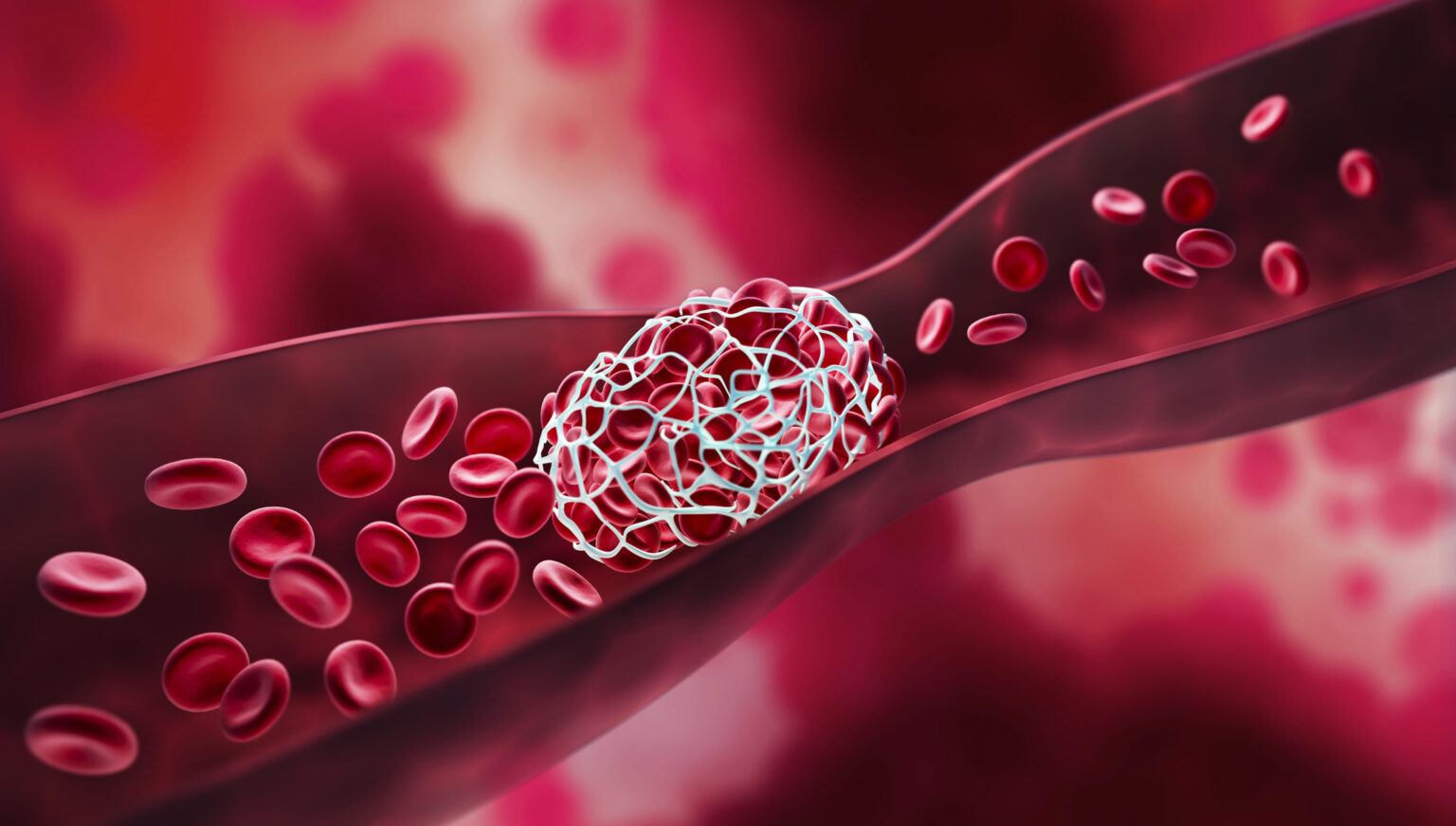
A year-long randomized clinical trial launching later this year at Vanderbilt University Medical Center will test whether artificial intelligence (AI) can help reduce blood clots that form inside blood vessels during hospitalization, or hospital-acquired venous thromboembolism (HA-VTE).
VTE includes both deep vein thrombosis and pulmonary embolism. According to the Centers for Disease Control and Prevention, it’s the leading cause of preventable hospital deaths. As many as 900,000 cases of VTE are diagnosed in Americans each year, and according to the CDC more than a third are related to a recent hospitalization.
Risk of VTE rises in hospitals due to factors such as patient immobility, effects from major surgery, and use of indwelling medical devices like central lines. VTE can be fatal if clots break off and travel to the lungs (pulmonary embolism) or other vital organs. About 1 in 3 patients with VTE experience long-term complications.
In hospitals, VTE prevention is the rule. Care teams work from electronic order sets suggesting medications and other preventive measures, and teams are prompted to document any exceptions or contraindications for these measures.
“Despite decades of research and numerous risk prediction tools, preventing HA-VTE remains a challenge as even a single case might do great harm,” said the trial’s lead investigator, Colin Walsh, MD, MA, associate professor of Biomedical Informatics. “Our AI-driven approach doesn’t require doctors to manually calculate risk scores or enter any data. Instead, it works quietly in the background, analyzing patient data in real time and alerting clinicians only when action is needed.”
As described in JAMA Network Open by Walsh and colleagues, the HA-VTE trial will use a so-called pragmatic format. Over a 12-month period, all adult patients at Vanderbilt University Hospital and VUMC’s Regional Hospitals will be randomly assigned to receive either standard care or care enhanced by AI alerts that prompt doctors to consider VTE prevention measures.
The trial builds on a machine learning-derived HA-VTE risk model developed by Benjamin Tillman, MD, assistant professor of Medicine in the Division of Hematology and Oncology, Benjamin French, PhD, professor of Biostatistics, and colleagues. Their automated algorithm, reported last year in Research and Practice in Thrombosis and Haemostasis, analyzes 25 variables commonly found in electronic health records, including vital signs, laboratory results, medical history and procedures such as central line placement.
In the HA-VTE trial, all adult patients will be continuously assessed by the algorithm. When the system identifies a patient randomized to the intervention arm who is at greater than 3.6% estimated risk of VTE during the hospital stay, isn’t already receiving preventive treatment, and has no documented reason to avoid such treatment, the system will send a daily alert to the care team. Alerts start on the second day of hospitalization. The system updates continuously, and each alert will include the patient’s estimated risk of VTE during their stay.
What makes this approach different from previous efforts is its automation and precision. In validation studies, the model correctly ranked patients by risk 89% of the time — considered excellent performance as prognostic models go.
“We’re testing whether the right information, delivered at the right time, can help busy clinicians make better decisions without adding to alert fatigue,” said Walsh, who in a previous randomized trial has tested AI-powered decision support for suicide prevention. “The goal is to prompt action only for patients who truly need it, reducing both the burden on health care providers and the risk to patients.”
The trial also addresses an often-overlooked question: whether AI tools work equally well across different health care settings. By implementing the same system in both a major urban academic hospital and smaller rural facilities, researchers can assess whether the technology maintains its effectiveness across diverse patient populations and care environments.
The researchers will monitor both the primary goal of reducing VTE during hospital stays and safety measures, including bleeding that can result from preventive medications. Results are expected in 2027.
The trial is supported by a grant from the Kaiser Permanente Division of Research under their Augmented Intelligence in Medicine and Healthcare Initiative.