



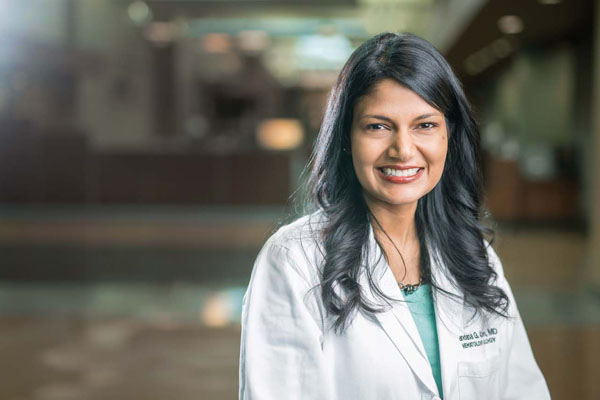
 Photo by Daniel Dubois

Vandana G. Abramson, M.D., gauges her smile as carefully as she prescribes doses of medicine. One patient may need beaming reassurance, while another might require a muted moment of understanding. On this Tuesday, she will meet with 26 patients. They come from across the United States to the Vanderbilt Breast Center, where Abramson, a medical oncologist, is the principal investigator in 20 clinical trials and the national leader spearheading four of those studies. Some patients will respond to established standards of care, but others—people with cancers that have become resistant to treatment—are seeking new drug therapies. Abramson devotes her Tuesdays and Wednesdays to patients, then spends the rest of her week doing cancer research and teaching. Every patient’s story highlights why that research matters. This window into some of Abramson’s interactions illustrates why compassion matters.
7:15 a.m.
The First Patient
Abramson sees her first patient, a 37-year-old woman with early-stage breast cancer. An MRI will indicate whether she has responded to three cycles of chemotherapy. Abramson explains the imaging process, answers her questions and tells her the results will be available that day. The woman’s tumor is HER2-positive, a more aggressive form of cancer.
8:16 a.m.
Inside the Workroom
In the clinic’s control center, the “workroom,” Abramson peers at a computer screen, looking up clinical trials, searching for one with a protocol that matches her third patient of the day. As many as 10 people—doctors, nurses, surgeons and a social worker—staff the workstations around the perimeter of the rectangular-shaped room. Abramson turns from the screen to talk with another doctor she is mentoring, medical oncology fellow Valerie Jansen, M.D., Ph.D. Then she picks up the telephone and calls Stephanie Kurita, M.D., a radiologist, to check on the MRI results for her first patient.
8:32 a.m.
Amazing Response
“It’s amazing” Abramson says, looking at the results with Kurita. Halfway through the chemotherapy cycles for this 37-year-old woman, an 8-centimeter tumor (3.12 inches) has virtually disappeared. “That’s a really good response,” Kurita agrees. Although Abramson is eager to share the good news, she waits to make that phone call when there will be more time to talk and celebrate. With more than 2 dozen patients to see, she has to stay the pace to carefully listen to all their questions and make sure they understand her explanations.
9:10 a.m.
Man with Breast Cancer
Abramson knocks on a door. A man’s voice answers from within the examination room where the patients are usually women. Inside, Warren Cummings looks up from his chair with a discouraged expression. He’s a retired fire chief who flies from Fairbanks, Alaska, to Vanderbilt to take part in a clinical trial for metastatic triple-negative breast cancer. His cancer had spread to his bones before he came to Vanderbilt-Ingram Cancer Center (VICC). He already knows about a possible complication from the experimental treatment he recently started. He’s worried he’ll have to stop taking the treatment because of elevated blood sugar.
Abramson, however, has good news.
“The scans look great,” she says.
“They do?” he asks.
She explains that while his existing bone lesions will never shrink, there are no new ones and the old ones aren’t growing. He tells her his pain level has decreased. She says that’s a promising indication he’s benefiting from the treatment.
Cummings is enrolled in a Phase 1 dose escalation of a combination therapy involving enzalutamide and taselisib. It’s a VICC-initiated study. Jennifer Pietenpol, Ph.D., Benjamin F. Byrd Jr. Professor of Oncology, has subtyped triple-negative breast cancer into distinct categories through her research at VICC. Cummings has a subtype that is unlike 90 percent of other triple-negative breast cancers. About half the mutations within his subtype have an androgen receptor as well as a mutation within the P13 kinase pathway.
“Mr. Cummings, you are getting two drugs that basically exactly target your tumor, which is probably why within the first two weeks your pain went away,” Abramson says.
She tells him to hold off taking the taselisib until his blood glucose level dips below 250, when she will put him on a lower dose.
“How is this going to affect the other people, Dr. Abramson?” he asks.
There are three people in this early phase of the study. If one patient has a serious complication within that period, all will have to decrease their dosage.
She smiles, touches his shoulder and calls him amazing. She tells him not to worry because the 30-day dose escalation period of the study has ended.
9:45 a.m.
The Patient’s Choice
Abramson and Jansen meet another patient with HER2-positive breast cancer, a woman with a stage 2 tumor. The woman inquires about treatment choices. Abramson tells her about the standard treatment involving chemotherapy before surgery and another option without chemotherapy. It’s a clinical trial with patients taking two targeted therapies, the drugs trastuzumab and pertuzumab, before surgery.
“If there is no cancer left, we can just continue the HER2 targeted therapy for a whole year and finish up,” Abramson says. “If there is a significant amount of cancer, we can talk about adding the chemotherapy after surgery.” The patient chooses to take part in the clinical trial.
10:20 a.m.
Delivering Good News
A 42-year-old woman waits to learn if the cancer diagnosed at age 35 has returned. She was diagnosed then with stage 3 triple-negative breast cancer and has been in surveillance for five years after taking an experimental drug treatment, undergoing surgery and receiving chemotherapy. The lab results are good, and the woman has no suspicious symptoms. Abramson tells her to come back next year for what will likely be her last visit to the Vanderbilt Breast Center.
1:30 p.m.
Limited Options
Abramson looks carefully at the chart for her next patient. This patient has undergone eight types of treatment over the course of a six-year battle. Breast cancer that had already metastasized to her lungs and bones had spread to her liver as of her last visit.
Abramson talks to her about trying a ninth treatment regimen, but she also tells her that her options are limited. She brings up the topic of end-of-life care.
2 p.m.
Good Prognosis
The fear is evident on the next patient’s face. It’s her initial consultation. She came to see Abramson wondering if her cancer is curable and worrying about what her treatment will entail. Abramson explains that she has early stage disease, that her prognosis is good and that she shouldn’t require chemotherapy after surgery. Instead, Abramson will prescribe a hormone therapy drug.
5:30 p.m.
Linking Patients to Clinical Trials
Abramson sits down in the workroom, looks at a computer screen and summarizes her day. The patients she has seen on this Tuesday are now linked with eight different clinical trials. She reviews their lab results and imaging reports and makes notations. She goes through a long list of emails and phone calls, responding to patients’ messages and clinicians’ questions. Then before she leaves, she plans ahead for Wednesday. On this week, she will see patients from Alaska, Indiana, Kentucky, Alabama, Texas and Tennessee.
“We want to provide care for as many people as we can, but we want everyone individually to feel like we’re here for them,” she says. “If they have any questions—anything—we want to make sure they understand their disease process. There is that other part of cancer care: giving comfort.”