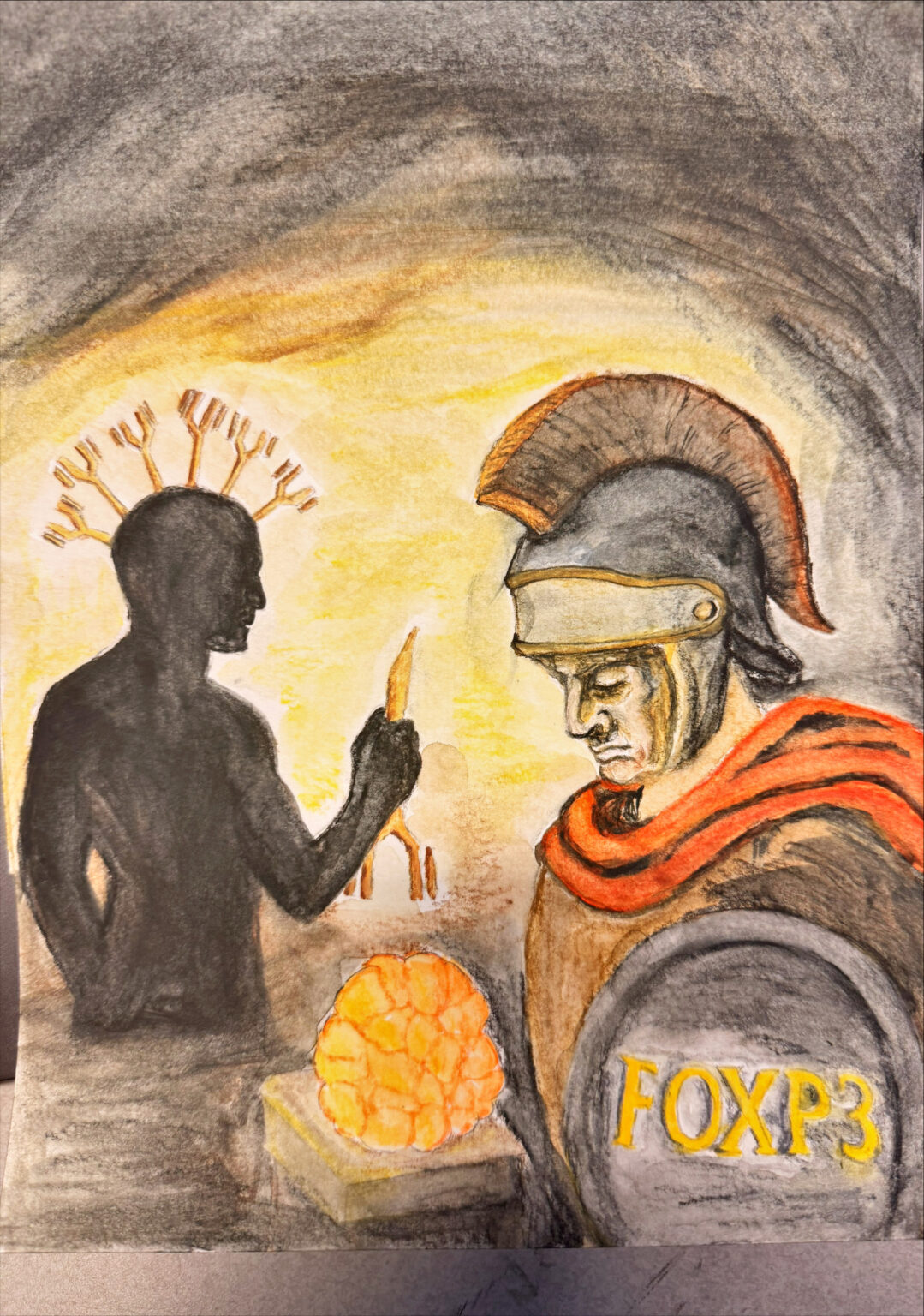
 Image of February 2026 cover art for Diabetes created by Christopher Wilson, PhD.

A groundbreaking study by Vanderbilt Health researchers has revealed a greater, detrimental role for B lymphocytes, or B cells, in the progression of Type 1 diabetes (T1D).
B cells are immune cells thought to drive the immune system’s attack on insulin-producing beta cells by activating anti-islet T cells. The study published in Diabetes, the journal of the American Diabetes Association, suggests they play an even more sinister role by also interfering with and limiting the function of regulatory T cells (Tregs) that help calm the immune system.
“Our study showed B cells can weaken the body’s natural defenses by interfering with Tregs, which normally behave as peacekeepers to ward off immune attacks on the pancreas and the insulin-producing beta cells,” said Daniel Moore, MD, PhD, associate professor of Pediatrics at Vanderbilt Health and the study’s corresponding author. “In mouse models that lacked B cells, Tregs were stronger and more effective, which allowed transplanted insulin-producing pancreatic tissue to survive longer.

“This finding shifts our understanding of B lymphocytes from serving as simple accomplices in the development of Type 1 diabetes to more active saboteurs. By focusing on these interactions, we hope to advance the development of innovative strategies to better preserve beta cells, delay or prevent Type 1 diabetes, and improve patient outcomes. We also believe this may be an important, unrecognized part of immune regulation that may be at work in other autoimmune disorders, so we hope this new insight becomes more widely investigated.”
The study used various mouse models to investigate the role of B cells in T1D. Flow cytometry, magnetic-activated cell sorting, and immunohistochemistry were used to analyze Treg populations and their functions.
The mouse models showed that lack of B cells enables durable islet transplant tolerance, enhances the expansion of Tregs, increases the ratio of insulin-reactive Tregs to activated or effector T cells, and enhances islet-protective Treg function.
These findings indicate that B lymphocytes accelerate destructive immunity by negatively regulating Treg development and function. The researchers note that targeting the B cell-Treg interactions, particularly in the thymus gland where T cells are produced, might offer new, more selective therapeutic strategies.

Because of its significance, the study was selected as the journal’s paper of the month for the upcoming February issue of Diabetes. The cover art related to the study is designed by Christopher Wilson, PhD, first author of the paper and an instructor in Pediatrics in the Ian M. Burr Division of Pediatric Endocrinology and Diabetes at Monroe Carell Jr. Children’s Hospital at Vanderbilt.
His foreboding artwork has the title, “Et tu, B Cells?” and features a B cell, depicted as a shadowy Brutus, preparing a surprise attack on Foxp3+ regulatory Tregs, depicted as Julius Caesar.
“Type 1 diabetes has deeply impacted my family, and so has art,” said Wilson. “My mother, an art teacher and an excellent artist in her own right, encouraged me to create art when I was younger. When I learned we were offered a cover, I knew it was my chance to dust off my watercolors and express my science through art.
“In Type 1 diabetes, we often think of B cells activating T cells to target beta cells. The idea of them lurking in the shadows and eliminating cells meant to protect against autoimmunity felt like the ultimate betrayal, something we never imagined they might do. That image reminded me of Brutus plotting Caesar’s demise in the chambers of the Roman Senate. I took some artistic liberties with Caesar, depicting him as a guardian of the islet dressed in Roman legion attire.”
Additional authors are Blair Stocks, MD, PhD, Baylor College of Medicine, and Alexander Falk at Monroe Carell.
This study was supported by a JDRF Career Development Award, National Institutes of Health grants F31DK107321 and R56DK128337, the Beatson Family Foundation, a Breakthrough T1D Postdoctoral Fellowship Award, and gifts from the J.P. Fletcher Foundation and from the Appleby Foundation.