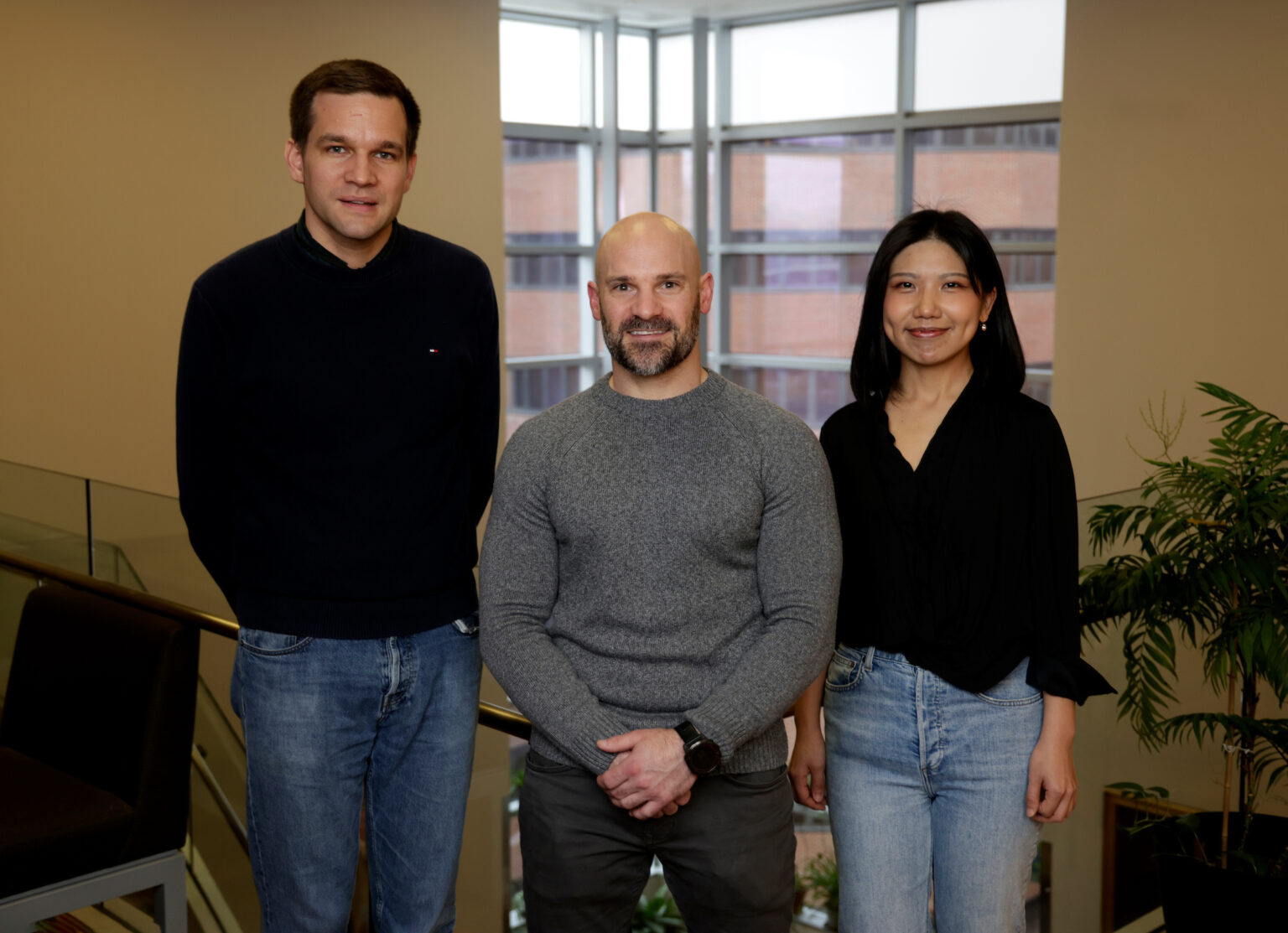
 From left, Fabian Bock, MD, PhD, Nathan Winn, PhD, and Xinyu Dong are studying insulin resistance. (photo by Donn Jones)

Researchers in the Vanderbilt University School of Medicine are zeroing in on insulin resistance, a primary risk factor for the development of Type 2 diabetes and cardiovascular disease that is often associated with obesity.
In a paper published Jan. 21 in the journal Molecular Metabolism, they report that deleting the cytoskeletal protein alpha-Parvin from skeletal muscle in a mouse model reduced glucose uptake by muscle and impaired exercise tolerance, hallmark signs of insulin resistance.
While GLP-1 receptor agonists used to treat Type 2 diabetes and obesity can improve insulin sensitivity, thereby lowering glucose levels in the blood, the latest findings provide another clue that could lead to more targeted ways to increase insulin-stimulated glucose uptake by muscle and exercise tolerance.
The report reflects decades of investigations into the molecular and biochemical bases for insulin resistance by researchers in the departments of Medicine, Cell & Developmental Biology, and Molecular Physiology & Biophysics.
The paper’s corresponding author, Nathan Winn, PhD, is assistant professor of Medicine in the Division of Gastroenterology, Hepatology and Nutrition, and assistant professor of Molecular Physiology & Biophysics.
Fabian Bock, MD, PhD, assistant professor of Medicine, and Xinyu Dong, a graduate student in the lab of co-author Roy Zent, MBBCh, PhD, are the paper’s co-first authors. Other co-authors from the Department of Medicine are Kakali Ghoshal, PhD, Santosh Thapa, PhD, and Ambra Pozzi, PhD.
Co-authors from Molecular Physiology & Biophysics are David Cappel, PhD, John Deaver, PhD, Luciano Cozzani, Deanna Bracy, Louise Lantier, PhD, Allison Do, Richard Printz, PhD, Owen McGuinness, PhD, and the late David Wasserman, PhD. The research was supported in part by National Institutes of Health grants K01DK136926, R01DK054902, R01DK050277, R01DK119212, R01DK069921, R01DK088327 and R01DK127589, the Department of Veterans Affairs, and the Keck Foundation.