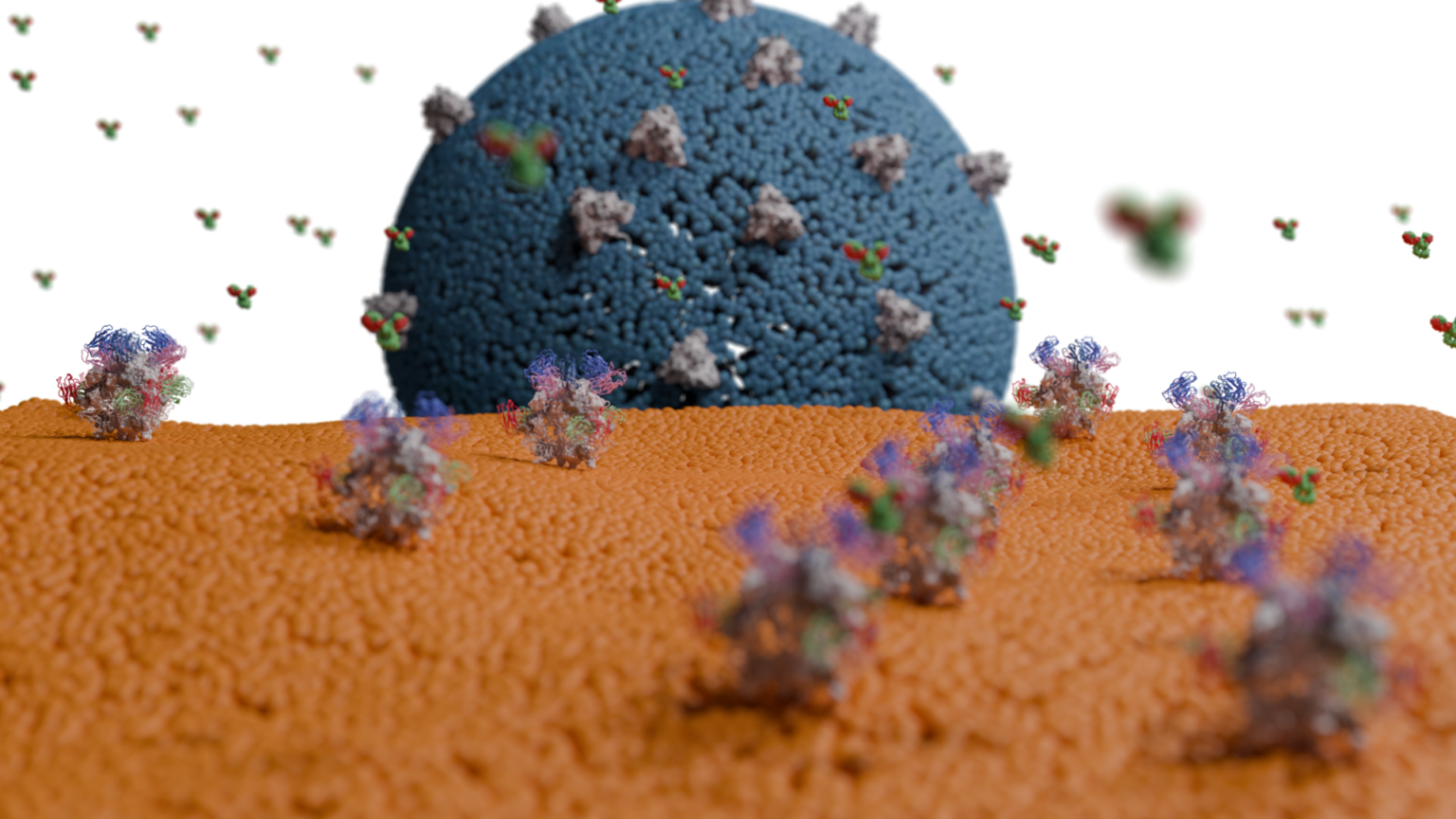
 Anti-measles antibodies bind to viral fusion proteins (gray) expressed on the surfaces of an infected cell (orange) and measles virus (blue). (illustration by Elad Binshtein, PhD, senior scientist - cryo-EM in the Crowe lab)

The Vanderbilt Center for Antibody Therapeutics has signed an option agreement with Saravir Biopharma Inc. for the company to develop human monoclonal antibodies isolated in the laboratory of James Crowe Jr., MD, for the treatment and prevention of measles.
As vaccination rates have fallen and the number of measles cases continues to soar, there is an urgent need for an antibody therapy, especially for people at risk of serious illness or death if they become infected with the easily transmitted respiratory virus.
Preclinical data on the antibodies, not yet published, “are very promising and demonstrate neutralization of the virus and prevention of measles infection in various animal models,” said Ronald Moss, MD, President and Chief Executive Officer of Saravir Biopharma.
Moss, a physician-scientist who has led several antiviral and vaccine programs from early-stage research through late-stage clinical trials, co-founded the Encinitas, California-based company last year to develop the first monoclonal antibody therapy against measles.

“I am pleased to work with Saravir Biopharma to bring these human measles antibodies to clinical testing, as time is of the essence,” said Crowe, director of the Vanderbilt Center for Antibody Therapeutics. “These antibodies hold significant promise to be used in people who are at risk of measles, but who cannot respond to the measles vaccine due to their weakened immune systems.”
Crowe is internationally known for his group’s development of human monoclonal antibodies against a host of pathogenic viruses. Holder of the Ann Scott Carell Chair, he is University Distinguished Professor of Pediatrics and Chemistry.
In recent years, high vaccination rates in the United States had nearly eliminated measles, the most infectious human respiratory virus. Yet in 2025, the Centers for Disease Control and Prevention reported 2,285 confirmed cases of measles — and another 1,575 cases during the first three months of this year.
While vaccination remains the primary, and most effective, means of preventing measles, proliferating outbreaks have put at risk millions of people who cannot safely receive or gain protection from the current live-virus measles vaccine. They include pregnant women and those who are immunocompromised because of medical conditions.
The anti-measles human monoclonal antibody or a combination of antibodies from Vanderbilt will now need to go through the first phase of often-lengthy human testing, although development could be accelerated due to the rapid spread of the disease, Moss said.
“We are determined and have the expertise to progress these antibodies to the clinic as … an important countermeasure to … measles outbreaks, which unfortunately have been predicted to occur for years to come,” he said. “We want to help stop the outbreaks.”