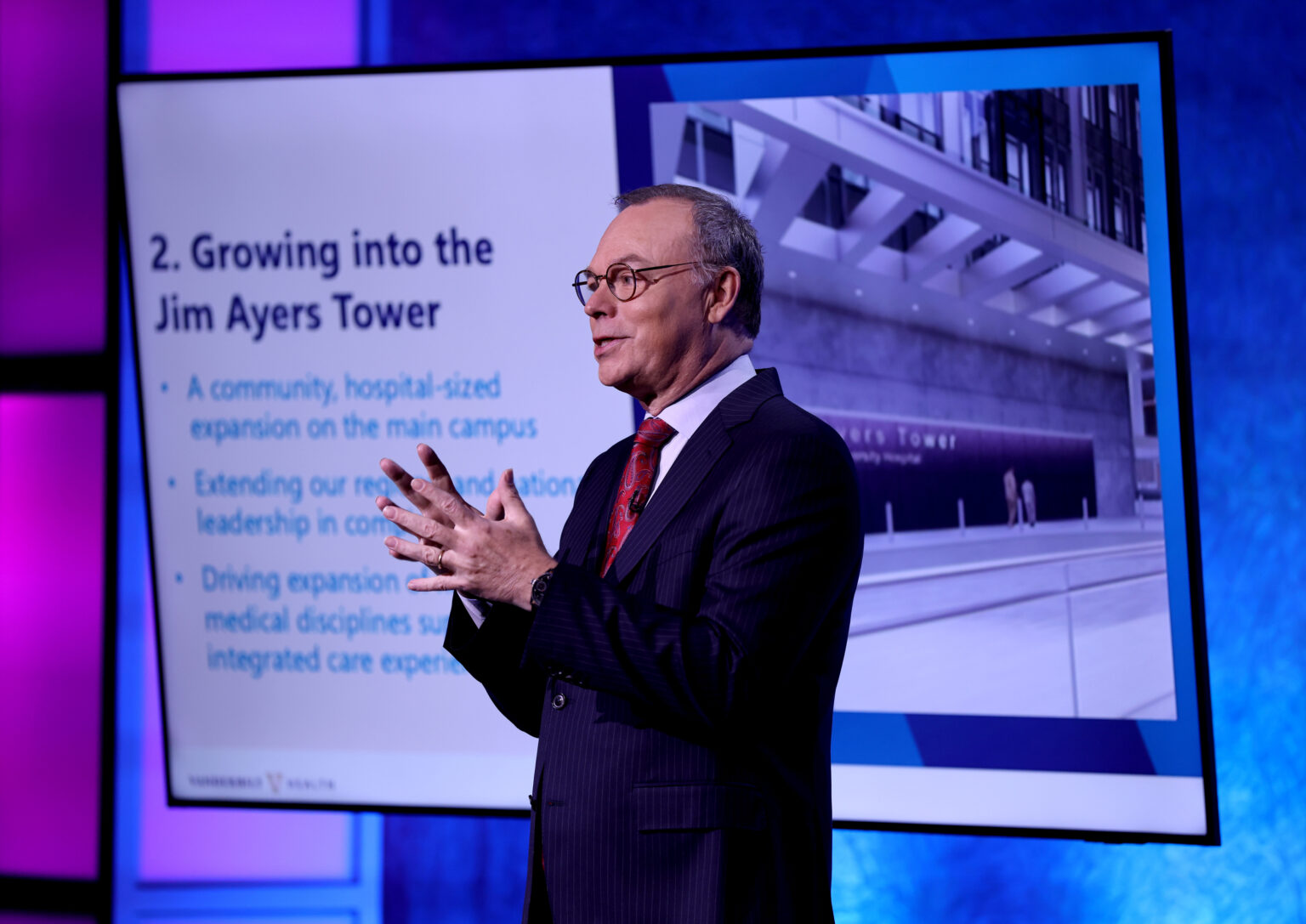
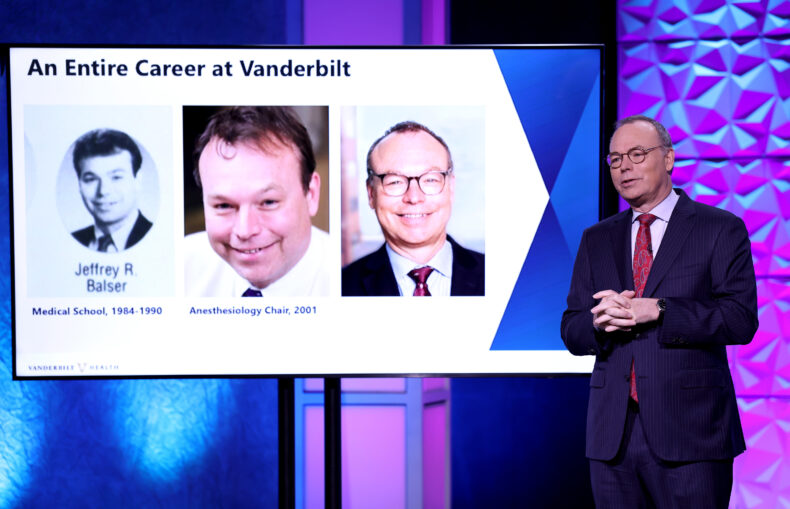
 Jeff Balser, MD, PhD, outlines Vanderbilt Health's priorities and growth drivers at the spring Leadership Forum. (photo by Donn Jones)

Vanderbilt Health (VH) enters a pivotal period of growth and transition with clear strategic priorities: deepening regional expansion, accelerating research innovation and leveraging technology to scale care.
The philosophy driving the expansion is that every facility bearing the Vanderbilt Health name should deliver the same world-class, personalized care as the Main Campus, said Jeff Balser, MD, PhD, President and CEO of VH and Dean of Vanderbilt University School of Medicine, during the May Leadership Forum.
“Transitions are healthy and help us grow — and what we do at Vanderbilt Health is far too important to miss a beat. We must be relentless in advancing this Medical Center’s mission and impact,” said Balser, who will retire at the end of 2026. “I’m energized by what lies ahead over the next eight months and excited to continue this work alongside you. Please know I’m so grateful for all you do — thank you for your leadership.”
Balser acknowledged the headwinds the enterprise navigated alongside its growth, framing the journey as evidence of institutional strength, not vulnerability. Vanderbilt Health has weathered those storms, he said, at times doing difficult things to course correct.
“What that tells me, and should also reassure you, is that Vanderbilt Health is growing not just in size, but in its resilience,” said Balser.
One system, one standard of care
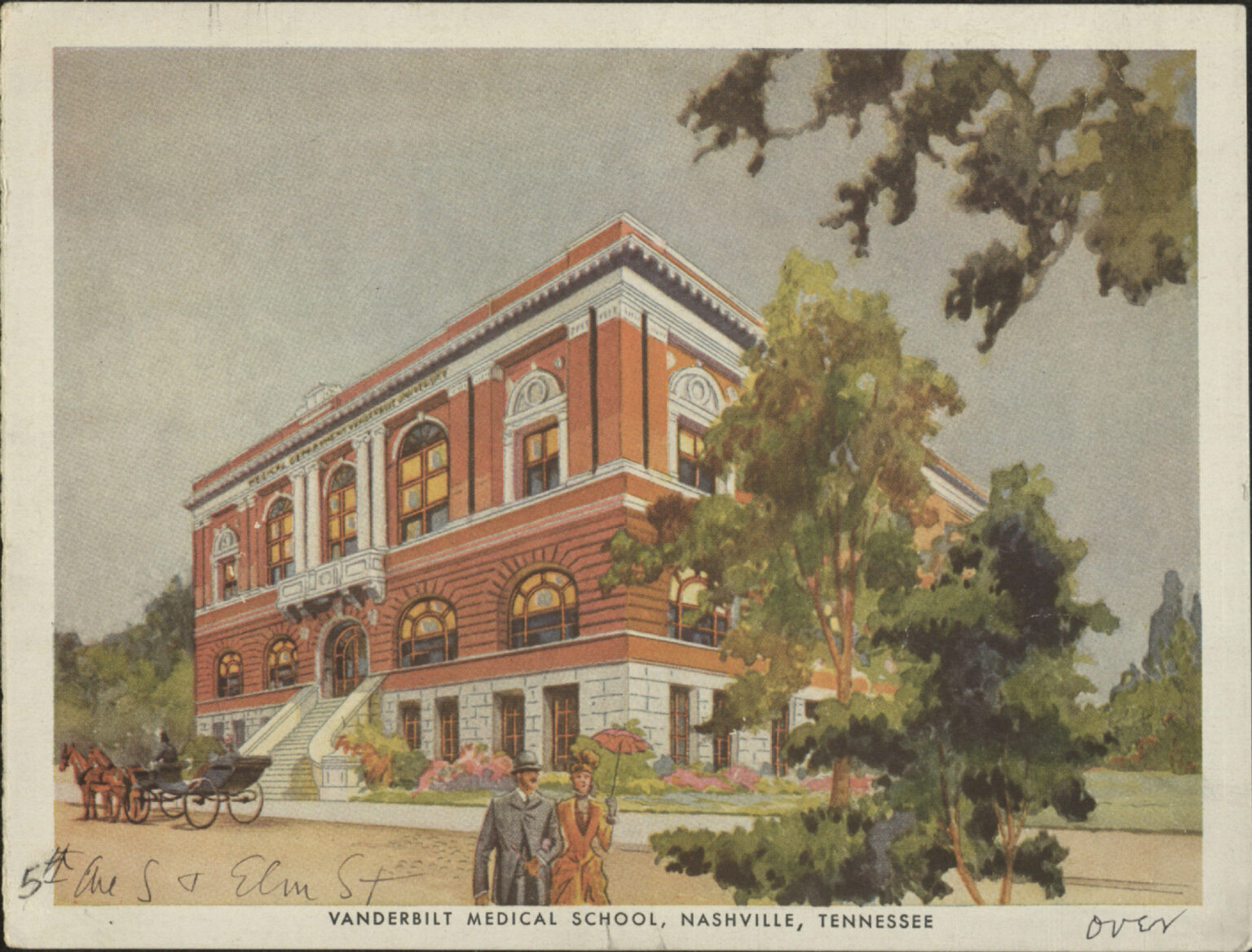
The health system’s regional footprint continues to grow, with new and planned facilities extending Vanderbilt Health’s reach across Middle Tennessee. The most recent addition, Vanderbilt Health Clarksville, officially joined in February; and there are new facilities under development in Murfreesboro and Brentwood.
The Jim Ayers Tower, the largest expansion since 2009, opened its first floor seven months ago and continues to come online, with an imaging floor and additional beds slated to open this year. The 17-floor tower expands capacity for the most complex cases, including heart and lung transplantation and advanced neurosurgery. Growing into that capacity, Balser noted, means expanding not just surgical specialties, but the full continuum of care that complex patients require.
“Our vision is not a hub and spoke model; we are becoming an integrated, regional system of care, providing patients with the best possible care experience wherever they cross our threshold,” he said.
A new option for urgent (but not emergency) care
Alongside systemwide expansion, VH is piloting a new model designed to reduce strain on one of its most pressured access points: the emergency department at Vanderbilt University Hospital, said Jane Freedman, MD, Deputy CEO and Chief Health System Officer.
This summer, Vanderbilt Health will pilot an Acute Care Center at One Hundred Oaks, accepting same-day appointments for established patients referred by Vanderbilt Health physicians, advanced practice providers and walk-in clinics. However, there will be no walk-ins directly to the clinic.
The model is designed to serve patients who need urgent but nonemergency workups, such as a CT scan done quickly, monitoring while awaiting lab results, or other time-sensitive evaluations that physicians have historically routed to the ED, she said. There will be ED-trained personnel on-site at OHO to respond if a patient’s condition escalates.
The goal, Freedman said, is timely care across both locations while reserving the ED for patients who truly need it.
“We have been thinking carefully about how to solve this in innovative ways,” Freedman said.

Research partnerships and AI sharpen Vanderbilt Health’s edge
The research enterprise is a cornerstone of VH’s competitive position. While federal health research funding growth is challenged nationwide, VH has broadened its portfolio through industry partnerships that now represent a growing share of research activity, Balser said.
A collaboration with GE HealthCare produced a patented AI approach using routine clinical data to predict individual cancer patients’ responses to immunotherapy. A new partnership with Bayer Pharmaceuticals, launched this fiscal year, targets treatments for cardiovascular and kidney disease.
“Our work with GE HealthCare has been presented at leading scientific meetings in the U.S. and Europe. It is a strong example of how collaboration with industry permits not only scientific advances, but also faster translation into more personalized, safer cancer care,” said Balser.
In the coming months, Vanderbilt Health will pilot the Innovation Clinic — an outpatient experience designed to demonstrate what AI-enabled care delivery can look like at scale. The clinic will feature Vivien, a multilingual virtual avatar guiding patients through previsit steps, alongside digital tools capable of gathering vital signs through screen-based interactions.
“Our vision for AI is not to reduce our workforce. But given the cost pressures on health care, it is imperative to leverage AI to expand our services to support our growing communities without expanding our workforce as much as we did in the past,” said Balser.
Culture grows here, too
Balser and Freedman reiterated that Vanderbilt Health’s culture is part and parcel of its growth trajectory, and that the culture of collaboration and innovation is to be actively protected, not assumed.
“As we continue to grow larger as a system, we want to preserve the culture we have treasured for so long,” she said. “The trust we place in one another to speak up and share openly — please continue to do that with your colleagues and with me.”
She described the hallmarks of Vanderbilt Health’s strongest leaders: those who build teams in addition to managing operations, create space for daily huddles, offer meaningful feedback, round with patients and care teams, and demonstrate self-awareness in how they communicate.
Balser echoed that sentiment with a direct acknowledgment of the workforce at the center of the patient experience. He said the more than 10,000 nurses who work at Vanderbilt Health are “front-line ambassadors” to patients and families.
“We genuinely care about the well-being and success of one another — and we find ways to take actions to demonstrate that caring,” he said.
All employes are encouraged to dedicate time to completing the 2026 Vanderbilt Health Engagement Survey, which launched May 5. Survey responses inform leadership priorities in areas including communication, collaboration and professional growth, and translate directly into action, said Freedman.
“The feedback we receive will provide valuable insight into employee engagement and will help guide the actions we take moving forward,” Freedman said.