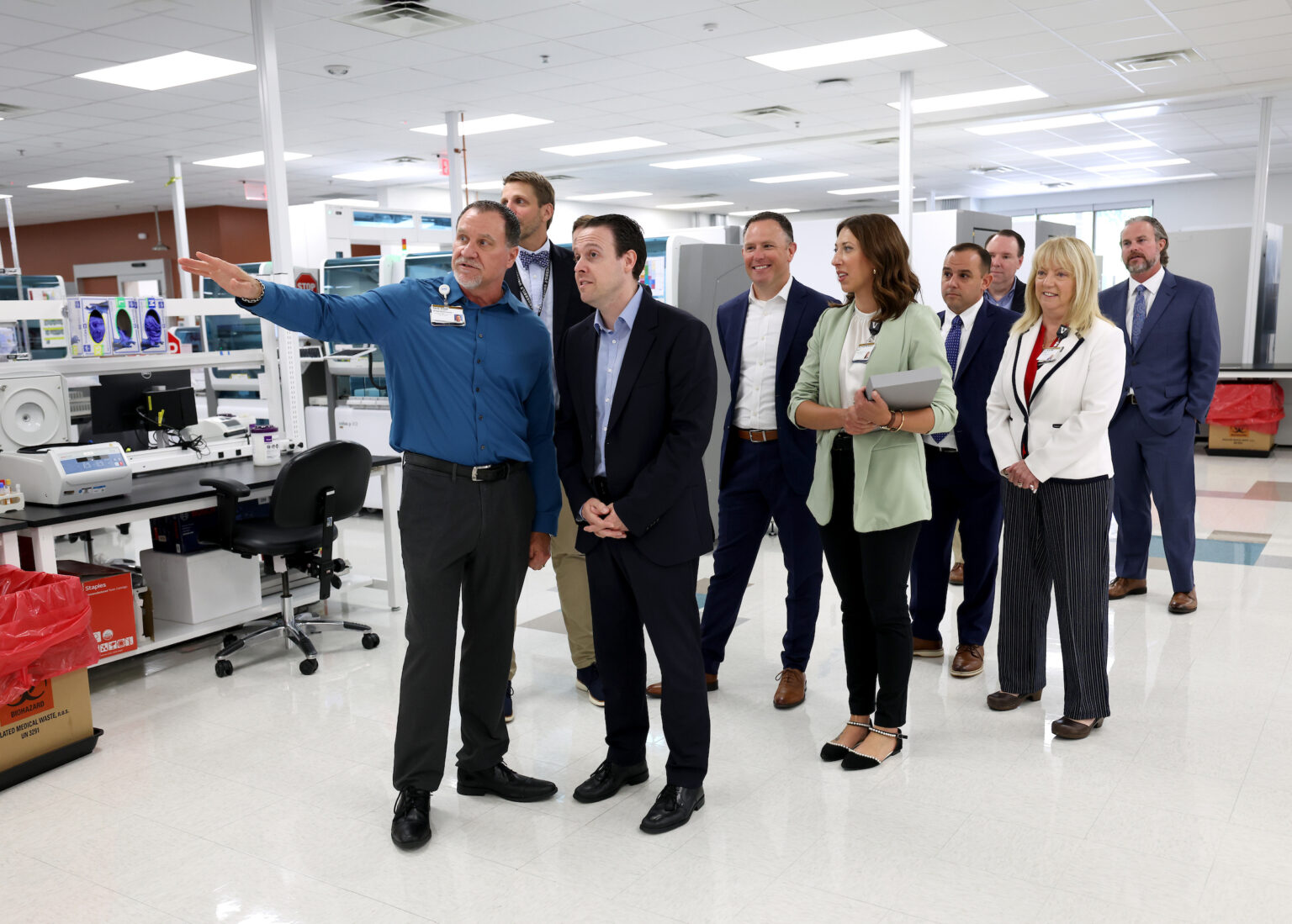
 Leaders from Roche tour Vanderbilt Medical Laboratories at MetroCenter during a visit to recognize Vanderbilt Health as the first U.S. installation of advanced Roche Diagnostics instrumentation. At front, David Vinson of VML, left, talks to Benjamin Lilienfeld, PhD, from Roche Global. (photo by Donn Jones)

Vanderbilt Health is marking a milestone: It is the first U.S. site for installation of an advanced clinical testing platform that will speed up laboratory testing and improve patient care.
The new cobas c 703 and cobas ISE neo analytical units are part of the cobas pro integrated solutions produced by Roche, one of the world’s largest biotech companies. The platform doubles testing capacity in the same space “footprint” of older instruments and reduces downtime maintenance requirements.
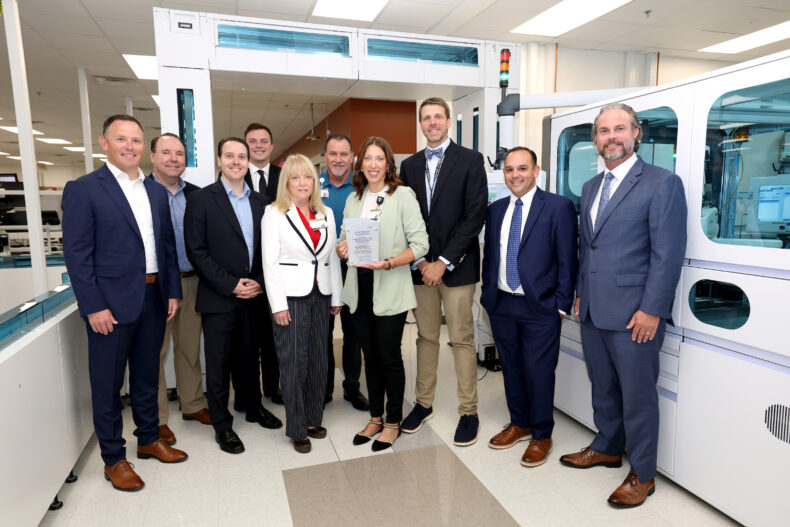
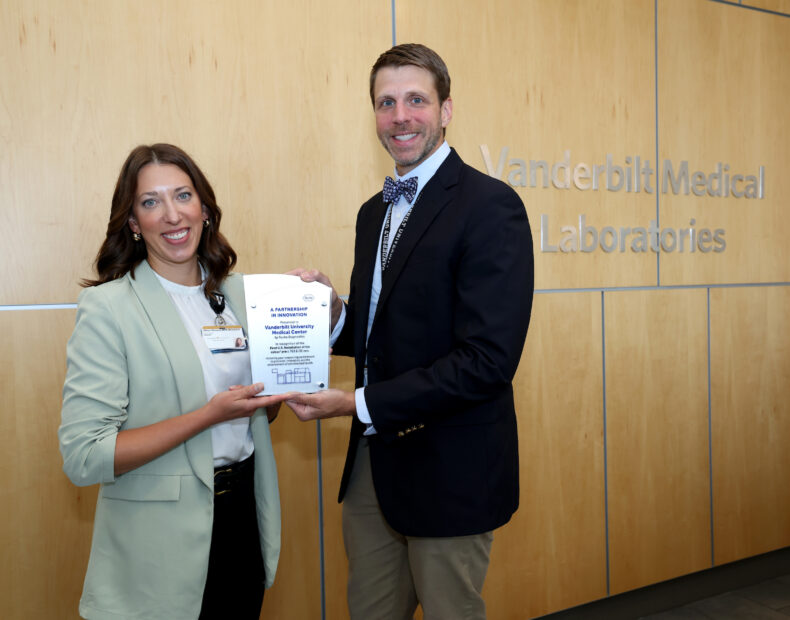
Roche officials joined leaders from Vanderbilt Medical Laboratories (VML) on June 16 to recognize and celebrate the cobas c 703 and cobas ISE neo installation.
“Vanderbilt Health is honored to be the first site in the U.S. to install this advanced Roche instrumentation to improve laboratory workflows and advance patient care,” said David Vinson, Senior Vice President of VML at Vanderbilt Health.
“This collaboration with Vanderbilt Health reflects a shared vision for the future of diagnostics,” said Antonio Vergara, Senior Vice President, Core Lab and Near Patient Care for Roche Diagnostics. “The high-volume clinical chemistry and enhanced automation of the cobas c 703 and cobas ISE neo analytical units will streamline workflows. We are thrilled to see this advanced technology yield time and space back to our customers, so that they can stay focused on serving patients.”
Clinical chemistry analyzers are used to test body fluids for various chemical substances, metabolites and proteins to aid in disease diagnosis, monitor organ function, and track treatments.
Three cobas c 703 and three cobas ISE neo instruments have been installed in new laboratory space that recently completed construction on the fourth floor of The Vanderbilt Clinic. The instruments are currently undergoing validation testing for an anticipated November go-live date. The new lab is down the hall from the previous TVC lab space.
“We’ve been able to design this lab from the ground up to improve our efficiencies and our workflows and to get results out to patients more quickly and more accurately,” said Allison Hermane, MPH, Director of Core Lab Service Lines at Vanderbilt Health. “This Roche equipment is a big part of that.”
The higher throughput of the cobas c 703 in the same footprint means more testing capacity in the same space, Hermane said. “As we bring on the Jim Ayers Tower and expect more patients and higher test volumes, we’ll be able to manage that and not impact turnaround times.”
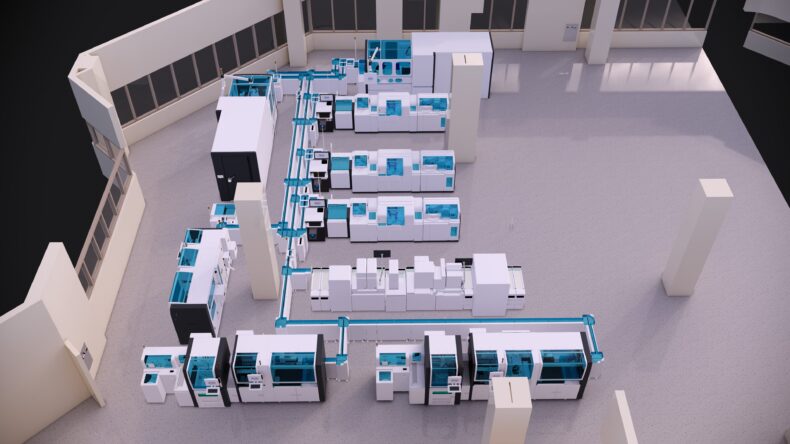
Joe Wiencek, PhD, Core Laboratory Medical Director and Associate Professor of Pathology, Microbiology and Immunology, said that VML leaders have worked with Roche to optimize workflow designs in the new TVC lab space.
“The systems are closer to the delivery of specimens, so there are fewer steps and fewer hands on each specimen,” Wiencek said. “The system is optimized for growth and expansion of care for our patients on the Main Campus and around Tennessee. The clinical chemistry and automation system will support tens of thousands of test results every day.”
The new analyzers also have improved automation and will require less downtime because of improvements such as the types of light bulbs used for testing: The cobas c 703 uses LEDs instead of halogen bulbs, which improves the lifespan and reduces maintenance.
“Our laboratory team will be spending less time on maintenance tasks and more time focusing on patient care,” Hermane said. “Less downtime means more uptime.”
According to Roche, the cobas c 703 can deliver up to 2,000 tests per hour and has 70 reagent positions; the cobas ISE neo unit delivers up to 1,800 tests per hour. The expanded reagent capacity will allow VML to offer tests that are not available using current chemistry analyzers. The new Roche platform at TVC also standardizes equipment being used at VML’s MetroCenter location and elsewhere across the system, which will reduce variability in test results for patients regardless of where their specimens are tested across Vanderbilt Health.
The cobas c 703 and cobas ISE neo join another Roche equipment “first” at Vanderbilt Health. The Core Laboratory space at MetroCenter was the first U.S. site for installation of Roche’s cobas connection modules Vertical — an elevator system that takes specimens up and over the corridor to the archive units.
Roche leaders who visited VML were: Adam Berman, Vice President of Sales for Core Lab and Near Patient Care, Roche US; Benjamin Lilienfeld, PhD, Lifecycle Leader, Serum Work Area Systems, Roche Global; Tanner Maurer, Senior Account Executive, Roche US; Nate Patton, Vice President of Marketing for Core Lab and Near Patient Care, Roche US; and Rob Wilder, Senior Director of Sales for Core Lab-Southeast, Roche US.