


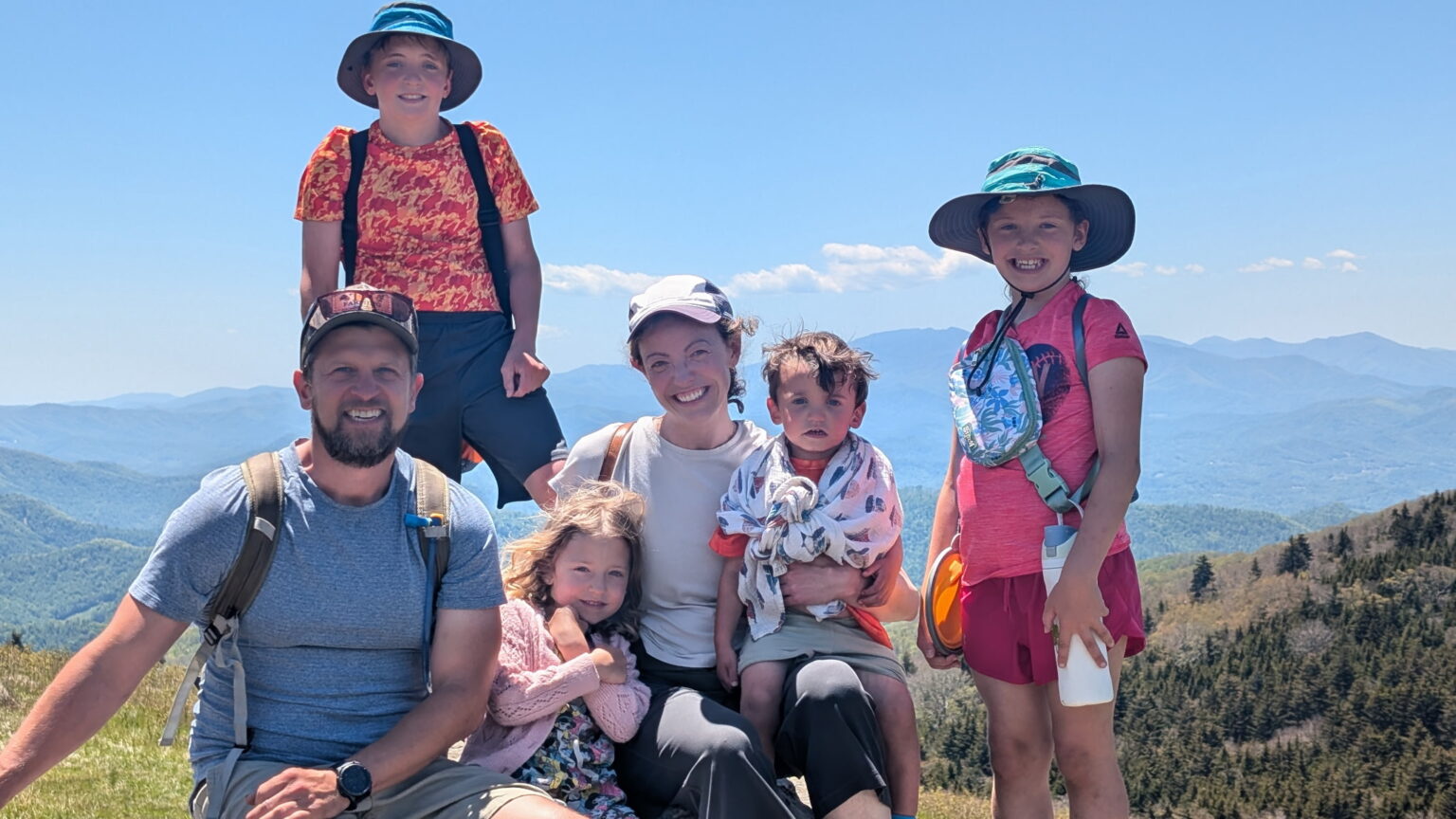
 The Pattersons take a family photo during a hike. From left, Gil, Gus, Josie, Emily, Simon and Samantha. (submitted photo)

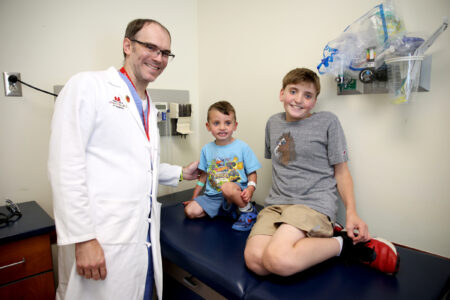
Simon Patterson is an active, curious 2-year-old who loves riding his bike and playing with monster trucks. So, when his daycare called his parents, Emily and Gil Patterson, about a concerning health episode, they were caught off guard.
“Daycare said he was having episodes where his fingers and lips turned blue,” Emily said.
That single call set off an unexpected chain of events that would impact all four children in the Patterson family, ultimately requiring advanced pediatric cardiac expertise at Monroe Carell Jr. Children’s Hospital at Vanderbilt.
Out of an abundance of caution, Simon’s pediatrician referred him for cardiac imaging with pediatric cardiologist Ashish Madhok, MD, MBA, in their hometown of Johnson City, Tennessee. An echocardiogram revealed Simon had an atrial septal defect (ASD) — a hole between the heart’s upper chambers. What initially seemed like an isolated incident quickly evolved into a more serious, though treatable condition. Simon’s “blue episodes” actually were seemingly unrelated.
“It’s a fairly common defect — one of the more common conditions we see in congenital heart surgery,” said Garrett Coyan, MD, MS, a pediatric cardiac surgeon at Monroe Carell. “But what’s changed over time is how we treat it.”
‘Everybody seemed so healthy’
A congenital heart disorder, ASD occurs in about 13 of every 10,000 babies born in the United States, according to the Centers for Disease Control and Prevention. Though ASDs can sometimes go undetected early in life, they can have serious consequences if left untreated, including heart failure, pulmonary hypertension and increased stroke risk.
“(Dr. Madhok) said while it’s unlikely that ASDs can run in families, it would be good to go ahead and screen the other three children,” Emily said.
Simon’s siblings — Augustus (Gus), 11, Samantha, 8, and Josie, 5 — all underwent screening as well. What doctors found was a surprise. Both Simon and Gus had large ASDs, while the girls also had smaller defects known as patent foramen ovale.
“We didn’t know any of this was going on — everybody seemed so healthy,” Emily said. “It’s not a defect you can see. They didn’t have symptoms.”
A family referral
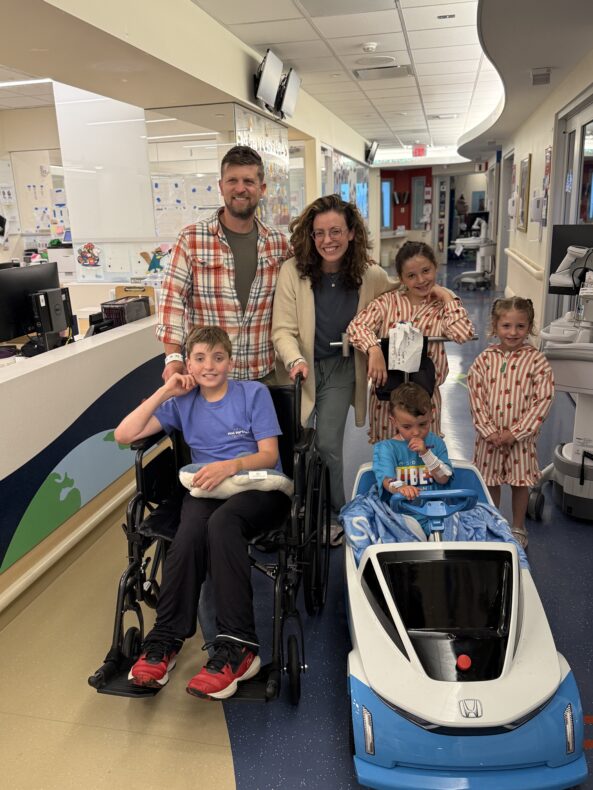
The entire family was referred to Monroe Carell, where the multidisciplinary congenital heart team with the Pediatric Heart Institute reviewed all four cases together in a case conference, a best practice of the team’s care.
“We really do have all the players on our multidisciplinary team,” said Coyan, Assistant Professor of Pediatric Cardiac Surgery and Assistant Professor of Biomedical Engineering. “All four cases were presented at conference, with cardiologists, surgeons, ICU specialists and anesthesiologists working together to determine the best path forward.”
Monroe Carell is home to one of the nation’s most experienced pediatric heart surgery teams, offering care that ranges from routine defect closures to highly complex congenital heart procedures. As part of the Vanderbilt Health system, Monroe Carell also integrates seamlessly with adult congenital heart disease care specialists to ensure a continuum of care into adulthood, as needed.
The collaborative model allows experts across cardiology, cardiac surgery, imaging, intensive care and nursing to tailor care plans to each child’s unique condition and to coordinate care seamlessly, even for multiple patients in the same family, like the Patterson brothers.
Back-to-back surgeries
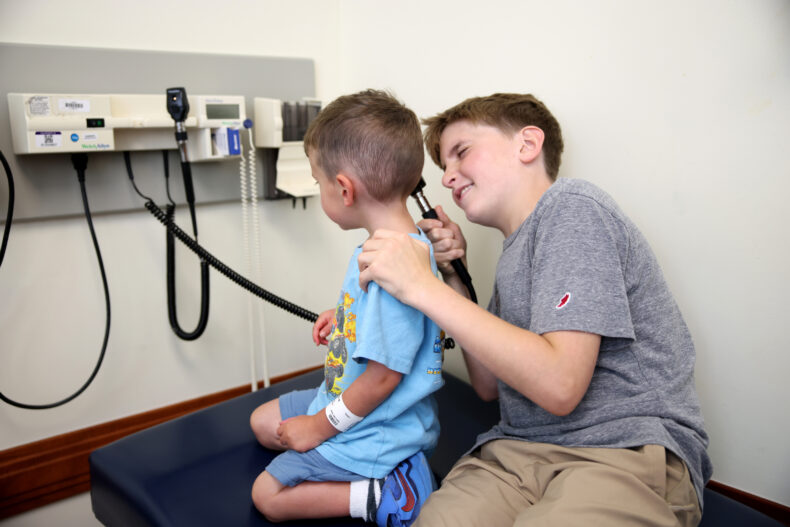
For children with ASDs, treatment options vary. About 85% of these defects can now be closed using minimally invasive, catheter-based procedures to implant a disc-shaped device.
“There are still some defects, because of their size and shape, that need surgery,” Coyan said. “(For Simon and Gus) their defects were large, and there wasn’t enough surrounding tissue for a device to safely close the hole. So, surgery was the best option.”
With two of their children needing open-heart surgery, the Patterson family arranged time off from work and school in order to prepare for an extended stay in Nashville, a four-hour drive from their home in Johnson City. The care team worked closely with the Patterson family to plan every step and coordinate logistics.
“We gave the family options,” Coyan said. “We ultimately decided to perform the surgeries back-to-back, starting with Gus, since he is older, and so he wouldn’t spend the day waiting and worrying.”
For Emily and Gil, the experience was emotionally overwhelming, but they felt reassured. “The medical care team was amazing and kept us involved and informed every step of the way. Right before anesthesia rolled Gus back to the operating room, he asked, ‘Wait — are you absolutely sure I have this?’” Emily said. “It’s a perfectly valid question, because it’s not something you can see. The medical team reassured all of us as they patiently answered our questions.”
In the operating room, Coyan and team repaired the defects using the patients’ own tissue.
“The actual operating portion took a little over two hours,” he said. “We stop the heart for about 15 minutes, patch the hole using the patient’s own tissue, then restart the heart and get them waking up right there in the operating room.”
Both boys recovered quickly. They were out of the intensive care unit the next day. Gus went home after just two days. Simon followed soon after, at five days.
“You would never know they had surgery. Within a few days they were up and running happy with no real pain,” Emily said.
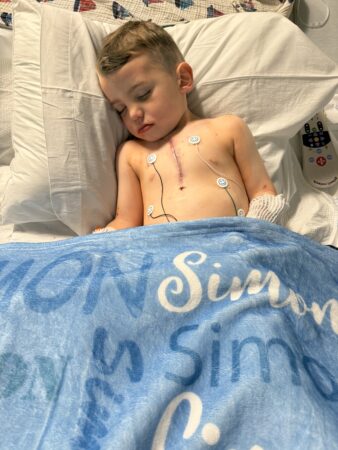
‘Heart surgery boo-boo’
Coyan said once the boys are past their initial six-week recovery, they can get back to everyday activities, sports, careers, etc., without restrictions. “As far as me, they’re done,” he said. “Once we repair these defects, the vast majority of kids are ‘one and done.’ They’ll continue follow-up with cardiology, but they go on to live normal lives.”
The team will continue to monitor Samantha and Josie for any follow-up care or treatment needed. Emily and Gil will also be screened for ASDs. But for today, the family is grounded in gratitude.
“We’re thankful to be home. We’re thankful to be healthy,” Emily said. “Everything looks different … it’s just a fresh lens. We realize that the next day is not guaranteed for any of us.”
Now, Simon calls his scar his “heart surgery boo-boo,” while Gus “wears his scar with pride.”
What began as a concerned call from Simon’s daycare team turned into an experience that has forever impacted the long-term health of the Patterson family. His parents are overcome with relief and gratitude.
“The care we had was phenomenal,” Emily said. “Every single person on the team was just amazing. They even turned Simon’s bed into a race car to bring him back to surgery. Simon is now back to riding his bike and playing with monster trucks like nothing happened. From the initial diagnoses, preparation, surgery and recovery, the team kept us in the loop the whole time. We are forever appreciative for the excellent care we received while at Vanderbilt!”


