Imagine meeting a patient who is believed to have a progressive neurodegenerative disease. What diagnostic methods might be useful? Would that person need to walk in a straight line, pick up an object or demonstrate grip strength?
What about listening for abnormalities in the patient’s voice and speech?

Speech-language pathologists (SLPs) in the Department of Hearing and Speech Sciences often go underrecognized for their collaboration with multiple areas of medicine. Many people only associate SLPs with providing services to children who have speech and language challenges, or perhaps with evaluating swallowing function for patients in the hospital. But for many patients, particularly those under the care of a neurologist, an SLP’s work can aid in differential diagnosis and guide rehabilitation recommendations.
“When there’s an interesting case in clinic, someone may come to me and say, ‘Hey, can you listen to this? I’m hearing certain things, but I want to know what you think about it,’” said Mike de Riesthal, PhD, CCC-SLP, Professor of Hearing and Speech Sciences, whose clinical work includes collaboration with multiple neurology clinics at Vanderbilt Health.
“The faculty and staff in Hearing and Speech Sciences who work with patients experiencing neurologic communication disorders have worked hard to develop their perceptual speech assessment skills through collaborative listening, consensus ratings and honest feedback,” added de Riesthal.
An SLP might evaluate a patient alongside a physician in the neurology clinic, in their own clinic, or remotely by listening to another physician’s recording of their speech. An additional expert opinion on the patient’s voice and speech can help identify what may be wrong when a patient presents with neurological symptoms.
“The vocal cords are particularly sensitive to a neurological abnormality in the brain,” said Antje Mefferd, PhD, CCC-SLP, Associate Professor of Hearing and Speech Sciences. “Their vibration patterns will become imbalanced in a way where you can hear it as a subtle roughness or breathiness in the voice, or the voice doesn’t sound resonant and clear anymore.”
Mefferd added that voice quality and speech precision are notable variables that can suggest a neurological issue.
“Clinicians can use a speech signal to detect these small changes, and that’s where our field tries to fill that gap in the diagnostic process,” she said.
Mefferd and de Riesthal, among other SLPs, are embedded in several neurology clinics, including the Huntington’s Disease (HD) Program, which sees patients with HD as well as the atypical parkinsonism disorders multiple system atrophy (MSA) and progressive supranuclear palsy (PSP).
“Having these clinicians is very helpful for patients who, as their disease progresses, develop speech and swallowing troubles,” said Amy Brown, MD, MS, Assistant Professor of Clinical Neurology in the Division of Movement Disorders. “To be able to see a doctor who can assess these things … and for that doctor to equip them and their family members with tools and information really works to the benefit of the patient.”
Brown pointed out that some patients, particularly those who have HD, already know their diagnosis because it’s genetic, while others who experience diseases that can present spontaneously with no family history — such as MSA or PSP — often seek clinical care not knowing what’s affecting them. Their speech is often the clue physicians need to make a diagnosis.
“Our job in these clinics is to listen to a patient’s voice and speech and provide a speech diagnosis,” said de Riesthal. “And the type of disorder we diagnose is usually associated with one or more potential neurological conditions because it hints at where in the nervous system the individual’s speech capability is breaking down.”
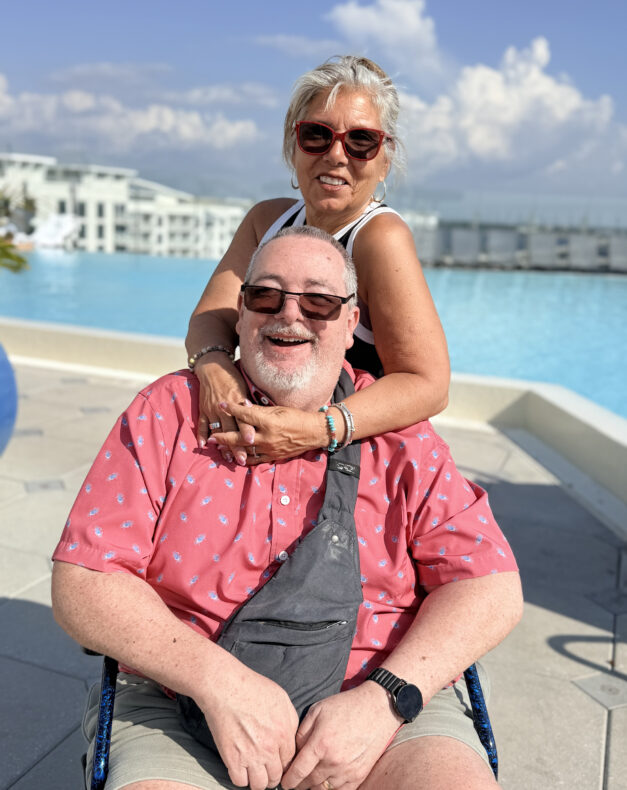
For patient Pat Byrne, 64, changes to his speech patterns — difficulty finding words and an inability to articulate well — marked the first sign of a neurological condition. Brain imaging by a provider in his then home state of Florida revealed gray areas in his cerebellum, leading to an initial diagnosis of a stroke. But Byrne’s intuition told him he hadn’t suffered a stroke, and he was right: He was actually beginning to experience the effects of MSA.
“(Diagnosing MSA) is like putting pieces together,” said his wife, Michele. “If you only have one part of the picture, you may diagnose it as one thing. But when you put them all together, you have a clinical diagnosis of MSA.”

Now equipped with better information to understand his condition, Byrne sought care at Vanderbilt Health. To supplement the efforts of his primary speech therapist in Atlanta, Byrne works with de Riesthal to understand how pacing his speech, controlling breathing and other factors can improve his communication.
But to the Byrnes, the greatest benefit of seeing de Riesthal in clinic is simply the comfort of having his steady clinical perspective on their side.
“I tell him that my biggest concern is not knowing what’s next,” Pat Byrne said. “He’s able to stay with me and tell me very plainly that the progression is different for everyone, but these are likely the next things that are going to happen. It’s very comforting to have someone able to tell you that so you have a better idea of how things are going to hit you.”
In addition to counseling Byrne on his speech, de Riesthal has also equipped him with knowledge that spans beyond standard speech therapy, including pointers on how to incorporate soft foods and improve swallowing while battling MSA.
When Byrne does eventually lose his ability to speak, that won’t spell the end of his work with de Riesthal and Vanderbilt Health’s Department of Hearing and Speech Sciences. Modern technology allows patients with neurodegenerative diseases to preserve their faculties even after the capabilities of their bodies begin to change. One such innovation is the use of an augmentative and alternative communication device, which allows patients to program words, phrases or entire sentences to be played for a listener.
This type of device gained widespread attention earlier this year when former Tennessee Titans player Chris Johnson, in revealing his ALS diagnosis, used a device with an eye-tracking mechanism and a voice modeled after his own to participate in an interview. Although Byrne can still speak, he has chosen the same path Johnson did: sampling recordings of his own speech and using artificial intelligence to model a voice so he can communicate through the computer without sounding robotic.
“Pat was very worried about having a distorted voice, and we didn’t want to have a voice box talk for him,” said Michele Byrne. With the help of the software, she said, “he sounds just like he sounded 20 years ago.”
Being proactive is at the core of preserving quality of life for patients fighting neurodegenerative diseases. Understanding changes to Byrne’s speech was the first step in determining what was affecting his brain, and now, anticipating his needs as his symptoms progress will set him up to maintain his dignity and identity for the rest of his life. When he’s no longer able to speak, his voice will still be heard.
“With MSA and other neurodegenerative diseases, you have to start doing things (such as voice recordings or procuring a wheelchair) before a person actually needs it,” said Michele Byrne. “So it’s very important to have somebody like Dr. Mike in your corner to tell you that you should be thinking of doing this now instead of waiting.”