


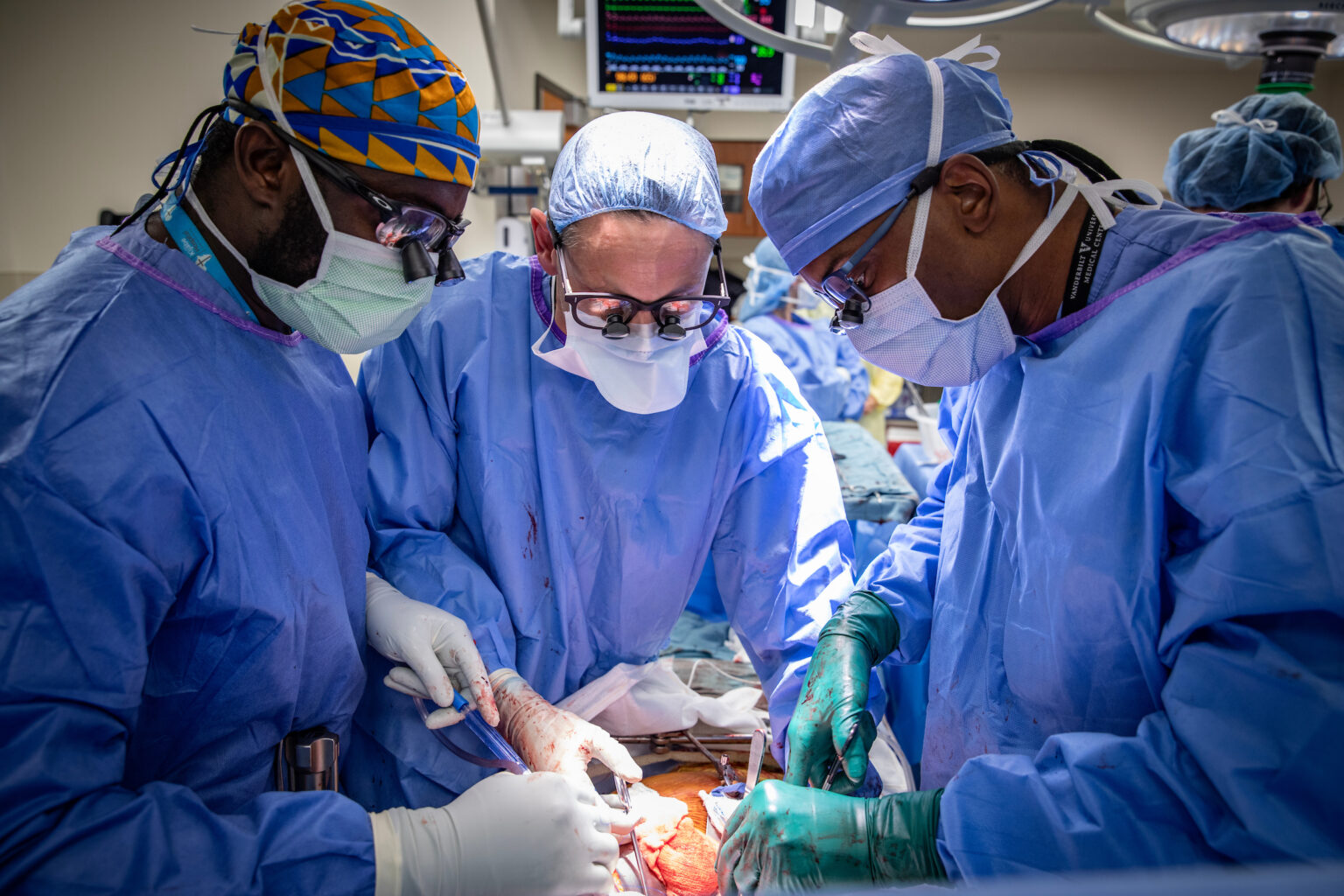
 From left, Enock Adjei, MD; Martin Montenovo, MD, MMHC; and Wali Johnson, MD, MPH, work on a liver transplant patient at Vanderbilt University Hospital in February 2024. (file photo by Erin O. Smith)

The Vanderbilt Liver Transplant team recently performed three liver transplants in 12 hours, a remarkable feat that spotlights the capabilities of the Vanderbilt Transplant Center, the busiest in the nation.
It started as an ordinary night — if there is such a thing in transplantation — at 7:30 p.m. on Oct. 28 as one liver transplant, according to Martin Montenovo, MD, MMHC, Associate Professor of Surgery and Chief of the Division of Hepatobiliary Surgery and Liver Transplantation.
While the team was performing the transplant, he received a call about 9 p.m. from Tennessee Donor Services, the federally designated donor network that facilitates organ and tissue donation in the region. Two more donor livers were immediately available because the center slated to get them declined. Vanderbilt Health was next on the list. But there were only a few hours to retrieve the organs and transplant them. Did the team want them?
“Yes,” Montenovo said.
Unlike many other centers, Vanderbilt Health can staff two operating rooms for liver transplants simultaneously, a capability implemented in recent years as the volume of transplants significantly increased.
It just required calling in an entirely different team for the second operating room in the middle of the night.
A multidisciplinary team sprang into action to make the transplants happen, including Angela Spears, BSN, RN, an organ procurement coordinator. Spears’ job was to quickly schedule organ procurement teams to fetch the organs, one of which required a Vanderbilt LifeFlight aircraft to retrieve the organ from a distant Tennessee hospital. She worked with Tennessee Donor Services, Vanderbilt LifeFlight, DCI Donor Services logistics and Vanderbilt University Hospital’s operating room to ensure the transfer happened smoothly.
In the middle of that, she was continuously reviewing other offers for organs for other Vanderbilt Health patients who may have had transplants later in the day. She credits the whole team, a “well-oiled machine” of which she is one part.
“I love my role and working with the liver transplant team is amazing,” she said. “They are the best of the best. We all have a part to do to make these transplants happen.”
It was also a busy night for Eva Brooks, RN, a clinical staff leader in the main OR at Vanderbilt Health. It was her job to bring in additional personnel and staff two ORs that night. In addition to the surgeons, each transplant case requires two nurses, a skilled scrub technician and anesthesia providers. Instruments and supplies need to be pulled quickly, as livers are only good for a handful of hours after removal and need to be transplanted immediately.
“It’s a lot of moving parts, but I’ll be honest, everybody always tries to find a way to say yes,” Brooks said.
The second OR went into service. And when the first liver transplant was finished, that OR was meticulously cleaned and prepared for the second transplant.
Montenovo; Wali Johnson, MD, MPH; Lee Gorden, MD; and Charles Mouch, MD, were the surgeons called to perform the three transplants. The anesthesiology team included Patrick Henson, DO; Mike Mantinan, MD; and anesthesiology residents Mercede Erickson, MD and Nikki Kingma, MD.
But they were just the tip of the iceberg when it came to the many faculty and staff who participated in the management of the transplant patients. It takes a highly specialized, multidisciplinary team of about 150 people to work on a single transplant. The transplant teams include physicians in each organ specialty, surgeons, anesthesiologists and nurse anesthetists, intensivists, nurses, nurse practitioners, pharmacists, social workers, financial coordinators, nutritionists, organ procurement coordinators, preservationists, perfusionists, and operating room staff, among others.
“I have to commend the staff that really stepped up on their time off and came in,” Brooks said. “They have such a passion for transplant and for our team and absolutely love working with our surgeons.”
“This has been remarkable,” Montenovo added.
The Vanderbilt Transplant Center performed 960 solid organ transplants in 2025, the most ever completed by a single center in one year in the United States. Of those, 183 were adult liver transplants and 18 were pediatric liver transplants. None of this would have been possible without the selfless acts of organ donors, from friends and family members who donated live kidneys and partial livers, to deceased donors of hearts, lungs, livers, kidneys and pancreases, who in their last acts gave most personal gifts.
“We have an incredible team,” Montenovo said. “People love what they do and believe in the work we do together. We’ve built a culture where everyone feels they belong.”

