


Life, Earth and Space Archive — Page 2 of 4




-
March 11, 2010
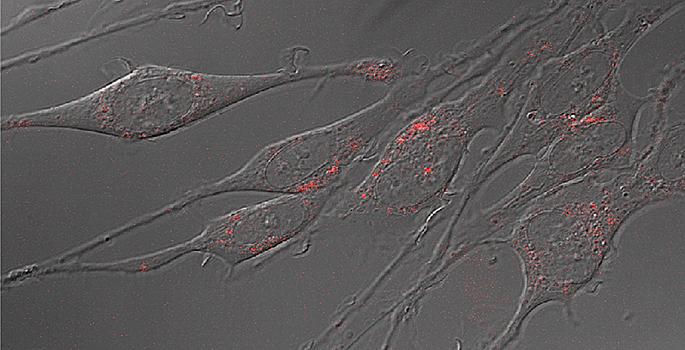
Human cells exhibit foraging behavior like amoebae and bacteria
When cells move about in the body, they follow a complex pattern similar to that which amoebae and bacteria use when searching for food, a team of Vanderbilt researchers have found. -
February 18, 2010
A new type of genetic variation could strengthen natural selection
The unexpected discovery of a new type of genetic variation suggests that natural selection – the force that drives evolution – is both more powerful and more complex than scientists have thought. -
December 21, 2009
TIPSHEET: The future of Pluto and Ceres
Three years ago, when the International Astronomical Union demoted Pluto to dwarf planet status, the unpopular decision was based on personal opinions and professional politics, not on rigorous scientific criteria that can clearly differentiate planets from lesser bodies, points out Vanderbilt astronomer David Weintraub. In the next decade, however, the amount of knowledge that we have about Pluto and another dwarf planet, Ceres, will change dramatically and this new information may affect our views of these objects and their status in the solar system as asteroids, dwarf planets or planets. -
December 18, 2009
Nuclear energy powered by uranium from the sea could promote peace in coming century
One of the best things the world can do to promote peace and stability in the coming century is to expand commercial nuclear power based on the extraction of uranium from the ocean. That is the proposition which Frank Parker, an internationally recognized expert in remediation of radioactively contaminated soil and water and a member of the National Academy of Engineering, advanced at an exclusive meeting held at the Pontifical Academy of Sciences in the Vatican last month. -
December 17, 2009
Astronomer receives NSF award to study black holes’ evolution and to support Fisk-Vanderbilt minority Ph.D. program
Vanderbilt University Assistant Professor of Physics and Astronomy Kelly Holley-Bockelmann has been awarded the National Science Foundation's largest ever Faculty Early Career Development grant in the field of astronomy. She will use the prestigious award to continue her studies of black holes while supporting the university's innovative program designed to make the university the top producer of underrepresented minorities with Ph.D.s in physics and astronomy. -
November 17, 2009
New study confirms exotic electric properties of graphene
First, it was the soccer-ball-shaped molecules dubbed buckyballs. Then it was the cylindrically shaped nanotubes. Now, the hottest new material in physics and nanotechnology is graphene: a remarkably flat molecule made of carbon atoms arranged in hexagonal rings much like molecular chicken wire. -
November 9, 2009
Interdisciplinary research team to develop novel drug detection technology using software that acts like a robotic scientist
With the support of a $2.7 million Recovery Act grant from the National Institute of Drug Abuse (NIDA), an interdisciplinary team headed by Vanderbilt chemist John McLean and physicist John Wikswo will attempt to determine whether an individual's white blood cells retain chemical memories of exposure to drugs like cocaine and alcohol that can be read reliably and unambiguously.