Genotyping Archive — Page 1 of 1

Head-and-shoulders portrait of a smiling man wearing a white medical coat and patterned tie against a brown background.
September 2, 2021

Study shows gene-drug interactions are common

When a drug or combination of drugs causes different responses in different people, genetic variation is often at play. Pharmacogenomics, through discovery of genetic risk and use of clinical genotyping, aims to reduce trial-and-error approaches to drug prescribing.

Young woman in a plaid shirt covers her mouth with one hand while clutching her abdomen with the other, appearing nauseated or unwell.
August 6, 2020

ID of ‘stomach flu’ culprit

Identifying the norovirus genotypes associated with more severe infections in children could guide strain selection for candidate norovirus vaccines.

Portrait of Dan Roden, MD, wearing a suit and patterned tie.
October 24, 2019

Article examines need for genotyping after stenting

Genotyping can improve outcomes in patients who require anti-platelet therapy following stent placement to open narrowed or blocked coronary arteries and prevent a heart attack.

Stylized microscopic illustration of a red cell dividing into two rounded daughter cells against a dark red background.
June 2, 2016

New software tracks cancer mutations, survival

A team at Vanderbilt University Medical Center (VUMC) has developed and tested software that scans electronic health records in real time to monitor cancer patient survival (from time of diagnosis) according to which genes, if any, are found to carry mutations.

genetic sequence
August 6, 2015

Genotyping project to be an ‘engine of discovery’

Vanderbilt University researchers next month will launch a major initiative to acquire “dense genotypes” from 100,000 individuals whose medical histories are known.

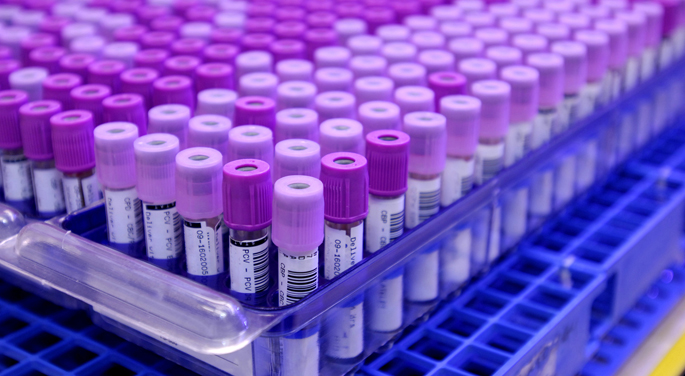
Rows of labeled blood collection tubes with purple caps arranged in a laboratory storage rack.
October 24, 2013

Eskind project seeks to demystify genotyping information for patients

With the aid of a two-year, $487,000 National Leadership Grant from the Institute of Museum and Library Services (IMLS), a Vanderbilt research team will develop a reusable model to promote better patient engagement with the health care team through delivery of consumer-friendly pharmacogenetic information.