


NIH Archive — Page 51 of 93



-
December 22, 2016
Discovery sheds new light on Angelman, Prader-Willi syndromes
A mutation associated with epilepsy and autism also is responsible for a “pale eye” trait in two rare genetic disorders, Angelman syndrome and Prader-Willi syndrome, neuroscientists at Vanderbilt University Medical Center reported this week. -
December 15, 2016
New clues emerge in rare form of childhood epilepsy
Researchers at Vanderbilt University Medical Center (VUMC) are one step closer to understanding what causes early-onset epileptic encephalopathy, a rare form of childhood epilepsy that is difficult to treat and has poor developmental outcomes. -
December 12, 2016
Single-cell analysis of solid tumors
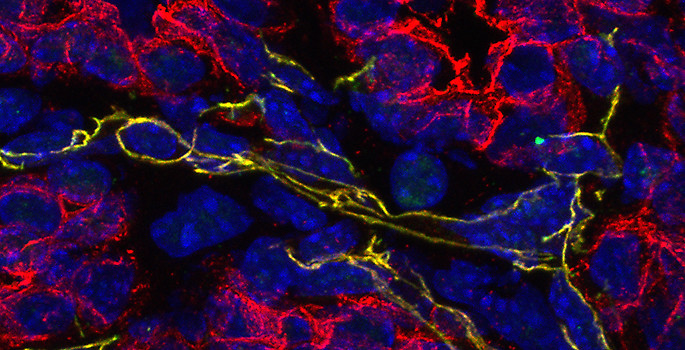
A new method will make it possible to study solid tumors and healthy tissues using mass cytometry. -
December 9, 2016
Protecting the blood-brain barrier
Vanderbilt investigators have discovered how a promising cancer immunotherapy causes brain swelling, findings that could lead to ways to protect brain function while fighting cancers. -
December 8, 2016
Making human beta cells reproduce
A new method developed at Vanderbilt will speed the search for potential therapeutics for diabetes: compounds that stimulate the replication of insulin-producing beta cells. -
December 8, 2016
Plasmin prevents muscle ‘hardening’ after injury: study
Vanderbilt researchers have made the surprising discovery that the protease plasmin, known for its clot-busting role in the blood, protects soft tissue from turning to bone after severe injuries and certain orthopaedic surgeries. -
December 6, 2016
Blood-brain barrier on a chip sheds new light on “silent killer”
A new microfluidic device containing human cells that faithfully mimics the behavior of the blood-brain barrier is providing new insights into brain inflammation, the silent killer.