


Vanderbilt Heart and Vascular Institute Archive — Page 7 of 9



-
August 1, 2013
New technique eases stroke risk for atrial fibrillation patients
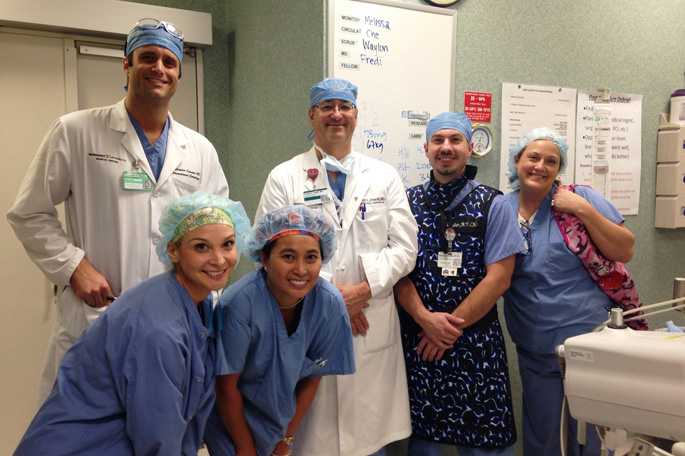
People with the most common irregular heart rhythm known as atrial fibrillation (AF) are at greater risk for stroke due to the formation of clots in the left atrial appendage (LAA), a small pouch which empties blood into the left atrium. -
July 18, 2013
Technology allows bedside look inside patients’ hearts
Vanderbilt Heart and Vascular Institute physicians are taking advantage of new technology in critical care that allows them to quickly visualize the patient’s heart at the bedside. -
May 9, 2013
VHVI repository helps define cardiac disease mechanisms
Peggi Angel, Ph.D., research instructor in Biochemistry, studies congenital aortic valve stenosis in children. It’s a disease where the heart valve, which is normally very thin, becomes bloated with extracellular matrix. This occurs rapidly in some children but not in others. -
April 25, 2013
Cardiovascular Research Day
During Cardiovascular Research Day, keynote speaker Sekar Kathiresan, M.D., second from left, associate professor of Medicine, Harvard Medical School, visits with Vanderbilt Heart and Vascular Institute’s Sergio Fazio, M.D., Ph.D., left, MacRae Linton, M.D., Thomas Wang, M.D., David Harrison, M.D., and Dan Roden, M.D. -
April 25, 2013
Study takes ‘cool’ approach to reducing heart attack damage
Vanderbilt Heart and Vascular Institute is participating in a clinical study to further evaluate the safety and feasibility of rapidly lowering the body’s temperature to significantly reduce the amount of damage caused by a heart attack. -
April 18, 2013
Wang to lead Division of Cardiovascular Medicine
Thomas Wang, M.D., has joined Vanderbilt as director of the Division of Cardiovascular Medicine and the physician-in-chief of the Vanderbilt Heart and Vascular Institute. -
April 11, 2013
Patient undergoes surgical first to treat his arrhythmia
The state of Michael Stanbery’s health was shocking.