Molecular Psychiatry (journal) Archive — Page 1 of 1

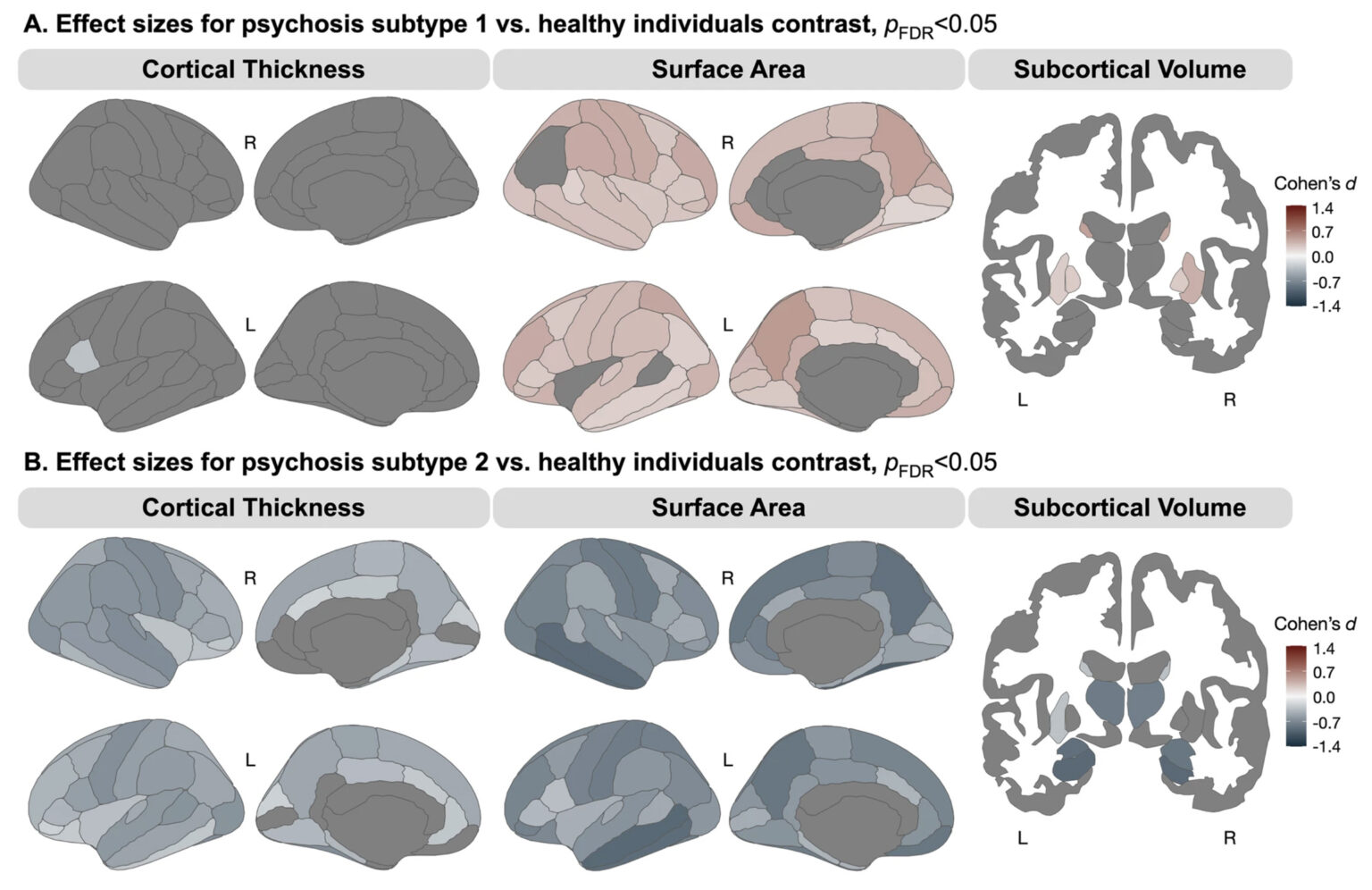
A. Compared to healthy individuals, psychosis subtype 1 demonstrated significantly larger surface area across the cortex and larger basal ganglia volumes. B. Compared to healthy individuals, psychosis subtype 2 demonstrated widespread lower surface area and cortical thickness, and smaller subcortical volumes. (Hill, L.D., et al. Subtyping psychotic disorders using a data-driven approach reveals divergent cortical and cellular signatures. Mol Psychiatry (2026). https://doi.org/10.1038/s41380-026-03774-2. Creative Commons Attribution 4.0 International License: http://creativecommons.org/licenses/by/4.0/. Rights and Permissions: https://tinyurl.com/2e9nxeah.)
August 27, 2026

Brain scan method may improve diagnosis, treatment of psychosis

The study suggests that heterogeneity, or the wide range of symptoms, treatment responses and long-term outcomes observed in patients with various forms of psychosis, may reflect separate illness mechanisms and developmental pathways.

January 31, 2019

Study explores genetic risk for suicide attempt

Using data from the UK Biobank and Vanderbilt’s BioVU, a new study in the journal Molecular Psychiatry finds that approximately 4 percent of suicide attempt risk is captured by genotype data.

January 23, 2015

New view of dopamine heteromers

Although heteromeric dopamine receptors composed of both D1 and D2 subunits have been proposed to play a role in depression and schizophrenia, recent studies suggest these heteromers do not exist.

September 18, 2014

VU study reveals shared pathways in psychiatric disorders

Schizophrenia and bipolar disorder share common genetic underpinnings. Vanderbilt researchers combined high-resolution gene expression studies with gene association data to reveal signaling pathways linked to schizophrenia and bipolar disorder.

March 20, 2014

Study team able to disrupt ‘building blocks’ of behavior

Researchers at Vanderbilt have been able to alter mouse behavior by silencing gene expression in interneurons, distinct populations of nerve cells that are the main regulators of brain circuits.

September 19, 2013

Transporter linked to autism risk

Vanderbilt University investigators for the first time have linked a non-inherited, de novo mutation in the dopamine transporter to autism spectrum disorder (ASD).