Nature Chemical Biology (journal) Archive — Page 1 of 1

Hassane Mchaourab sits at a desk in an office beside two computer monitors, a laptop, and a telephone.
January 6, 2022

Study explores how bacteria become drug resistant

Vanderbilt researchers have revealed more of the inner-workings of a two-stage “molecular motor” in the cell membrane that enables bacteria to become resistant to drugs.

Close-up of pale, branching bacterial colonies growing across a red agar plate.
June 28, 2018

New staph virulence factor

Jun. 28, 2018—The new factor, an enzyme involved in host-pathogen interactions, may be a viable target for treating staph infections.

hamburger and fries
June 2, 2014

Vanderbilt study supports notion ‘You are what you eat’

An international research group led by Vanderbilt University scientists has shown for the first time that a lipid, or fat molecule, can regulate “psychostimulant” behaviors by interacting with a brain protein.

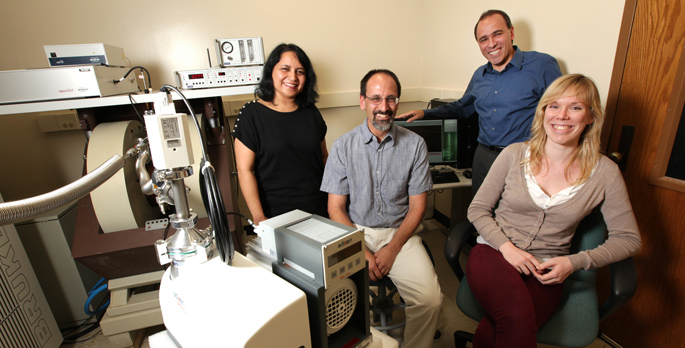
Four researchers pose beside a large DEER spectroscopy instrument in a laboratory; one sits in front of the equipment while three stand behind.
December 12, 2013

Proton transfer powers multidrug resistance: study

Vanderbilt University researchers and their Belgian colleagues have discovered the mechanism behind a multidrug transporter. Their findings, posted this week by Nature Chemical Biology, could lead to new treatments for multidrug resistant bacterial infections.