Vanderbilt Diabetes Research and Training Center (DRTC)

Vanderbilt Diabetes Day celebrates investigational achievements, looks toward future

Vanderbilt Diabetes Day, an annual event that showcases the work of outstanding scientists and researchers in the fields of diabetes, obesity and metabolism was held this month, and it marked the first time many investigators working under the auspices of the Vanderbilt Diabetes Research and Training Center (DRTC) had gathered in one space since the beginning of the COVID-19 pandemic.

International gathering scrutinizes immune response, beta cell biology in Type 1 diabetes

Team members involved in the study include, from left, Melissa Hilmes, MD, Daniel Moore, MD, PhD, Alvin Powers, MD, Jon Williams, PhD, and Jack Virostko, PhD. (photo by Jessica Kimber)

Study proves standardized protocol can support reliable MRI use for multisite pancreatic research

Researchers with the Vanderbilt Diabetes Research and Training Center (DRTC) at Vanderbilt University Medical Center led a multisite study which has demonstrated that, when controlled and standardized, quantitative magnetic resonance imaging (MRI) of the pancreas is highly reproducible when using different MRI hardware and software at different geographic locations.

Insulin in vials

Beta cell regeneration

Vanderbilt researchers dissected the complex microenvironment of the pancreatic islet to discover the signals that drive beta cell regeneration — as a possible treatment for diabetes.

Pancreatlas provides access to complex images of the human pancreas

Images of cells and tissues are a critical part of biomedical research as they show which molecules or proteins are present and where these molecules are located in the tissue. Using increasingly sophisticated microscopes and imaging approaches, scientists can now look at more than 40 different molecules at once, an approach known as multi-plex imaging, where in the past they could only look at three or four molecules at a time.

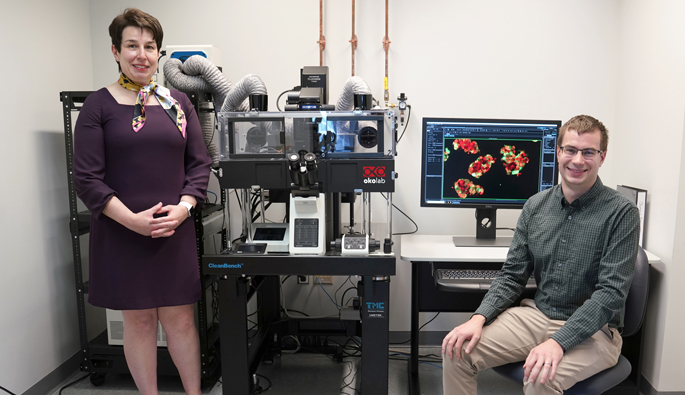
Marcela Brissova, PhD, and MD/PhD student John “Jack” Walker are part of the research team that developed a pseudoislet system for integrated studies of human islet function.

Pseudoislet system expected to advance pancreas and diabetes research

The multicellular, 3-D structure of human pancreatic islets — the areas of the pancreas containing hormone-producing or endocrine cells — has presented challenges to researchers as they study and manipulate these cells’ function, but Vanderbilt University Medical Center researchers have now developed a pseudoislet system that allows for much easier study of islet function.

1 2 3