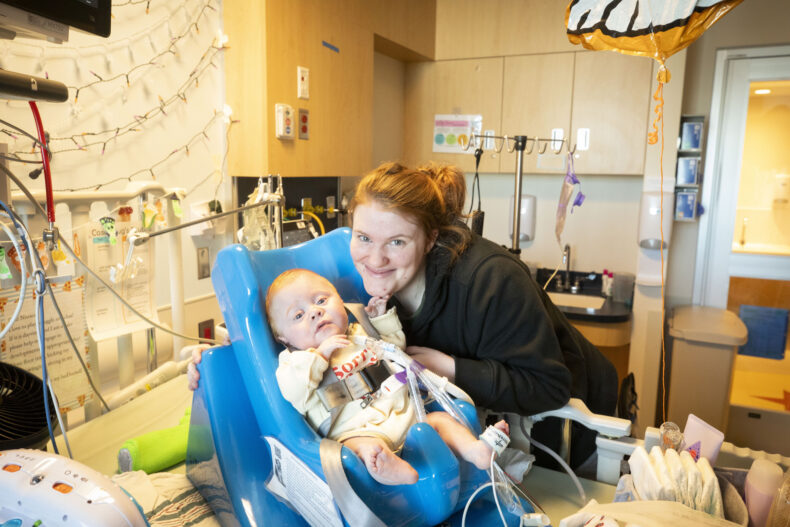
 Sheridan Clawson and her son, Casey, in the NICU at Monroe Carell Jr. Children’s Hospital at Vanderbilt. (photo by Susan Urmy)




Monroe Carell Jr. Children’s Hospital at Vanderbilt has long been a place where novel, cutting-edge care and medical milestones happen.
Sheridan Clawson credits the hospital for her son’s survival.
Casey Clawson was born Jan. 30 at 26 weeks gestation and weighing 420 grams (less than 1 pound). After spending his first two months in an East Tennessee hospital, he was transferred to Monroe Carell for specialized care to treat bronchopulmonary dysplasia (BPD), also called neonatal chronic lung disease.
Monroe Carell is home to a Level IV-designated Neonatal Intensive Care Unit (NICU), one of the largest and considered among the best in the country, treating an estimated 1,500 infants a year.
Over the past two decades, there has been a steady increase in the number of patients born preterm who are transferred to Monroe Carell with severe lung disease requiring highly specialized care that only a few hospitals in the country can provide.
In August, Monroe Carell opened the Complex Infant Lung and Airway Disease Program in the NICU. This program is housed in a special unit developed specifically for this population of infants and their specialized needs. Families in this unit have children with BPD, pulmonary hypertension, and/or congenital malformations of the large airways of the lungs.
The 15-bed unit is already full.
“Much of that can be attributed to the fact that we have become a referral center for this population of patients because of the expertise of our pediatric surgical, pulmonary and ENT (ear, nose and throat) colleagues,” said Dupree Hatch, MD, MPH, associate professor of Pediatrics and medical director of the NICU. “We have been providing this type of care for decades. In the past 10 years, we have seen a consistent growth in the volumes of older patients in the NICU with severe lung or airway disease.
“We needed a unit that would specialize in the care for this specific patient population from a developmental and a respiratory standpoint.”
About 25% of infants born at a gestational age of 22 to 32 weeks — two to four months early — develop BPD, a life-threatening chronic lung disease that requires respiratory support and oxygen to help them breathe. Over the last three years, the babies born at 22 weeks gestation have had a 52% survival rate at Monroe Carell, which is comparable to other U.S. NICUs specializing in treating the tiniest babies at the limits of viability.
Patients with BPD often have some of the longest hospitalizations. Patients in the unit range from 4 months to 2 years old, with most requiring tracheostomies or long-term mechanical ventilation before their discharge home.
“This specialized unit will better enable us to focus as a team on those premature infants who require the most resources to get home,” said Paul Moore, MD, professor of Pediatrics and director of Pediatric Allergy, Immunology and Pulmonary Medicine at Monroe Carell.
“This collaboration with neonatology, pulmonary, otolaryngology and other disciplines (including respiratory therapy, social work and case management) facilitates state-of-the-art care,” added Moore, who holds the Dr. John Moore Lee and Janie Robinson Directorship in Pediatrics.
Care teams have been planning for this unit for nearly four years. Thanks to the generosity of Scott and Sandi Borchetta, resources allowed for an expansion of the NICU space and services. Currently housed on the 12th floor, the unit will ultimately move to the recently completed 14th floor, which will be named the Scott & Sandi Borchetta Floor.
The design of the unit has allowed patients, families and specialists to be in one space providing coordinated care, support for long-term neurodevelopment outcomes, and a community for families dealing with similar issues.
“We understand that the kind of care we envision is not for every hospital,” said Susan Guttentag, MD, the Julia Carell Stadler Professor of Pediatrics and director of the Mildred Stahlman Division of Neonatology. “We have a deep expertise in the kinds of airway conditions that can result from long-term endotracheal breathing tubes as well as a depth of knowledge in the management of more serious, chronic lung tissue disease.
“Advances in the care of preemies and the care coordination to safely shorten hospitalization enable more of them to go home with their families to live happy and productive lives.”
Due to the high volume of referrals coming to Monroe Carell for this kind of specialized care, the NICU will also house what is being referred to as a Neonatal Command Center. This additional component will allow the care team to engage in remote care consults with prospective families prior to their arrival in the unit and will act as a vehicle for physicians at Monroe Carell to offer their expertise to other centers seeking opinions on the management of patients with these diseases.
Most of the children who will be hospitalized in the new unit are not local. While the NICU frequently cares for patients from across Tennessee, as well as Kentucky, Alabama and Mississippi, it is seeing a growing number of patients from South Carolina and Virgina referred to Monroe Carell because of prenatal abnormalities or postnatal disease.
“The command center will allow us to build a technological infrastructure that will connect families with the teams who will be caring for their child,” said Hatch. “We want to be able to provide as smooth of a path or transition into the unit as possible.”
Another advantage of the new space is the ability of parents to stay with their child in the room.
Clawson applauds the staff and the top-notch care her son is receiving, and she finds comfort in the other families surrounding her on the unit, she said.
“The main thing about this unit, besides the incredible medical care, is that I can sleep here,” said Clawson. “I can stay right here with him and learn everything I need to about his trach(eostomy), his feedings, how to care for him. I am able to be right here by his side.”
Having a host of support has been a welcome addition too, she said.
“He is getting amazing care here. What’s nice is that they help me too. And to see other families going through the same things that you are … that’s been really good for me to talk to them.
“And for Casey, he loves sitting at his door and looking out. He sees other kids like him. We do that often!”
Now 9 months old, Casey is expected to be discharged in the next month.
Clawson has completed her training for tracheostomy changes and is learning how to operate the home ventilator and feeding pump. Once Casey is weaned off his IV medications and Clawson successfully fulfills a 72-hour required independent stay with her son in the hospital, the family will inch closer to home.