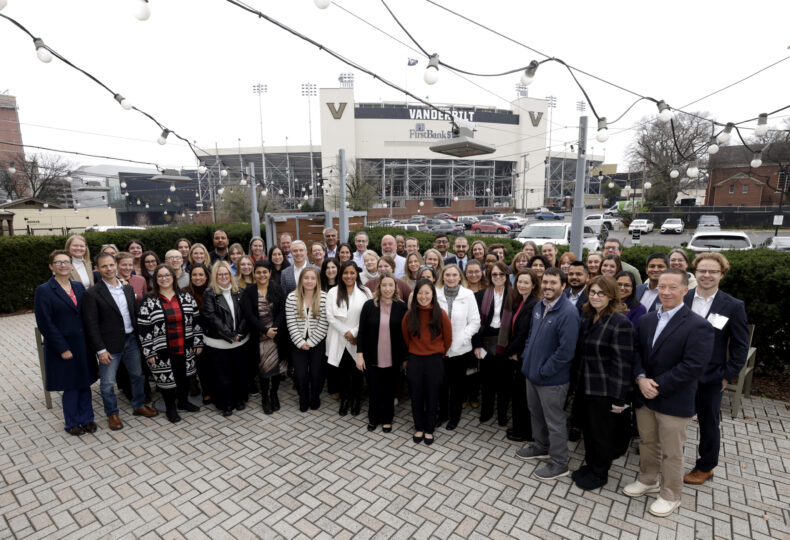
 Investigative teams from throughout the United States have joined forces for a study, REVERSE-LC, led by Vanderbilt Health. The study, which is now enrolling, is evaluating the efficacy of the immunomodulatory drug baricitinib for treating the persistent neurological and cardiopulmonary symptoms of long COVID. (photo by Donn Jones)




Since the virus that causes COVID-19 emerged in late 2019, there have been over 780 million cases worldwide and over 7 million deaths. Despite the development of vaccines and effective therapeutics, millions of patients experience an often-devastating, post-acute infection syndrome known as long COVID (LC).
In the United States, it is estimated that up to 20 million adults with LC experience persistent neurocognitive impairments (NCI) and cardiopulmonary symptoms such as dyspnea (shortness of breath) and exercise intolerance for months to years after having COVID-19. The public health burden of LC is estimated to be the largest seen from an emerging disease in the past century, yet there remain no effective interventions.
In 2024, Vanderbilt Health investigators received funding from the National Institute on Aging (NIA) for a phase 3, multicenter, placebo-controlled trial to evaluate the efficacy of the immunomodulatory drug baricitinib for treating the persistent neurological and cardiopulmonary symptoms of long COVID.
Baricitinib is a Janus kinase (JAK) inhibitor that received FDA-approval to treat acute COVID-19 following a randomized, controlled trial designed and run by an international team including Vanderbilt Health physician-scientist and senior author, E. Wesley Ely, MD, MPH. Ely is the principal investigator for this new LC trial, and patients are being enrolled at Vanderbilt Health and collaborating institutions Emory University, University of Minnesota Twin Cities-Minneapolis and University of California San Francisco.
The Randomized Double-Blind Placebo-Controlled Trial EValuating Baricitinib on PERSistent NEurologic and Cardiopulmonary symptoms of Long COVID (REVERSE-LC) has now received additional funding from the National Institute of Allergy and Infectious Diseases (NIAID) program called RECOVER-Treating Long COVID (RECOVER-TLC) to expand the investigation by working with the NIA to add 13 more enrolling sites throughout the United States.
“It is very encouraging that both NIH institutes, the NIA and NIAID, are partnering to get answers faster for those who are suffering,” said Ely, the Grant W. Liddle Professor and co-director of the Critical Illness, Brain Dysfunction and Survivorship (CIBS) Center.
This expansion is being led by the collective leadership at the CIBS Center and the Vanderbilt Coordinating Center (VCC).
“Our 13 expansion sites worked closely with the VCC, led by (VCC co-director) Jessica Collins and our funders to rapidly accelerate the site-activation process,” said Sean Collins, MD, MSc, professor of Emergency Medicine and co-medical director of the VCC. “Through this combined effort we were able to host a training meeting and open sites in less than two months. The enthusiasm of this great group of people is being carried forward to enrollment, and we are hopeful we will finish the study early and provide critical answers about the impact of baricitinib on LC.”
Collins, who holds the Clinical Directorship for Emergency Medicine Research, is the contact PI for the NIAID expansion.
During a recent organizational meeting at Vanderbilt, Ely told the collaborating scientists, “This is about building a community of like-minded people who are pursuing both great science and humanism. This is the first time in over a century that we have enough patients at the same time with a single IACC (infection-associated chronic condition) to conduct large trials such as REVERSE-LC.
“Long COVID is a massive yet under-recognized global public health problem. Through this premier, high-touch, multicenter trial, we aim to reduce the gap of knowledge regarding this multisystem disease that can be so devastating to the long-term wellbeing of millions.”
According to the National Academies of Sciences, Engineering, and Medicine definition, long COVID is an IACC that occurs after having COVID-19, with symptoms present for at least three months, which can be relapsing and remitting or progressive and can affect one or more organ systems.
“A leading hypothesis is that long COVID could be caused by viral reservoirs or areas of dormant virus that can evade detection in the body and cause ongoing inflammation, but few large-scale clinical trials to date have tested treatments aimed specifically at immunomodulation,” said Ely.
“Importantly, even when there is no active infection, many of these same health problems may be caused by a similar state of chronic inflammation. The Janus kinase (JAK)-STAT pathway has been shown to drive this inflammatory response and is linked to heart disease, cognitive issues and persistent viral reservoirs.”
REVERSE-LC will include 550 adults 18 and older who have experienced at least one long Covid symptom that is new or has worsened following a confirmed COVID-19 infection. Participants will either receive baricitinib or a placebo. The year-long study will assess the impact of baricitinib on brain function, heart and lung function, and overall quality of life. After baseline, multiple assessments will be taken at three, six and 12 months.
The added sites are Brigham and Women’s Hospital, MetroHealth in Cleveland, Ohio, New York University Langone Health, Swedish Health Services in Seattle, Washington, University of Arizona, University of California Los Angeles, University of Colorado Anschutz, University of Florida, University Hospitals Cleveland Medical Center at Case Western Reserve University, University of Illinois Chicago, University of Texas at San Antonio, West Virginia University, and Yale University. Stanford University is a scientific support site (non-enrolling).
Visit the REVERSE LC website to learn more about the trial and how to participate. The research is supported by NIH grants R01AG085873 and NHLBI 1OT2HL156812-01.