


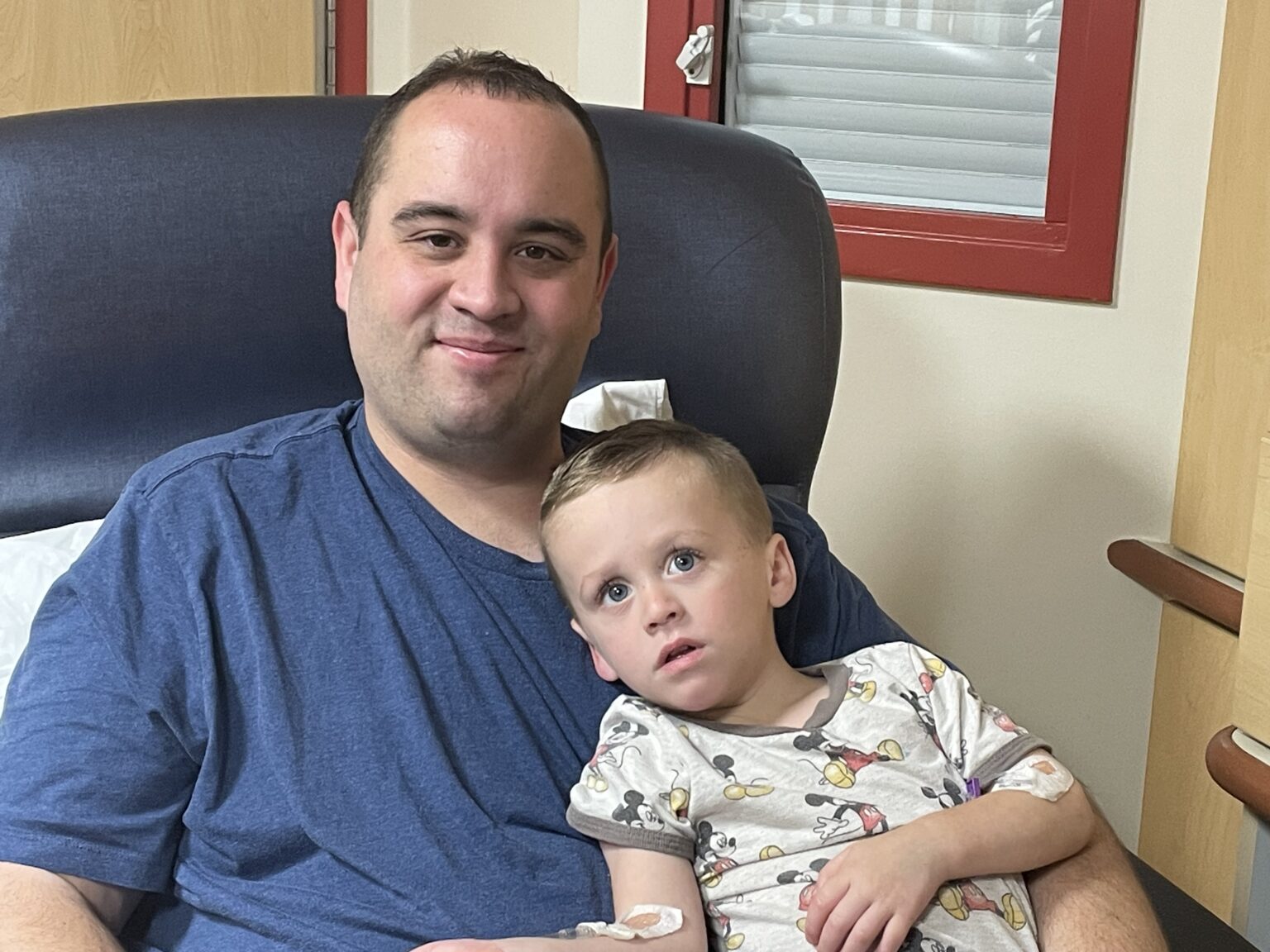
 Tristen Pierrot and his son Bennett. (photo by Jessica Pasley)

Tristen Pierrot never imagined he would need to use his skills as an EMT for his own child.
While preparing for an outdoor birthday party for his 5-year-old daughter, Pierrot’s 2-year-old son, Bennett, went missing.
He was found at the bottom of the family’s pool — blue, lifeless and with a stomach full of water.
Pierrot immediately began CPR on his son.
“He had no pulse, no heartbeat. He was not breathing,” recalled Pierrot. “After the first round of CPR, my stepfather took over so I could blow water out of his lungs.
“I did that twice and there had to have been two 12-ounce bottles of water that came out. It was unreal. I started CPR again and that is when I felt a heartbeat.”
As a family of EMTs and owners of Med-Star Medical Staffing, an EMT and paramedic staffing agency, the Pierrots, who live in Lewisburg in Marshall County, had resuscitation equipment including Ambu bags and oxygen tanks available to assist with life-saving efforts.
“When he woke up, you could see it in his eyes that he was OK.”
Emergency crews whisked Bennett to a nearby field where he was intubated and taken by a LifeFlight helicopter to Monroe Carell Jr. Children’s Hospital at Vanderbilt where he spent three days in the Pediatric ICU on a ventilator. He was recently transferred to a regular floor of the hospital to continue his recovery. The family expects to head home in a few days.
“He is an absolute miracle,” gushed Pierrot. “When he woke up, you could see it in his eyes that he was OK. And then the MRI came back and showed no brain damage, no deficits at all. It’s just unheard of.
“We’ve been told by multiple people that this kind of outcome is so rare. Most children who go through what he did are not up and walking. They are going to rehab.”
Every year in the United States, an estimated 4,000 people die from unintentional drowning. Tennessee statistics:
- Drowning is the leading cause of unintentional injury-related death for children ages 1 to 4 in Tennessee.
- State health records indicate roughly 21 to 22 child drownings occur annually.
- The rate of child drownings in Tennessee is 2.2 deaths per 100,000 children, which is nearly double the national average.
Trauma experts at Monroe Carell said the Pierrots’ story is a reminder of how quickly these tragedies can happen.
“The earlier a drowning is recognized, the better the outcome,” said Meredith Montgomery, MD, a clinical fellow in Pediatric Emergency Medicine at Monroe Carell. “It truly can be the difference between life and death. The reason drowning can have such devastating consequences is because the brain isn’t getting enough oxygen. The longer the brain goes without oxygen, the greater the risk of permanent brain injury.
“The family, the bystanders and the EMS crew are the true heroes in Bennett’s story. Their quick actions made all the difference,” she said.
Safety experts at Monroe Carell urge caregivers and adults to be mindful of the ABCs of water safety:
A – Adult supervision
- Active adult supervision is the most important water safety rule. At least one adult should be focused on the pool and close enough to touch the swimmers if necessary.
- Designate an adult “water watcher.” This person’s sole responsibility is to watch the pool area for 15 minutes and not read or talk on the phone. After 15 minutes, pass the responsibility to another adult for 15 minutes, and so forth. Ensure that the “water watcher” is a sober adult who knows CPR and has basic swimming skills.
- “Floaties” (inflatable armbands) or other inflatable flotation devices are not life jackets and are not a substitute for adult supervision.
B – Barriers and boating safety
- Have a properly working physical barrier such as a fence, pool safety cover and pool alarm (one meeting code requirements).
- If the home opens directly to the pool, install door alarms and locks.
- Always swim at a lifeguarded beach and pay attention to the beach warning flags.
- On a boat, wear properly fitted U.S. Coast Guard-approved life jackets.
C – Classes
- Teach children to swim. The American Academy of Pediatrics recommends swimming lessons for children as young as 1.
- Adults and children who are 13 and older should learn infant and child CPR.
“In Bennett’s case, the immediate CPR provided by his family gave him the best possible chance while EMS was on the way,” Montgomery said. “It’s a powerful example of the difference that CPR training can make.”
Pierrot knows things could have been very different if CPR was not immediately initiated.
“One of my biggest messages is for people to learn CPR,” he said. “Classes are so assessable. Lots of parents would be in sheer shock and maybe not know what to do. Or maybe they attempt CPR but are not doing it correctly. It’s hard when there is a traumatic situation, and there’s a lot going on.
“We were able to begin CPR so quickly and get oxygen restored to his brain … we had a good outcome.”
Pierrot said the family takes precautionary measures with their pool — removing the steps to limit access and requiring their children to wear life vests.
“It only takes minutes for a child to drown, which is why active adult supervision, pool safety measures, and learning CPR are all so important,” added Montgomery.


