


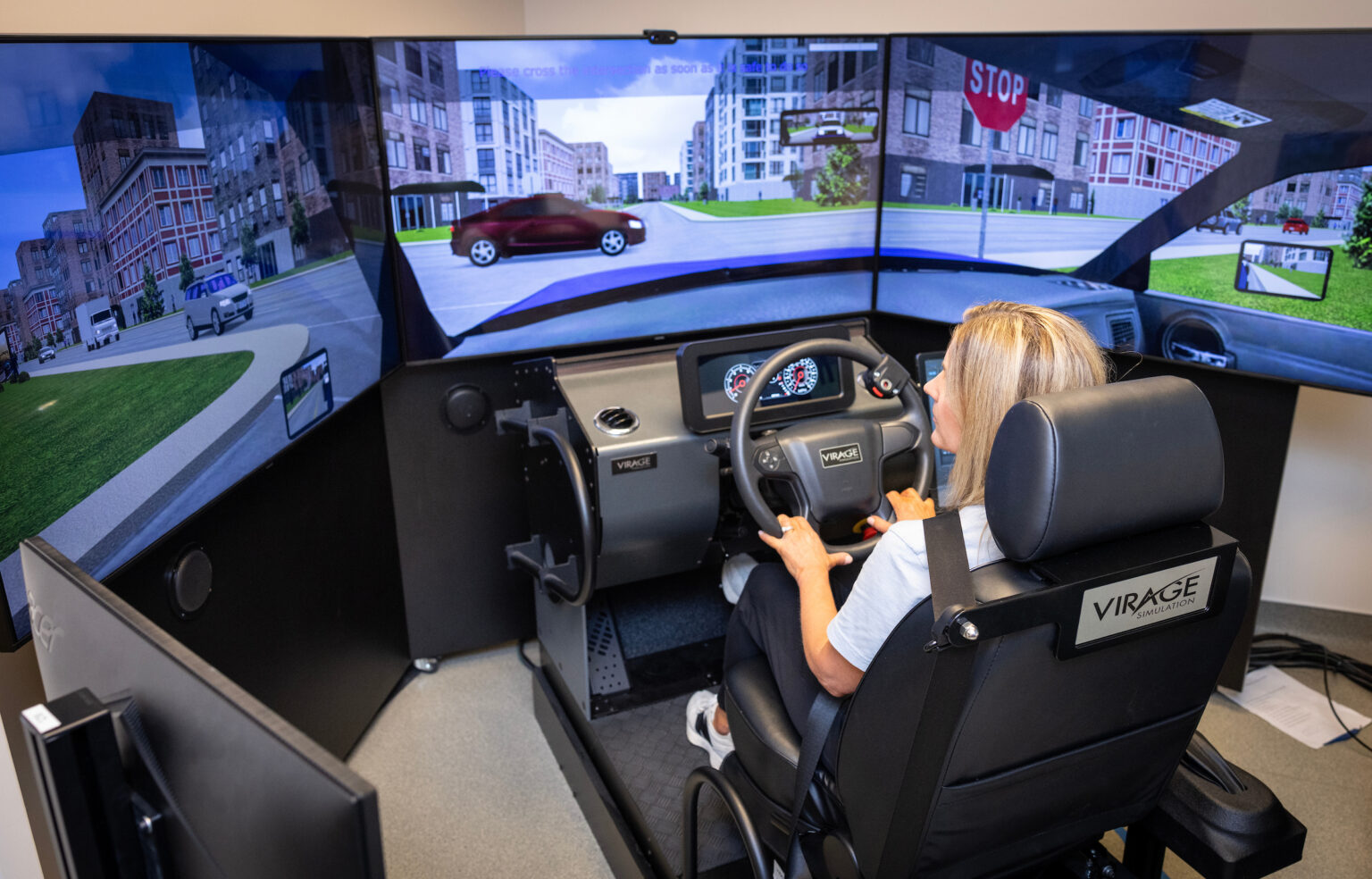
 The driving simulator is highly immersive, with motion effects and tactile feedback, such as vibrating if the driver jumps a curb or slams on the brakes. (photo by Erin O. Smith)

Returning to a normal lifestyle after a life-altering injury is difficult enough. Adding in the challenge of driving — whether starting from scratch, making modifications to a vehicle or relearning motor function (in multiple senses of the word) — can make the task seem insurmountable. Driving rehabilitation is an aspect of the recovery process for some patients that can present more of a challenge than one might realize.
Changes in physical, visual and cognitive function can all contribute to changes in driving capability and even jeopardize driver safety. That’s why it’s important for patients to rehabilitate their driving skills in addition to standard physical, speech-language or occupational therapy after an injury.
The Pi Beta Phi Rehabilitation Institute at Vanderbilt Bill Wilkerson Center, which aims to help patients recover from central nervous system disorders, has had a driving rehabilitation program since the 1990s. This year, with a grant from General Motors, the institute added a driving simulator to its list of offerings for patient rehabilitation.
“Vanderbilt Health has a long-standing commitment to driving rehabilitation, and we’re proud our grant helped expand that care with a simulator,” said Anton Busuttil, Plant Executive Director of GM Spring Hill Vehicle Assembly. “It gives patients a safe way to reintroduce real-world driving scenarios — from simple routes to more complex conditions — while clinicians guide progress toward a confident return to the road.
“Safety is our overriding priority at GM. We are honored to support an innovative program that gives patients the ability to rebuild skills and confidence to drive safely after injury or illness.”
The support from General Motors also allowed the team to ensure the simulator could reach its full potential as a rehabilitation mechanism.
And to complement the grant, the Pi Beta Phi Alumnae Club also covered a significant portion of the expense through donations made possible by the Department of Hearing and Speech Sciences’ annual Christmas Village fundraiser.
“I think that additional funding shows a belief in the work we’re doing,” said Kristy Weissling, SLPD, CCC-SLP, Professor of Clinical Hearing and Speech Sciences and Director of Pi Beta Phi Rehabilitation Institute.
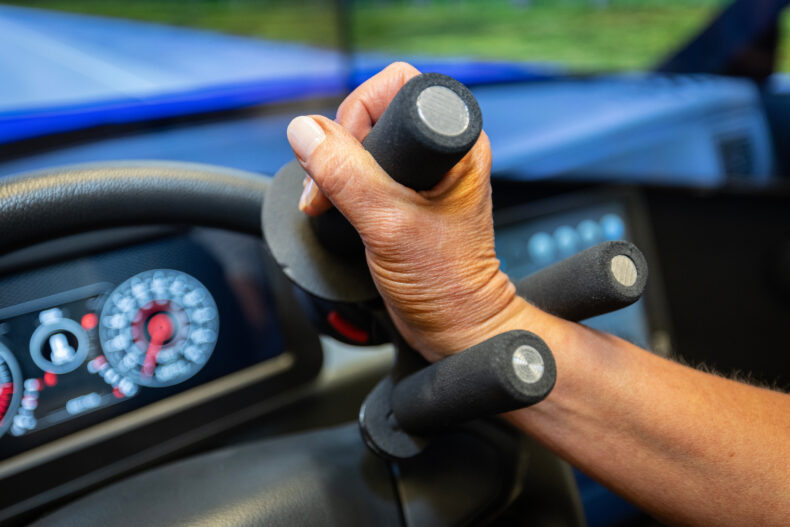
A driving simulator can help a patient adjust to any necessary alterations to the vehicle in which they’ll be behind the wheel when the time comes to get back on the road. It’s possible they won’t be behind the wheel, per se: Perhaps they’ll be behind a pair of hand controls, or using handles attached to the wheel. It’s all about meeting a recovering patient where their needs are to ensure a safe experience for them and their fellow drivers.
“Part of the benefit of this driving simulator is that it’s infinitely customizable to meet a patient’s needs,” said Mike de Riesthal, PhD, CCC-SLP, Professor of Hearing and Speech Sciences. “This program has become one of the more popular programs among Vanderbilt physicians because of the service it provides. It essentially evaluates driver safety for individuals with a variety of medical conditions that might affect their driving.”
The simulator is highly immersive: To begin a training session, patients climb into a standard driver’s seat, buckle in, turn the ignition with a key and begin the scenario. They can even adjust the air conditioning that will blow on their faces the way it would when starting a real car on a hot summer day.
Drivers experience motion effects, which can be turned on or off depending on how immersive the experience needs to be and whether the patient has motion sensitivity. The settings can also be adjusted to give the patient tactile feedback, such as vibrating if the driver jumps a curb or slams on the brakes.
“Research shows, especially with the stroke population, that when a patient works on a simulator first, they’re more than 50% more likely to pass the road assessment,” said Christy Horner, OTR/L, certified driver rehabilitation specialist. “This simulator allows us to look at driving in a controlled environment. … It’s made a world of difference to have something that feels more akin to a real-world scenario.”
The clinical value of the simulator is twofold: physical safety and mental self-efficacy. From a safety point of view, the goal is clear: get a patient into an ideal approximation of a setting in which they’ll find themselves when their rehabilitation is complete, and get them as acclimated as possible to that environment. But subjectively, too, patients who have gone without driving due to a life-altering injury can feel as though they’ve suffered a genuine loss, and Weissling said getting back on the road, if appropriate, can be a major boon for the emotional aspect of recovery.
“Driving is very related to independence in our culture in the United States. We’re drivers,” she said. “If you think about getting to appointments and being able to go grocery shopping when you want to, it’s a big part of what our patients experience.”
There’s also a great deal of academic value, as Weissling said that in the future, the clinical research team heading the program hopes to publish literature on the value of using a driving simulator as part of speech-language therapy for recovering patients.
What may not be immediately obvious to someone on the outside, though, is what kind of connection exists between driver rehabilitation and Hearing and Speech Sciences in the first place. But as de Riesthal explains, interdisciplinary work drives the program.
“The program was started by occupational therapists at Pi Beta Phi Rehabilitation Institute, and they have encouraged collaboration across disciplines in preparing some patients for return to driving,” said de Riesthal.
The disciplines that intersect at Pi Beta Phi Rehabilitation Institute — speech-language, occupational and physical therapy — are all rooted in cognition, which translates directly to a patient’s capability in a context such as operating a vehicle.
“What is uncommon and forward-thinking about the Hearing and Speech Sciences program at Vanderbilt is that we actually have our hands in speech-language pathology across many different parts of the Medical Center,” said Weissling. “But we also have this unique aspect of the Pi Beta Phi Rehabilitation Institute, which started out as the first outpatient neurorehabilitation unit at Vanderbilt Health, complete with occupational, physical and speech therapy. … That clinic really fits into our department’s mission of applying the care our clinicians provide across multiple disciplines.”