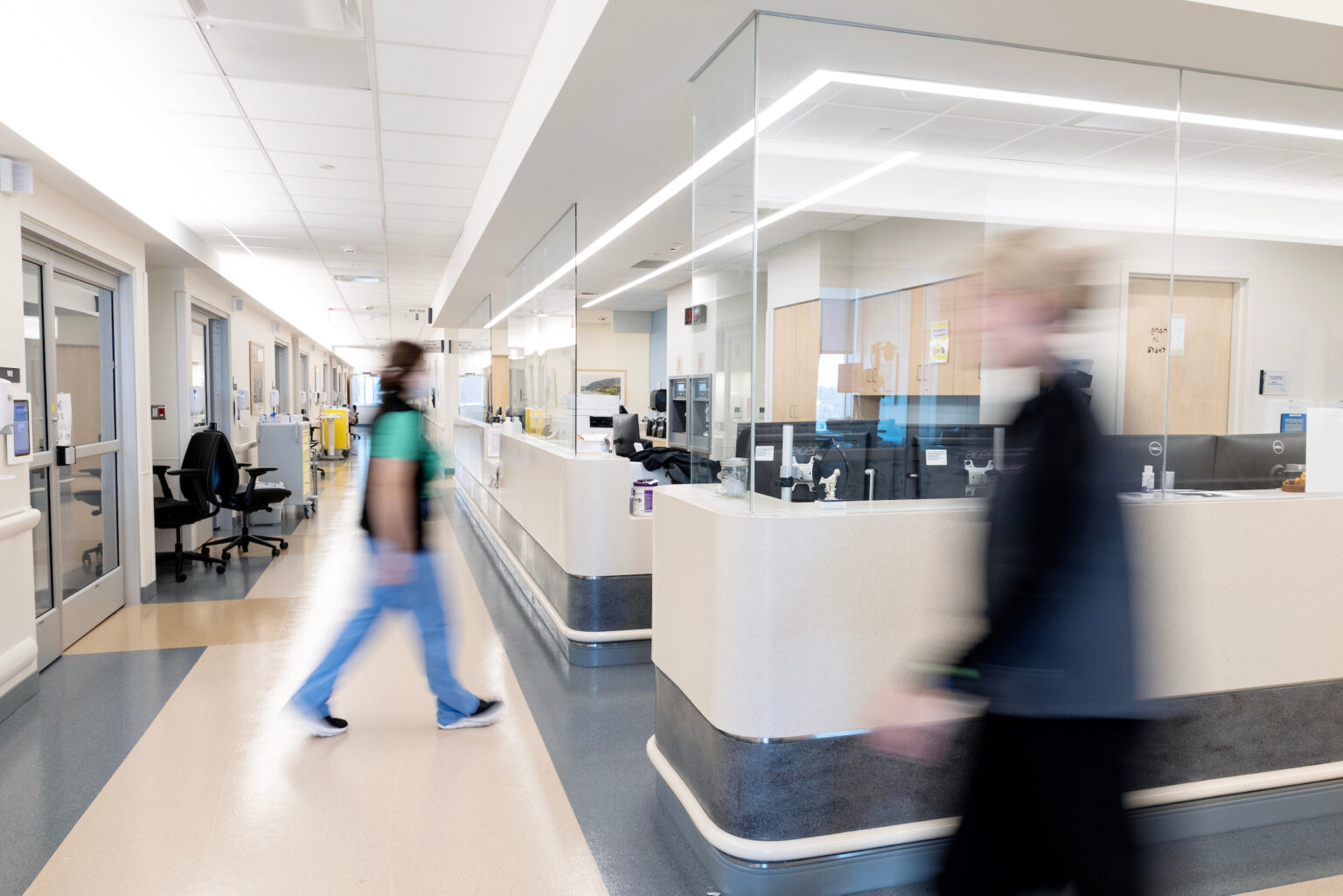
 Nurses walk past a nursing station on the ninth floor of the Jim Ayers Tower on the Vanderbilt Health Main Campus in Nashville. (photo by Erin O. Smith)

Nurses are foundational to delivering consistent precision care to patients, however, 40% nationwide reported in 2025 they anticipate leaving health care in the next five years. They’re experiencing burnout and seeking healthier work-life balance through flexible work models that offer variety and professional skill growth.
To better support nurse well-being and staffing needs, Vanderbilt Health Nursing launched the Vanderbilt Staffing Collaborative (VSC), a program reshaping conventional staffing approaches to meet today’s evolving nursing workforce needs.
“We asked our own nurses, ‘What’s important to you,’ and many gave feedback that they wanted to work in a different way. Additionally, our nurse leaders wanted a resource that supported employees on the unit by filling scheduling gaps and reduced reliance on outside labor sources,” said Erin Tickle, DNP, MMHC, RN, Associate Nurse Executive, Nursing Strategy and System Integration.
VSC hires and manages employees assigned to fill short-term staffing roles within the Vanderbilt Health system through two divisions, resource pool and TempForce. Resource pool employees work per diem, helping to fill various unit scheduling gaps as needed, spanning specialties and location. TempForce employees are placed in longer-term positions, working on the same team for a 13-week period or longer, to support units with extended vacancies.
Launched in late 2022, the collaborative was initially expected to hire 75 inpatient nurses with a focus on adult inpatient care. Due to its successful implementation and growing demand, that number quickly increased to 200 staff. VSC now employs over 300 workers.
By providing greater staffing stability, the VSC equips nursing leaders with scheduling alternatives that reduce mandatory overtime and on-call shifts for their teams.
The flexible scheduling models in the collaborative also engaged a previously untapped workforce of health care professionals unable to accommodate traditional nursing schedules. In addition to attracting new workers, the program serves as a pathway for permanent employment, with approximately 180 individuals transitioning into full-time positions since the program started.
“In engaging new members of the workforce, they experienced our culture and what it looks like to work at and be part of Vanderbilt Health. Through that, it’s been a successful mechanism for converting VSC employees to full-time staff. We didn’t realize how significant that would be in creating an employment pipeline,” said Tickle.
Beyond inpatient nursing, VSC has now expanded to include operating room nurses, surgical technicians, surgical first assistants, licensed practical nurses, and respiratory therapists in inpatient and ambulatory locations.
In early 2026, the collaborative partnered with community nursing programs to introduce Student Nurse Care Partners roles, currently employing 54 students at Vanderbilt University Hospital and Vanderbilt Clarksville Hospital.
“We’ve been able to engage with our community schools, offering opportunities to shadow different nursing expertise, develop clinical skills and hopefully welcome them to Vanderbilt Health as full-time nurses in the future,” said Alexandria Melton, MSN, RN, CPN, Director, Staffing Collaborative.
“Ten years ago, you would never think nursing would have this opportunity, but this collaborative has been so successful because Vanderbilt Health Nursing has a culture dedicated to innovation,” said Melton. “It encourages us to challenge our ways of thinking and create new solutions for how we care for our peers and patients.”