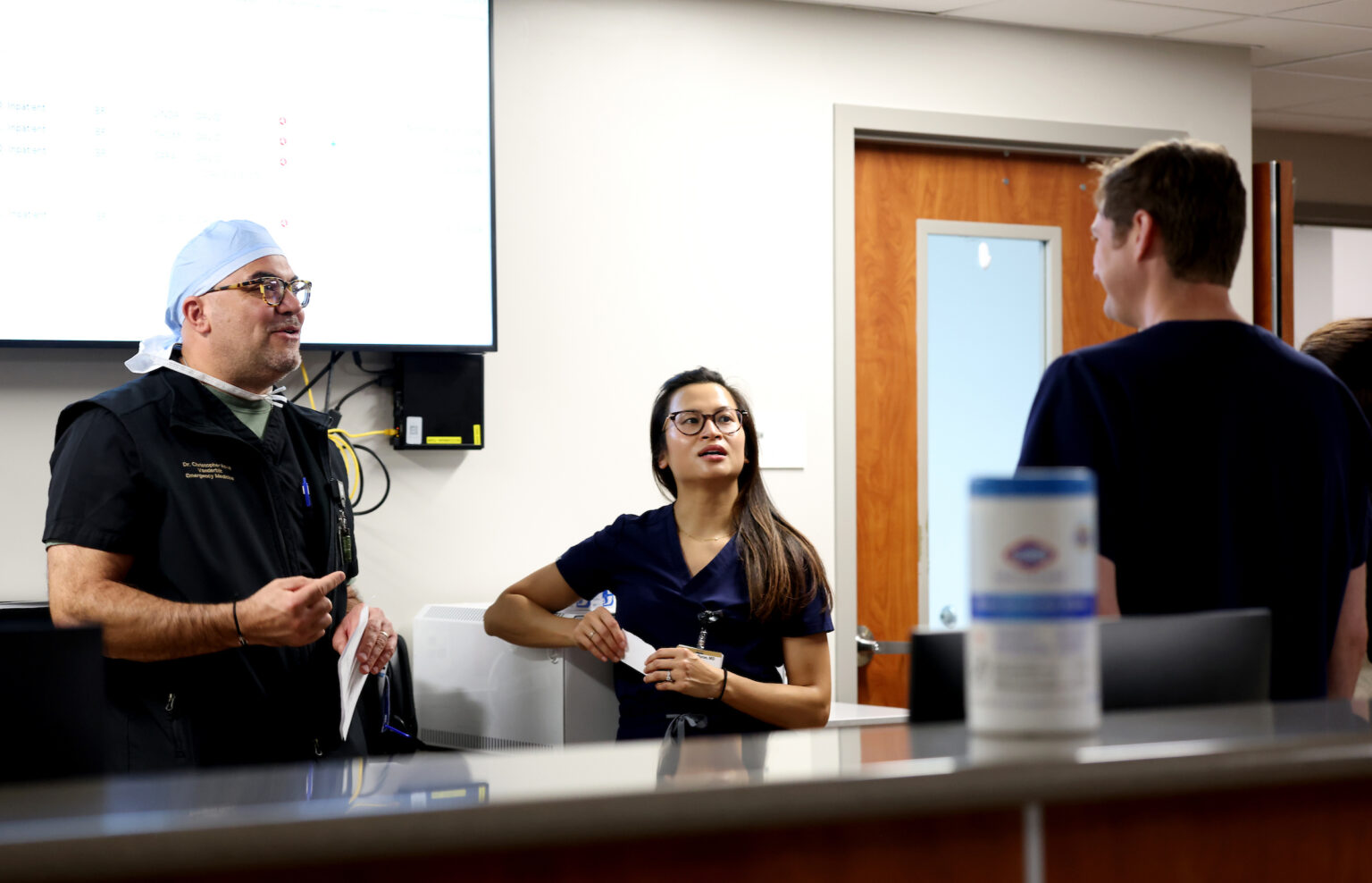
 An ICU/PCU care team in Vanderbilt Tullahoma-Harton Hospital discuss the afternoon's schedule. Vanderbilt Health's Center for Patient and Professional Advocacy kicked off its accountability programs at the Regional Hospitals a few years ago. (photo by Donn Jones)
The Center for Patient and Professional Advocacy’s expansion into Vanderbilt Health’s growing network adapts the tools built over three decades at the Main Campus — including the Coworker Observation Reporting System (CORS) and Patient Advocacy Reporting System (PARS) — to fit each community. CPPA is a cornerstone of health care culture transformation, serving more than 300 sites in 29 states, Australia and other countries encompassing more than 225,000 clinicians.
On Sept. 1, Vanderbilt Clarksville Hospital becomes the latest, rolling out CORS and related programs for physicians, advanced practice providers and nurses. CPPA’s model already reaches hundreds of thousands of clinicians nationally and internationally, and partner sites like Mount Sinai Health System have achieved share rates for professionalism concerns as high as 94%.
Ahead of the Clarksville launch, William Cooper, MD, MPH, Senior Vice President for Professionalism and Clinical Excellence and President of CPPA, and Celeste Hemingway, MD, MHPE, Vice Chair of Education in the Department of Obstetrics and Gynecology and CPPA Faculty, talk about what the program accomplished at the hospitals that came before it.
Q: Where does CPPA currently have a presence among the Vanderbilt Health system, and what’s on deck for Clarksville?
Hemingway: CPPA has a presence — at Wilson County, at Tullahoma-Harton and at Bedford. And our program, which gives nonpunitive feedback to colleagues by trained messengers, has been present at all of those sites. After they became part of Vanderbilt Health, we worked with their teams and were able to roll out those programs at all of the programs at each of the Regional Hospitals. Now those programs are very strong in all of those locations, and we do CORS for physicians, APPs and nurses at all of those locations.
On Sept. 1, Clarksville will join officially and roll out its CPPA programs for physicians, APPs and nurses. So we’re excited about that.
Cooper: What I would add is this is really about the Vanderbilt Health Credo. One of the things we’ve really tried to do is engage with the hospitals as a part of our shared commitment to delivering the best care, but also to make this the best place to work. We have developed tools and processes over the last 30 years to ensure that everybody has the chance to model our Credo.
If somebody has a bad day, we don’t sweat it. We just address it using our process — give them feedback as soon as possible to say, “Hey, that didn’t go like we thought it should in terms of how you interacted with that patient. What we want to do is give you the chance to reflect and think how it might go differently next time.”
The medical staff leaders and the nursing leaders have been eager to bring another Vanderbilt Health best practice to their community to support them in what they’re trying to do. Because CPPA is a national and even international program, we can use that to make the care that’s delivered and the experience for patients and colleagues at each of the Regional Hospitals be the best it can be. That’s certainly been our experience. Sometimes people have told us, “Gosh, no one’s ever said this to me before, because I didn’t know that was creating problems.” By just giving them that respectful feedback, they’re able to incorporate a course correction the next time something doesn’t go exactly right.
Q: What does that success actually look like on the ground?
Cooper: At Vanderbilt Health, if you have a bad day and you go crosswise with somebody, somebody’s going to tap you on the shoulder within the next day or two and say, “Gosh, tell me what was going on — sounds like that was kind of stressful. How can I help you? And is there any way your response could be different next time?”
One thing we’ve been able to do is identify, at our Regional Hospitals, some individuals who are really struggling with stressors in their life or other challenges. By bringing all those team members into the Vanderbilt Health system, we’re able to connect them with resources through our employee assistance program — whether it be coaching or ways to help them navigate something really stressful that’s happened in their life or family. Our trained messengers, our peers who are delivering the feedback, are trained to say, “Hey, do you know about this program? It’s a phenomenal program that Vanderbilt Health has that provides support.” It’s not just dumping it on you and saying get better, stop behaving unprofessionally — it’s really more a statement of: Your success is our success.
The Regional Hospitals — we have such enormous respect for their mission, for their communities. So we’ve tried to be respectful of that history and make this a gradual part of their processes, so it can be adapted into the local environment in a way that works for them, with leadership at the nursing, physician and hospital APP level to really make sure that’s done respectfully.
Hemingway: I think one of the strengths of the program is that we engage our hospital partners in the program — the messengers who deliver these reports and have conversations with their colleagues are members of each hospital. When we bring our program to Clarksville, we do a messenger training for the individuals there who are going to share reports with their nursing, physician and APP colleagues. Engaging them in the work, teaching them about the process, making sure they know the nonpunitive nature of the conversations they’re going to have — it helps get that program socialized and helps them understand the purpose behind it: to make Vanderbilt Health a great place for them to work and a great place for patients to get care.
Q: Tullahoma-Harton garnered a series of awards and certifications recently. Hospital President Rich Ellis said it’s not the awards that change the culture — it’s that as the culture changed, the hospital started earning more of them, which reinforces the culture further. Can you speak to the relationship between clinical success and culture?
Hemingway: I think it creates a culture where people know they have a place to speak up. Making sure all of our hospitals know about the protections in place allows people to feel there is a safe place to address concerns. And as you address concerns, I think that elevates the level of care they’re able to provide and creates a culture where we can talk to each other — “Can I ask you a clarifying question; can I tell you about something I saw?” Over time, the hope is people feel more and more comfortable in a psychologically safe environment to address concerns directly with each other.
Cooper: What we want is a culture where people feel the ability to speak up and speak with each other, not about each other. If a patient is positioned differently in the operating room, and I feel safe, I will speak up. If there’s a change in a vital sign in one of our inpatient units, somebody can say, “This looks a little different than what’s in our order” — they’re not going to be afraid to call and notify their colleague, because they know that message is going to be received with the intent to give the best possible outcome to those patients. That culture of speaking with each other is a key part of this — the culture of what it means to live into the Vanderbilt Health Credo is an essential driver for the success of the CORS program, and for the culture and clinical outcomes that follow.
Q: How long does it typically take for a hospital to see change on the ground once CPPA programs are in place?
Cooper: What we’ve seen at the Regional Hospitals, like what we’ve seen elsewhere, is a nice steady increase in people’s willingness to report concerns, because they know we’re going to take care of it and help them improve. As people build trust, we’ll often hear from nursing managers who say, “We had a physician who worked in this unit; they’d admit patients here; and they were really challenging to deal with”— and suddenly it’s like a light switch went off and things are better.
When you get those success stories, people begin to see that we actually mean it, that we’re committed to these communities. When you put that “V” logo on a building, we take on the responsibility to represent what it means to be there — and our Regional Hospitals take that very seriously.
Q: Dr. Jane Freedman has talked about how Vanderbilt Health is Vanderbilt Health no matter where you are — the same quality, the same level of care. Dr. Cooper, your new role sits at that enterprise level, making sure those pieces integrate. What does that look like as Vanderbilt Health expands its footprint, its territory, its people?
Cooper: When we expand our territory, our footprint and our people, we bring the greatest advances in technical, medical and surgical care — yes — but it’s actually bringing our culture. These communities are now part of our broader community. If you work at any place that is a Vanderbilt Health place, we want you to have an amazing experience. Part of that is making sure we treat each other with respect.
Q: Dr. Hemingway, from your vantage point working with the Regional Hospitals, what have you seen?
Hemingway: I’ve been working with Clarksville quite a lot. The people who work at Clarksville have been there a long time. They’re members of that community; they live in that community. One of the folks we work with doing some of this professionalism work has been there 15 years. There’s a lot of institutional knowledge, a lot of knowledge about the community and about the people they’re working with, in a very collegial way. I think we can build on that to elevate the culture, while keeping in mind that respect for people who’ve worked very hard there for years and years.
I’ve really enjoyed working with the team at Clarksville. I hope what we’ll see is that the quality — what you see as you enter Vanderbilt Clarksville Hospital — just gets better and better as time goes on. But the fact that there are people there invested in that place, because it’s their community, makes a huge difference, and I think that’s a huge asset. There are some really great people at all the network hospitals trying to elevate the level of care and collegiality, and I think our nursing team would say the same about the nursing professionalism folks who work at all of the Regional Hospitals.
Cooper: I have a personal investment — I was born at Vanderbilt Clarksville Hospital’s predecessor, Clarksville Memorial Hospital, and lived in the community for a couple of years before my family moved away. So I’m invested in seeing it work out for the place where I was born. Its success is something I’d be really excited about.
People should be proud of what they do. They are doing great work, and we’re excited about the next steps. Everyone is unequivocal in their commitment to having that hospital be a shining star for the community and for the region. I think our program will be one more tool that they have to achieve that goal.
Cooper, Professor of Pediatrics and Health Policy, holds the Cornelius Vanderbilt Chair in Pediatrics.