


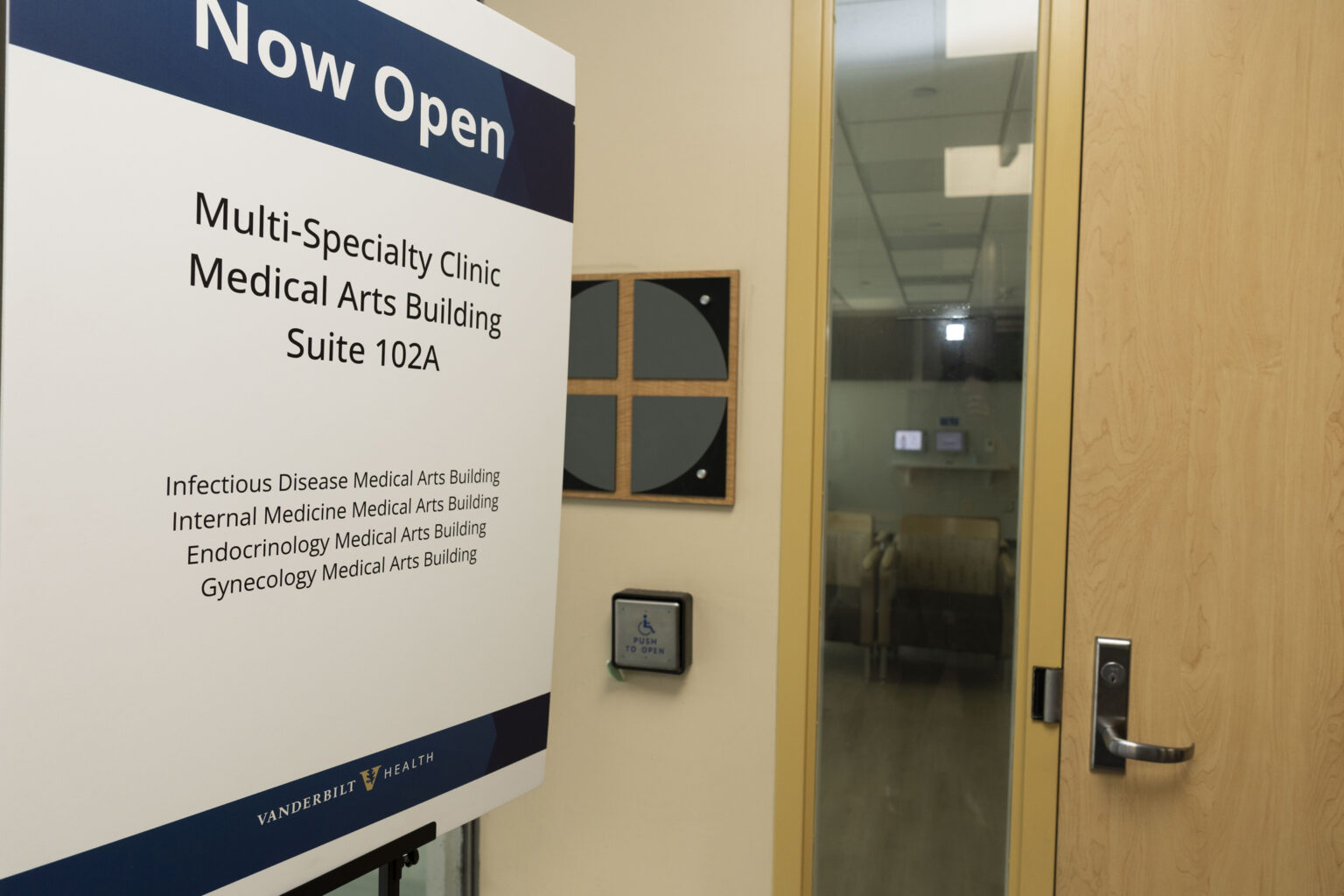
 The Innovation Clinic entrance on the first floor of the Medical Arts Building. (photo by Susan Urmy)

A clinic that opened July 13 on the Main Campus on the first floor of the Medical Arts Building looks unlike any other at Vanderbilt Health: no front desk and no receptionist, just tablets and screens where a check-in line would form. The Innovation Clinic sees real patients, accommodates physicians from various specialty groups, and doubles as the health system’s dedicated test site for technologies and workflows it hopes to spread systemwide.
“Every clinic at Vanderbilt Health is held to the same standard — patients get excellent care, and they feel cared for. That doesn’t change here,” said Patty Wright, MD, Professor of Medicine in the Division of Infectious Diseases and Chief Medical Officer for Adult Ambulatory Clinics. “What does change is that we now have one place designed to try new ways of delivering that care, learn quickly, and work the problems out before anything reaches the rest of our clinics. Our patients are partners in that. We tell them we’re trying something new, and we ask how it went.”
Physicians work two at a time at the clinic, which is part of the five-year Vanderbilt Clinic Innovation Project. The clinic opened with infectious diseases specialists Wright and Bryan Harris, MD, MPH, MMHC, Executive Vice President for Shared Clinical Services. They were soon joined by primary care physicians Sarah Stern, MD, MSACI, Assistant Professor of Clinical Medicine, and Rohini Chakravarthy, MD, Assistant Professor of Medicine. Joining early in September were endocrinologists Dara Mize, MD, Assistant Professor of Biomedical Informatics and Medicine and Chief Medical Information Officer, and Chase Hendrickson, MD, MPH, MMHC, Executive Medical Director of the Medicine Patient Care Center. Gynecology is expected in October and rehabilitation medicine in January 2027, with additional specialties under discussion.
“The most innovative thing about this clinic is that it exists in the first place,” said Chetan Aher, MD, Associate Professor of Surgery and Associate Chief Medical Officer for Adult Ambulatory Clinics. Piloting anything new has meant first finding a willing site, he said. “Now we have a dedicated pilot site for every new thing we want to test. Other health systems don’t have that, and we’ve never had that before. This will allow us to innovate more rapidly.”
The staffing model is the first thing under study: A single medical assistant, working from a tablet device rather than badge-tapping into desktop computers around the clinic, covers the patient intake role — gathering vital signs and other information — and pivots as needed to provide front desk-type assistance to patients.
“We’ve untethered them from a desktop,” Aher said. “It saves them time; it saves them steps.” Cutting staff is not the goal, he added: “We’re doing this to let staff work on the things that are much more complicated that we do not have technology to solve. If you’re a patient services specialist, for example, that might include devoting more of your role to getting visits scheduled and working through work queues to make sure that patients get the studies they need.”
Whatever is tested has to work for everyone who walks in, said Mize. “If we’re looking for a scalable model, you can’t cherry-pick your patient population,” she said. “We need to find tools that will work for the breadth of patients that we see. I have patients who say, ‘You mean I don’t have to talk to a human? That’s awesome.’ And I have patients who pull out a flip phone. We’ve got to be able to handle all of that.”
Candidate tools are vetted through HealthIT, undergo cybersecurity and safety review and, for artificial intelligence, review by the medical center’s AI governance committee. A touchless vital-sign “mirror” that reads blood pressure, temperature and pulse oximetry without a cuff or probe is being evaluated in HealthIT’s technology lab at 3401 West End in Nashville. Mize said whether a given tool scales to the institution will hinge on patient experience, quality of care, and effects on workflow and clinic capacity. Physicians at the clinic work standard schedules, with no allowance made for the testing of tools and workflows.
What a Vanderbilt Health clinician can know, Aher said, is that “every new thing that we put out has been tested by real clinicians with real patients in a real patient care environment.” He noted that, in addition to rank-and-file clinicians, the clinic includes senior executive leaders for informatics and for the health system.
Others central to the launch include Neal Patel, Justin Young, Scott Kilgore, Melissa Peterson, Cynthia Facemeyer, Byung Kang, Peter Shave, Mark Arrieta, Jared Cobb, Brad King, Rebecca Bradley, Haafiz Hemani, Erin Moorman, Mollie Boland, Autumn Tucker, Michelle Torres, and Jordan Dodd.

