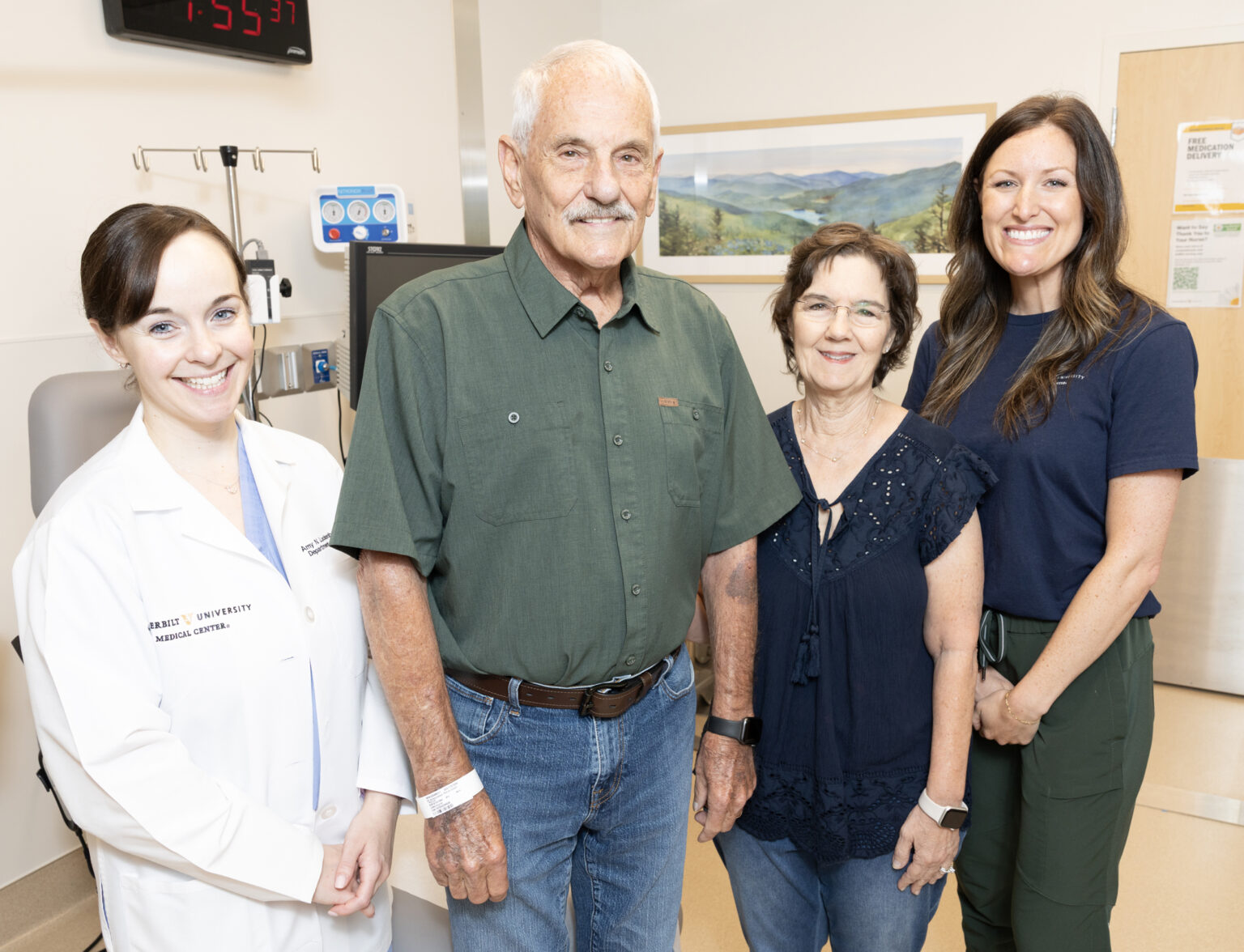
 Bladder cancer patient Patrick Delahoussaye and his wife, Roxane, with Amy Luckenbaugh, MD, left, and Bree Duncan, BSN, RN, right. (photo by Erin O. Smith)

Bladder cancer patient Patrick Delahoussaye, 81, of Brentwood, Tennessee, has been trying to drink plenty of water over the past 18 months — up to 96 ounces a day — to keep a slow-release medication “pretzel” from lodging in his bladder, which can be very irritating.
And he also has some pain when the pretzel is removed and another inserted periodically in clinic, but he is no longer riddled with the cancer that “looked like a coral reef,” Delahoussaye said.
The first line treatment for noninvasive bladder cancer is Bacillus Calmette-Guérin (BCG), an immunotherapy that has been used since the 1980s to trigger a patient’s immune system to fight off cancer cells and reduce the risk of cancer coming back inside the bladder.
But BCG was ineffective for Delahoussaye after a year of treatment, so his options were limited to bladder removal — a 5-7-hour surgery that requires a four-day hospital stay, with 1 in 3 patients returning to the hospital within 30 days — or joining a clinical trial.
“To do a bladder removal for a noninvasive cancer, understandably for many people, is a hard sell,” said Amy Luckenbaugh, MD, Associate Professor of Urology in the Division of Urologic Oncology at Vanderbilt Health.
“And so, we have new chemotherapies that are in a little device that we call a ‘pretzel’ that we insert in the bladder, and it gives off the chemotherapy slowly over time and only impacts the bladder lining without impacting the whole body.”
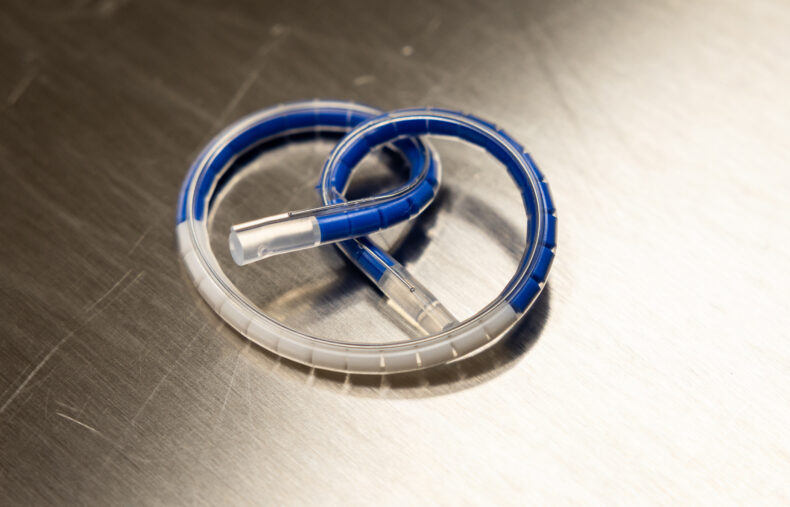
Delahoussaye was the first Vanderbilt Health patient enrolled in the SunRISe-5 trial for the TAR-200 gemcitabine pretzel in October 2024, after three surgeries and ineffective treatment with BCG. He had two big risk factors for bladder cancer in his history — smoking and chemical exposures. He stopped smoking 44 years ago but believes he could have also been exposed to chemicals during his time managing an aircraft painting facility in Louisiana.
“I had some hard times in the beginning of the trial; as you can imagine, putting gemcitabine in your bladder for 24 hours a day, seven days a week, can get aggravating,” he said. “It’s not easy, but I wanted to do it not only to cure my cancer but also to help people after me.”
Bladder cancer is the 10th leading cause of cancer death in the U.S., with 1 in 333 women and 1 in 125 men dying from it, according to the American Cancer Society. Delahoussaye and his wife, Roxane, had a friend who died of bladder cancer, which reinforced his motivation for entering the trial.
“I’m always pretty optimistic as a person,” Roxane Delahoussaye said. “He’s had a lot of ups and downs with his health; he also had Merkel cell carcinoma in 2012. When this cancer came along, yes, I was worried, but knowing it was contained inside the bladder was a good sign.
“Once it leaves a bladder, and the cancer metastasizes into the lining, and possibly outside of the bladder, that’s when you worry. And he never had that issue. That helped me sleep at night. It was good news,” she said.
Patrick Delahoussaye credits Bree Duncan, BSN, RN, Research Nurse Specialist IV, for helping him through the trial over the past year and a half.
“The experience has been nothing but outstanding, in most ways, and the treatment eliminated my bladder cancer,” he said. “The inside of my bladder looks like it did the day I was born. There’s no cancer showing in the urine or the blood.”
Roxane Delahoussaye agreed.
“Bree would tell him, ‘Don’t give up. I know you want to give up on the trial but stay with it. You’re doing great.’ She was such a cheerleader, and she was always available. Patrick always told me, ‘If it wasn’t for Bree, I probably would have quit.’ I just can’t sing Vanderbilt’s praises enough because I think my husband’s alive because of Vanderbilt, and I really do mean that.” she said.
The Food and Drug Administration approved the gemcitabine intravesical system (pretzel) in September 2025.