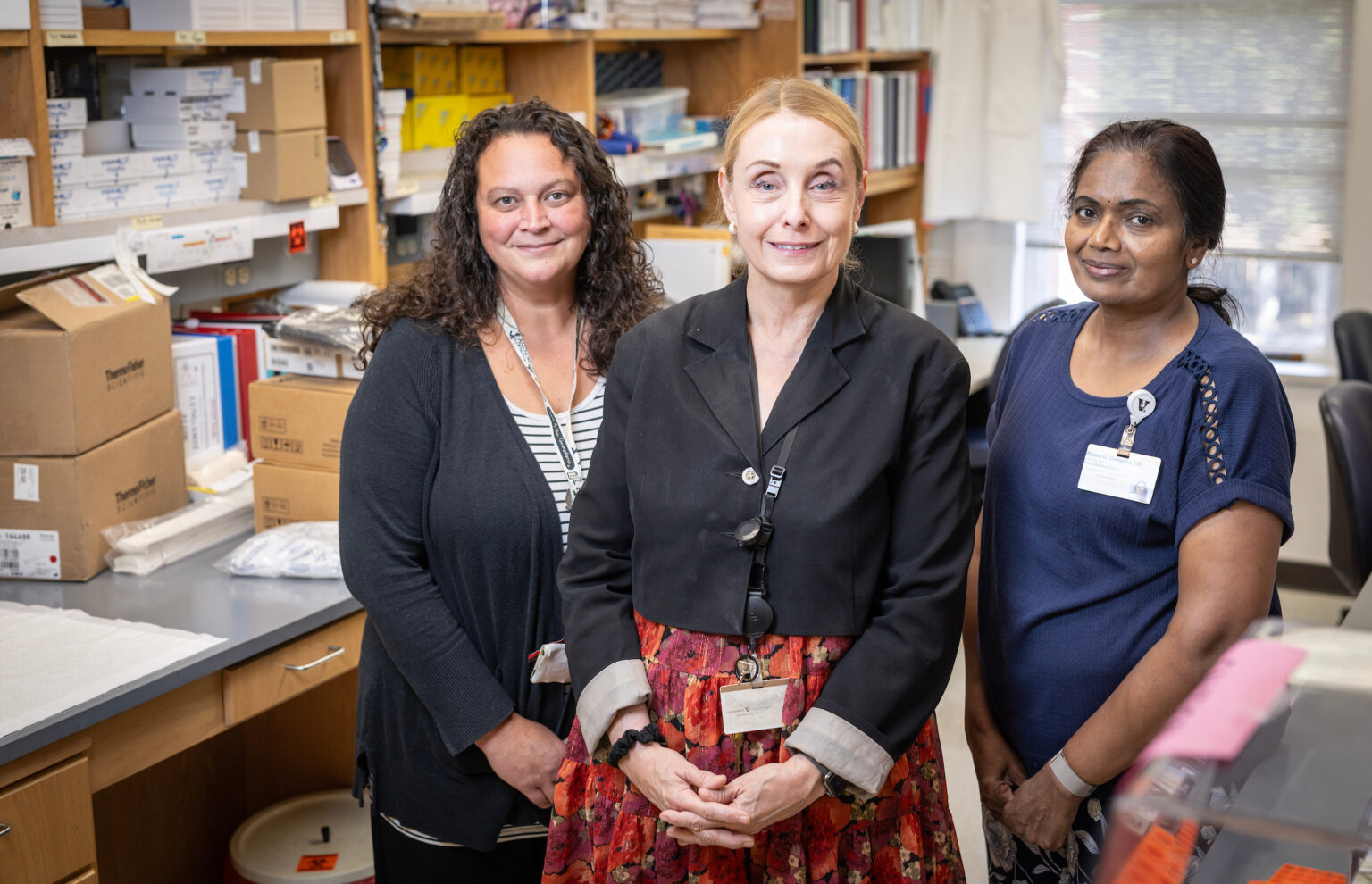
 Elizabeth Phillips, MD, center, with colleagues in the Center for Drug Safety and Immunology; from left, Research Fellow Amy Palubinsky, PhD, and Senior Research Specialist Rama Gangula, MS.
(photo by Erin O. Smith)
Elizabeth Phillips, MD, center, with colleagues in the Center for Drug Safety and Immunology; from left, Research Fellow Amy Palubinsky, PhD, and Senior Research Specialist Rama Gangula, MS.
(photo by Erin O. Smith)

Vanderbilt Health has received an award from the National Institutes of Health (NIH), expected to total approximately $8.5 million over five years, to establish and lead a Severe Cutaneous Adverse Reaction (SCAR) Clinical Research Consortium.
Part of the NIH’s Rare Diseases Clinical Research Network, SCAR is the first U.S. consortium devoted to rare, life-threatening immune reactions to common medications that can cause widespread skin blistering or peeling, organ damage, blindness, and death — and for which no proven treatment is available.
Led by Principal Investigator Elizabeth Phillips, MD, Director of the Center for Drug Safety and Immunology at Vanderbilt Health, the consortium includes 13 centers, 23 investigators with expertise in dermatology, allergy and immunology, infectious diseases, pediatrics, rheumatology, ophthalmology, clinical pharmacology, and informatics, and patient advocacy groups.
“For too long, patients who survive these reactions have been left without clear answers about why it happened, which medicines are safe, and what the future holds,” Phillips said. By bringing clinicians, researchers, and patients together, “we can finally build the evidence needed to run the clinical trials these patients deserve.”
Phillips, who holds the John A. Oates Chair in Clinical Research, is a Professor of Medicine, Dermatology, Pathology, Microbiology and Immunology, and Pharmacology. She is internationally known for her investigations of genetic risk, mechanisms and outcomes associated with severe immune-mediated adverse drug reactions.
SCARs include SJS/TEN (Stevens-Johnson syndrome/toxic epidermal necrolysis), which can cause blindness and has a mortality rate as high as 50% in the most severe cases, and DRESS syndrome (drug reaction with eosinophilia and systemic symptoms), which can lead to autoimmune disease, even years after the drug has been stopped.
Common medications can trigger these reactions, including certain antibiotics, anti-seizure drugs, and the gout drug allopurinol. A recently recognized SCAR has been linked to immune checkpoint inhibitors, a common class of cancer immunotherapy.
NIH support for the consortium is provided through the National Institute of Allergy and Infectious Diseases, the National Center for Advancing Translational Sciences, and the National Institute of Arthritis and Musculoskeletal and Skin Diseases under award number U54AI205728. Its work is organized into three research projects:
SJS-ENCORE, led by Benjamin Kaffenberger, MD, at The Ohio State University, will build the largest carefully confirmed long-term cohort and biorepository of SJS/TEN patients in the United States, and will validate tools to measure disease severity and outcomes.
Improving DRESS care, led in Boston by Li Zhou, MD, PhD, at Brigham and Women’s Hospital, and Kimberly Blumenthal, MD, MSc, at Massachusetts General Hospital, will use electronic health records and artificial intelligence to identify DRESS earlier.
They also will develop validated diagnostic tools to identify the drug causing the reaction and assess its severity, which will be shared across consortium sites.
Defin-SCAR, led by Phillips, will follow more than 400 DRESS patients to understand relapse and long-term autoimmune complications. It also will develop an integrated testing approach, combining genetic and skin testing and laboratory assay, for all SCARs to reliably identify culprit drugs so patients know which medicines are safe.
Other sites in the consortium include Cincinnati Children’s Hospital Medical Center, Mayo Clinic, the University of Illinois Chicago, University of Pennsylvania, Duke University, Memorial Sloan Kettering, and Children’s Mercy Kansas City.
By the end of the five-year funding period, the consortium expects to have long-term outcome data and biological samples from more than 500 patients, representing the country’s first comprehensive SCAR biobank and data resource.
Patient advocacy partners, including the Stevens-Johnson Syndrome Foundation and DRESS Syndrome Foundation, helped shape the research aims and will take part in consortium activities, including launching a public website for patients, families and clinicians.
The consortium also will support the next generation of researchers through dedicated SCAR fellowships, mentorship across institutions, and pilot grants for early-career investigators.