 Ian M. Burr, MD, PhD

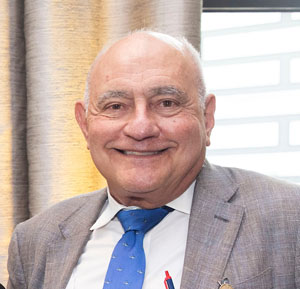
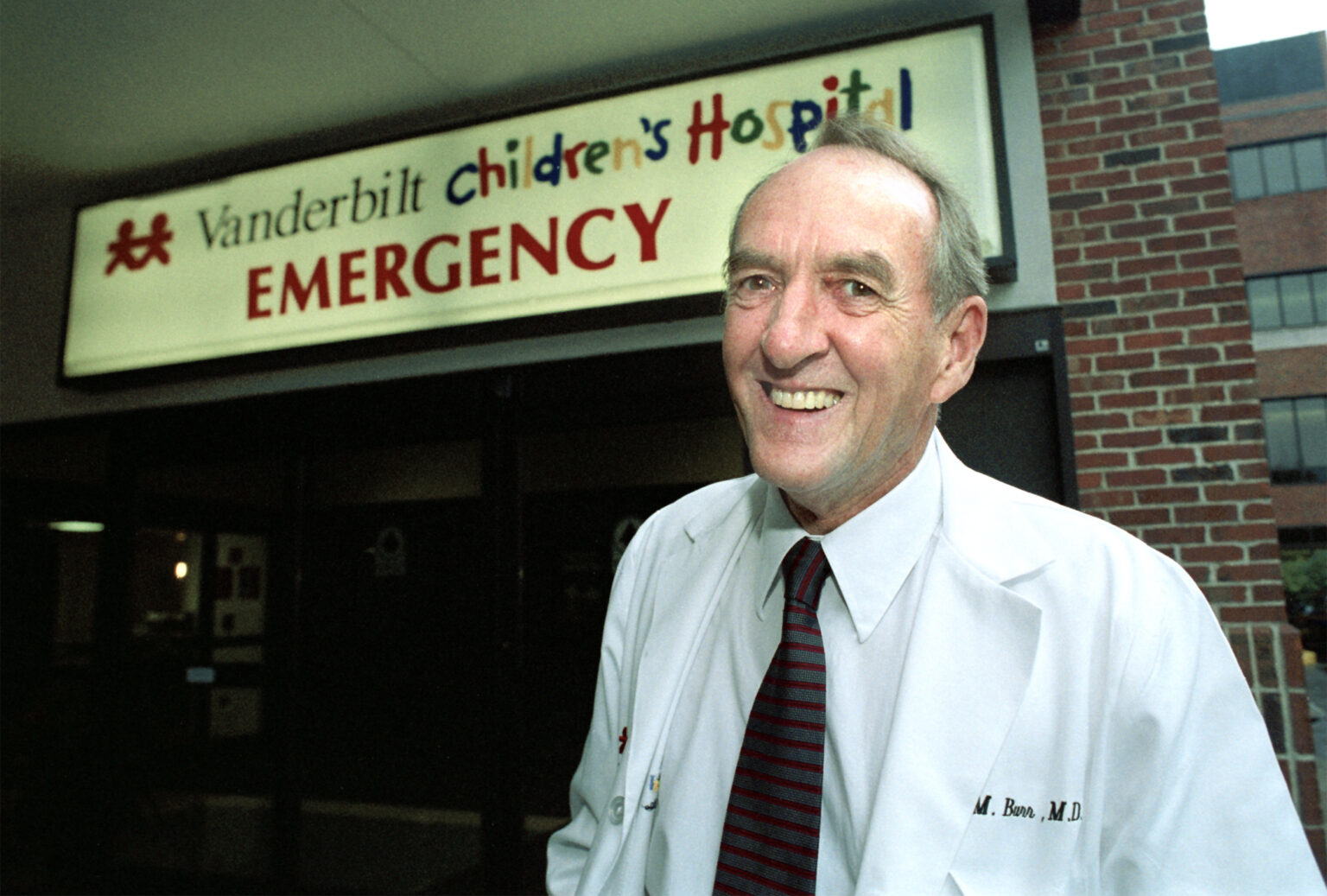
Ian M. Burr, MD, PhD, former Chair of the Vanderbilt Department of Pediatrics whose vision and advocacy helped establish Middle Tennessee’s first freestanding children’s hospital, died Oct. 5. He was 90.
“Dr. Burr will be remembered as a legendary champion of child health. In addition to his numerous contributions to the understanding and treatment of childhood diabetes, his tireless efforts were a driving force in the design and development of Monroe Carell Jr. Children’s Hospital at Vanderbilt. His understanding of the value of family-centered care helped lay the foundation for the leadership and success of our children’s program,” said Jeff Balser, MD, PhD, President and CEO of Vanderbilt Health and Dean of Vanderbilt University School of Medicine. “At this time our thoughts are with his wife Cindy and his family.”
Recruited to Vanderbilt in 1971 as only its second pediatric endocrinologist and Director of the Division of Pediatric Endocrinology, Dr. Burr dedicated his career as a physician-scientist and mentor to improving child health, including care for diabetes and other endocrine disorders.
Dr. Burr left Vanderbilt for a couple of years before returning in 1988 to become only the fifth Chair of the Department of Pediatrics. Under Dr. Burr’s leadership, the department saw incredible growth, expanding its clinical services, strengthening academic programs and rising to become one of the nation’s leading pediatric departments in research funding, a distinction that holds true today.
As a Howard Hughes investigator, he conducted influential research on insulin secretion, diabetes management, glycogen storage diseases and congenital adrenal hyperplasia, authoring or co-authoring more than 100 scholarly papers. In roles across Vanderbilt, Dr. Burr recognized the need for specialized pediatric care across Tennessee as he helped build programs in genetics, metabolic diseases, nephrology and gastroenterology and launched outreach clinics in Knoxville, Chattanooga, Fort Campbell and other communities.
Born in Tallangatta, Victoria, Australia, in 1936, Dr. Burr earned his medical degree from the University of Melbourne in 1959. He completed his pediatric residency training at Melbourne’s Royal Children’s Hospital between 1960 and 1963. Four years after graduating from medical school, he was appointed acting medical director of the hospital as it relocated to a new campus. Queen Elizabeth II attended the facility’s inauguration, and Dr. Burr played an important role in its planning and design.
He came to the United States on a National Institutes of Health postdoctoral fellowship in pediatric endocrinology at the Department of Pediatrics at the University of California, San Francisco.
His early experience with children’s hospitals in Melbourne shaped his future vision for what a children’s hospital could be as he helped realize Middle Tennessee’s first freestanding children’s hospital in Nashville.
William Russell, MD, who served as Director of the Division of Pediatric Endocrinology for 26 years, is one of the few remaining faculty and staff members who witnessed Dr. Burr’s transformation of the division and of the department, where he established a pediatric endocrinology training program and, amid a shortage of specialists, personally led clinical programs in genetics, metabolic diseases, nephrology and gastroenterology.
“Despite his illustrious career as administrator, scientist, teacher, mentor and clinician, Ian made his strongest mark when he led the visionary groundwork for a freestanding children’s hospital at Vanderbilt,” said Russell, the Cornelius Vanderbilt Professor of Pediatrics and Professor of Cell and Developmental Biology.
“Ian was driven to create a self-contained hospital to bring state-of-the-art medical care and world-class research to children in a child- and family-friendly environment. By engaging the support of Vanderbilt leadership and of the Middle Tennessee pediatric community, he overcame substantial barriers. Ian had a major impact on me personally, and I will miss the opportunity to visit with him and continue to tell him how the seeds he planted have grown into a lush garden for children’s health.”
In 1999, Dr. Burr stepped down from his role as Chair of Pediatrics to assume the role of Associate Vice Chancellor for Children’s Services to focus his attention on the creation and building of the new hospital. His efforts, combined with the extraordinary generosity of Monroe Carell Jr. and his family, culminated in the opening of Monroe Carell Jr. Children’s Hospital at Vanderbilt in 2004.
Dr. Burr retired in 2006 and was subsequently named Professor Emeritus. The endocrinology division was officially renamed the Ian M. Burr Division of Pediatric Endocrinology and Diabetes in his honor during a celebration in 2009.
“On behalf of the entire Department of Pediatrics, I want to offer my condolences to Dr. Burr’s family and offer my sincere gratitude for all he accomplished on behalf of children,” said Juan C. Salazar, MD, MPH, Chair of the Department of Pediatrics, System Pediatrician-in-Chief for Monroe Carell and James C. Overall Professor of Pediatrics. “While I did not have the privilege of knowing Dr. Burr personally, his extraordinary vision and leadership changed the course of children’s health care in Tennessee and well beyond. His dedication to building strong academic and clinical programs and supporting scientific discovery established a lasting legacy that continues to benefit patients and families every day.”
Beyond helping create the hospital, Dr. Burr co-founded the Cumberland Pediatric Foundation (which still exists today), strengthening connections between the hospital and community pediatricians throughout the region. He also served as a member of the Monroe Carell Advisory Board from 1989 to 1991 and then again from 2002 to 2007.
Dr. Burr was preceded in death by his wife of 54 years, Wendy, who died in 2011. He later married Cindy Miller, who survives him and was by his side when he died.
A memorial celebration of Dr. Burr’s life will be held Wednesday, Oct. 28, from 3 to 6 p.m. in the Bennett Hall Social Room at Scarritt Bennett Center, 1027 18th Ave. S.
Donations in Dr. Burr’s memory may be made to Monroe Carell, Jr. Children’s Hospital at Vanderbilt.