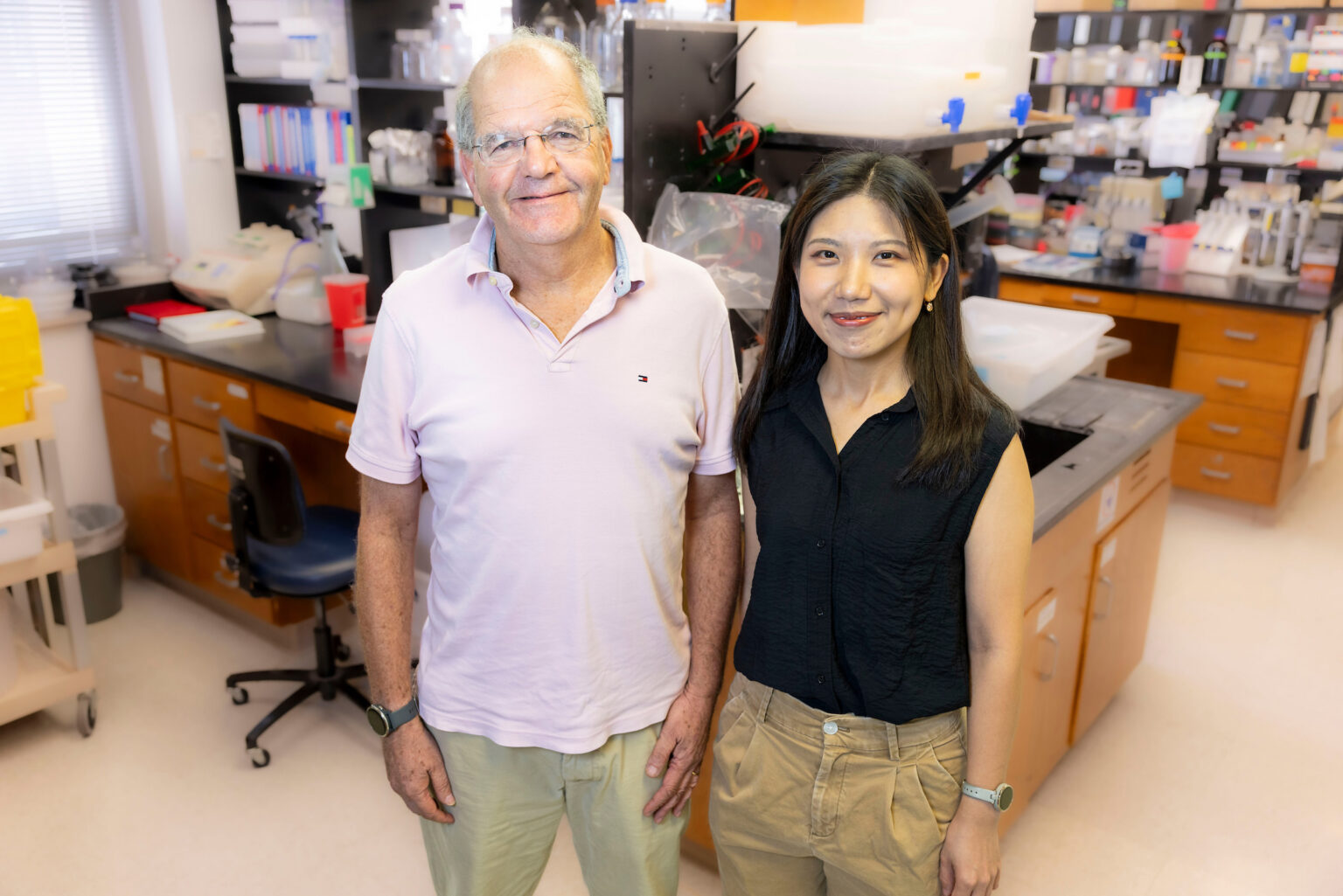
 Roy Zent, MBBCh, PhD, and graduate student Xinyu Dong, with their colleagues, have solved some of the mysteries of kidney development. (photo by Susan Urmy)

The formation of the kidney, like other branched structures in the body, is a tightly controlled process that is not well understood. It’s important, because when this process — called branching morphogenesis — goes awry, the kidneys fail to function normally.
Now, researchers at Vanderbilt Health and the Nashville VA Medical Center show that a cytoskeletal protein, alpha-parvin, regulates branching of the ureteric bud, which elongates to form the ureter connecting the kidneys to the bladder, as well as other key kidney structures.
Using a state-of-the-art, 3D live-organ imaging technique to track individual cells in the developing mouse kidney, they showed that alpha-parvin coordinates the dynamic network of actin filaments known as the actin cytoskeleton, which not only provides structural support for cells but enables them to move.
And the right kind of cellular movement, called cellular rearrangement, is critical for branching morphogenesis. Without it, the kidneys fail to develop normally.
The group’s findings, published Sept. 18 in the journal Science Advances, “help with our fundamental understanding of how the kidney develops,” said Roy Zent, MBBCh, PhD, the paper’s corresponding author. “Many developmental defects that lead to (kidney) problems later on are related to this branching process.”
Zent is the Thomas F. Frist Sr. Professor of Medicine in the Division of Nephrology and Hypertension at Vanderbilt Health and Division Chief of Nephrology at the Nashville VA, part of the Department of Veterans Affairs Tennessee Valley Healthcare System.
Xinyu Dong, a graduate student in the Zent lab, is the paper’s first author.
Other co-authors currently at Vanderbilt are Fabian Bock, MD, PhD; Nada Bulus; Glenda Mernaugh; Shensen Li; Wanying Zhu, PhD; Meiling Melzer; Kyle Brown, PhD; Colton Miller; Olga Viquéz, PhD; and Ambra Pozzi, PhD.
This research was supported in part by the National Institutes of Health (grants R01DK069921, R01DK088327, R01DK127589, K08DK134879 and R01DK119212), Department of Veterans Affairs, American Society of Nephrology, and Keck Foundation.