


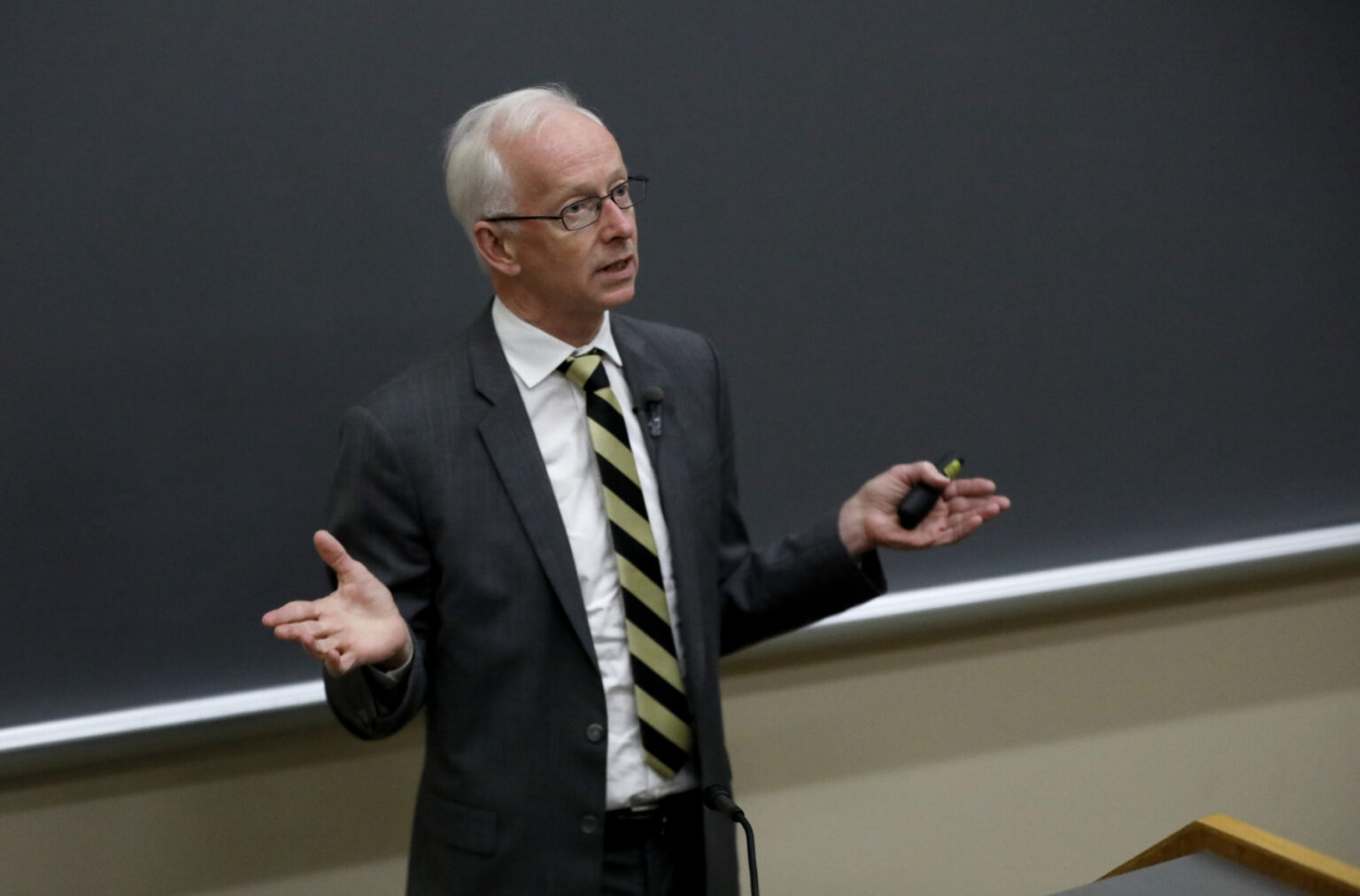
 Donald Brady, MD, talks about the history of medicine at Vanderbilt. (photo by Donn Jones)

Did you know patients at Vanderbilt University Hospital could once look out at sheep grazing on the grounds? Or that for the first five years Canby Robinson, MD, was dean and planning the move of Vanderbilt University School of Medicine and Vanderbilt University Hospital to the 21st Avenue campus, he rarely set foot in Nashville?
Or that the sturdy walls of what is now Medical Center North protected four American elm trees — their canopies still shading Chapman Quadrangle — from Dutch elm disease that nearly wiped out these trees in the U.S.?
Donald Brady, MD, Executive Vice President for Educational and Medical Staff Affairs at VUMC and Executive Vice Dean for Academic Affairs at Vanderbilt University School of Medicine, shared these facts and more as he guided a packed audience through a century of history at Vanderbilt University School of Medicine and Vanderbilt University Medical Center.
Brady, whose own connection with Vanderbilt spans more than four decades since his undergraduate days studying Latin, gave his talk on Sept. 16, the same day the doors of the building housing Vanderbilt University Hospital and Vanderbilt University School of Medicine opened 100 years ago. The foundation of Brady’s talk was created by Lynn Webb, PhD, former chief of staff for Dean Steven Gabbe, MD, and longtime faculty member.
Serendipitously, Sept. 16 is also Brady’s birthday. He fittingly spoke at the iconic, two-story amphitheater, original to the 1925 building, where legends like Barney Brooks, MD, VUSM’s first professor and chair of the Department of Surgery, once gave demonstrations and presented clinical cases.
Brady walked the audience through the drama surrounding the construction of the 1925 building, which put then Vanderbilt University Chancellor Kirkland at odds with the newly selected VUSM Dean Robinson. The university had already secured $4 million for the project through the nation’s General Education Board and generous donors.
Robinson was adamant that he needed a minimum of $12 million to build his vision of a novel facility that would “have clinical care, research and education all in the same building.” Another $4 million, including more money from the General Education Board and donations, was ultimately secured, which satisfied Robinson, and construction began.
Brady noted that many legends of medicine taught, conducted research and cared for patients at the 1925 facility, including:
- Vanderbilt surgeon Alfred Blalock, MD, and his research and laboratory assistant Vivien Thomas, who conducted research together that later led to the groundbreaking development of the Blalock-Thomas-Taussig shunt.
- Mildred Stahlman, MD, professor of Pediatrics and Pathology, Microbiology and Immunology, who revolutionized the care of infants born with hyaline membrane disease. Stahlman established the nation’s first newborn intensive care unit to use monitored respiratory therapy in babies born with damaged lungs at VUH.
- Levi Watkins, MD, the first African American to earn a medical degree from Vanderbilt University School of Medicine. Watkins advanced cardiac surgical techniques, devices and therapies throughout his career, as well as advancing civil rights.
- Vanderbilt pathologist Ernest William Goodpasture, MD, who developed a process for culturing vaccines in chicken embryos and fertilized eggs. His work, which began in the 1930s, revolutionized vaccine development.
- Pharmacologist/biochemist Earl Sutherland Jr., MD, won the Nobel Prize in 1971 for discoveries related to cyclic adenosine monophosphate, or cyclic AMP. Sutherland’s research opened new fields of investigation into the regulatory function of hormones.
- Vanderbilt University biochemist Stanley Cohen, PhD, won the Nobel Prize in 1986 for discovering epidermal and nerve growth factors, sharing the award with Italian neurobiologist Rita Levi-Montalcini, MD. Their work sparked the development of new therapies for many diseases.
Brady shared that Goodpasture, who felt that his discovery of the mumps virus was a bigger achievement than culturing vaccines in chicken embryos, was also a strong contender for a Nobel Prize in Medicine.
“In fact, he was nominated for the Nobel Prize in Medicine eight times and never won,” Brady said. He also shared that Goodpasture likely was in line for a ninth nomination but died before that could occur. The Nobel Prize cannot be awarded posthumously.
Brady also highlighted individuals who might be lesser known but no less important to Vanderbilt’s history. These include:
- Annie Bramwell, assistant to the VUSM dean beginning in 1898. She supported the leadership at Vanderbilt and was an invaluable resource of institutional knowledge for 58 years.
- Robert (Bobby) Vantrease, a renowned, award-winning medical illustrator, worked at Vanderbilt for 64 years. He is the talent behind many popular pen-and-ink sketches of buildings on the Medical Center campus.
- William (Bill) Gunter, who served as the diener (assistant who prepares bodies for autopsy) of the VUSM anatomy labs, worked at Vanderbilt for 56 years.
- Howard Price, technical supervisor in Pathology, Microbiology and Immunology at VUMC, has worked at Vanderbilt for 65 years. He has a decades-old green notebook that contains a recipe for viral transport media. This became critical early in the COVID-19 pandemic when the world was running out of this vital component for testing. Price’s recipe meant VUMC could make its own.
Brady spotlighted notable achievements of VUSM leaders through the years, noting significant facility construction and expansion, as well as the growth in faculty and programs.
“It’s always been known, from all the way back in 1925, that we’re going to do great education; we’re going to provide great clinical care; and we’re going to do cutting-edge research,” said Brady. “That’s what we’re about. And we celebrate and collaborate together. It was true then; it is true now.
“It’s been a lot of fun to learn about what we’ve done and where we’ve been, but the great thing is that we hold to our (founding) principles of doing the right thing for people every time, whether it’s our patients, our students, our trainees or each other.”
For the record, the grazing sheep mentioned above were part of research conducted by Stahlman, the longest serving VUSM faculty member (71 years) upon her death in 2024.
And as for those majestic American elms, arborists differ in their opinions about why the four elms inside Chapman Quadrangle survived, but those whose hearts are close to the Medical Center are confident that the structure that has kept so many lives sheltered throughout the decades also shielded these special trees from harm.


