


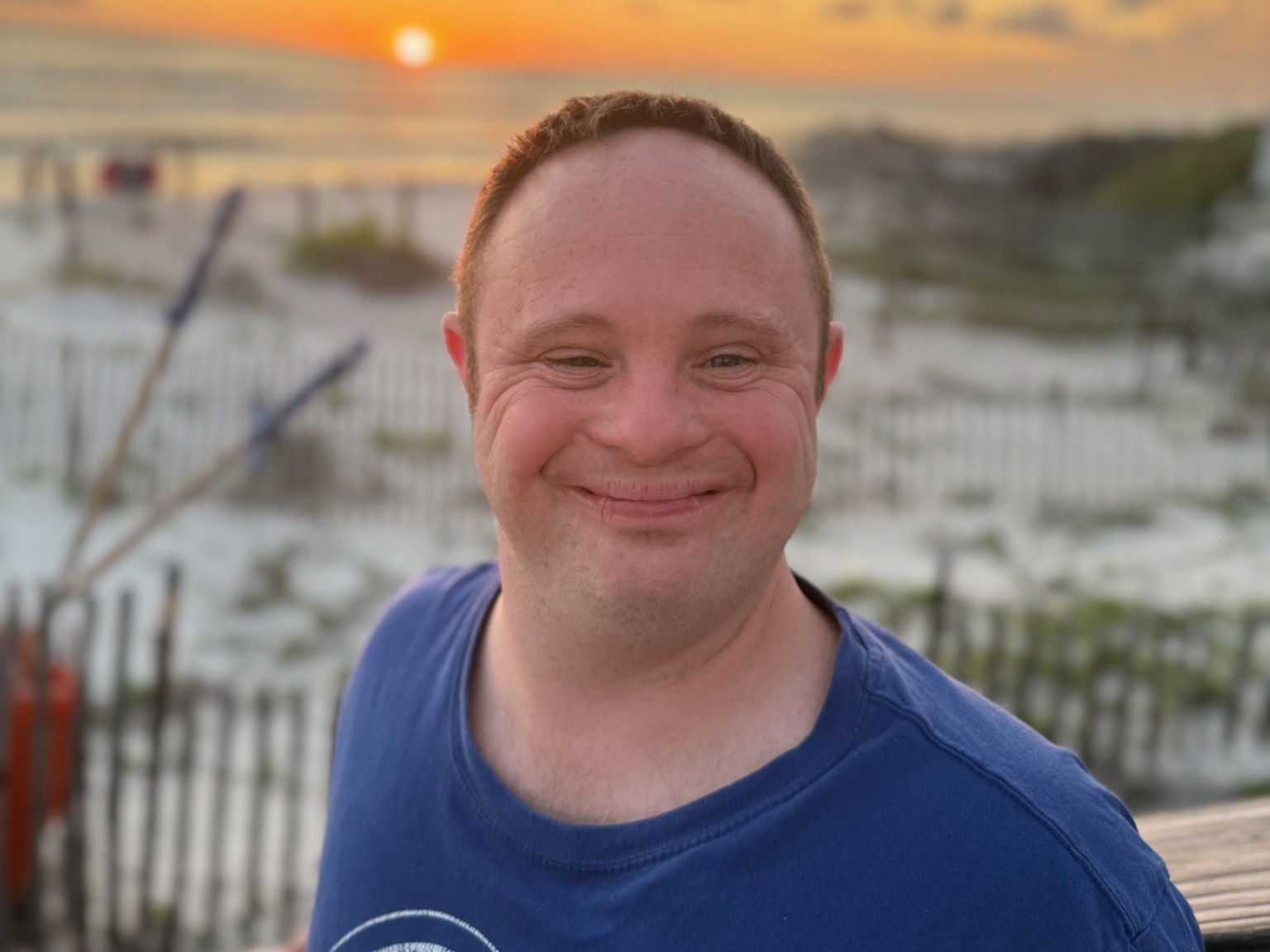
 Evan Dewey is the first and currently only participant in Vanderbilt Health's arm of the ABATE study. (photo courtesy/Jane Dewey)

Evan Dewey makes friends everywhere he goes. He’s buddies with the Vonlane bus drivers who transport him and his father, Brian, from his hometown of Atlanta to the Vanderbilt Center for Cognitive Medicine — the closest enrollment site for the worldwide ABATE study that is testing a potential treatment for Alzheimer’s disease in people with Down syndrome.
Evan, 42, has also made friends with Lamar Bowman, RN, and Sherri Halls, RN, at the Vanderbilt Clinical Research Center where he has his blood work done before he heads to Vanderbilt Psychiatric Hospital to receive either a placebo or an immunotherapy vaccine designed to show the body how to create antibodies against amyloid plaques, or abnormal deposits of protein in the brain that cause Alzheimer’s disease. During his post-shot observation, Evan listens to music, eats lunch and chats with his friend Sarah Nelson, DNP, FNP-BC, a nurse practitioner with the Center for Cognitive Medicine.
The goal of ABATE is to see if the vaccine reduces the amyloid in the brain, with the ultimate goal of preventing Alzheimer’s disease development in individuals with Down syndrome. This is the first in a series of studies Vanderbilt Health will participate in with these goals in mind.
Clinical trials related to Alzheimer’s disease have been ongoing for decades, but clinical trials related to Alzheimer’s disease for those with Down syndrome are new — even though they are a high-risk population.
“Individuals with Down syndrome are at markedly elevated risk for developing Alzheimer’s disease because they have a third copy of the amyloid precursor protein gene on chromosome 21,” said Jo Ellen Wilson, MD, PhD, MPH, associate professor of Psychiatry and Behavioral Sciences and the study’s principal investigator. “So, from very early on in life they’re developing much more amyloid than the non-Down syndrome community. And by the fourth decade of life, around half but perhaps even more individuals with Down syndrome will already have elevated amyloid in their brains, which is the main biologic risk factor for Alzheimer’s disease.”
This is exactly why Evan’s mother, Jane, a former pediatric occupational therapist who follows the Down syndrome community closely, sought out the study.
“For a long time, they’ve been studying Alzheimer’s, but they haven’t studied the Down syndrome population probably as close as they should have because the connection between chromosome 21 and genetic Alzheimer’s is very strong,” she said. “I became very concerned about Down syndrome and Alzheimer’s, had been following it on different webinars, found out about this study at Vanderbilt and pursued it,” she said.
“It just felt so important for this study to be done. It will not, of course, cure Alzheimer’s, but it could delay the onset of the amyloid plaques.”
ABATE is not Evan’s first clinical trial — he’s participated in others at Emory University Hospital in Atlanta — but he’s the first and currently only participant in Vanderbilt’s arm of the ABATE study.
“This tells you just how hard it is,” said Wilson. “With any clinical trial, you have pretty strict inclusion and exclusion criteria. We always want to make sure that it’s the right participant for the trial, and we’re hopefully going to maximize the benefit, if there is any, to the study drug and minimize any potential harm.”
To qualify for the study, participants must be between the ages of 35 and 50, have Down syndrome, not have dementia and be accompanied by a study partner, such as a family member or caregiver. Before he was approved, Evan had PET scans, MRIs, blood work and cognitive testing.
“The MRI and PET scans don’t bother him — we were pretty amazed by that,” said Jane. “He’s always been good with blood work and blood draws. He’s a very willing participant, though this is not something we pushed. We let Evan choose whether to participate or not.”

Evan and Brian have traveled to Nashville four times and will make 12 more in-person visits plus four visits by phone for the trial.
Beyond the benefit of helping researchers understand and slow the progression of Alzheimer’s in people with Down syndrome, the Dewey family has benefited from the ABATE study in unexpected ways.
“Jane was familiar with Evan’s condition from the day he was born, and I have learned over time about Down syndrome,” Brian said. “Now that I’m retired, this study gives me an opportunity to have more father-son time with Evan. We both enjoy traveling, and it’s a lot of fun to be with him, doing this together.”
The theme of World Down Syndrome Day 2026, which is March 21, is “Together against loneliness.” With so many friends in Atlanta and at Vanderbilt Health, Evan is far from alone. He said he’s excited about the study and sees it as his job.
“There’s a lot of hope in terms of one day finding treatments for Alzheimer’s disease, in particular in Down syndrome,” Wilson said. “We’re so thankful that the funders of this research are making this vital study available to the Down syndrome community.
“But more importantly, we are incredibly thankful for our Down syndrome participants and their families for trusting us and believing in this work. We want participants like Evan to live their life to the fullest and don’t want it shortened or diminished in any way by Alzheimer’s disease. So, we’re committed to doing all that we can.”


