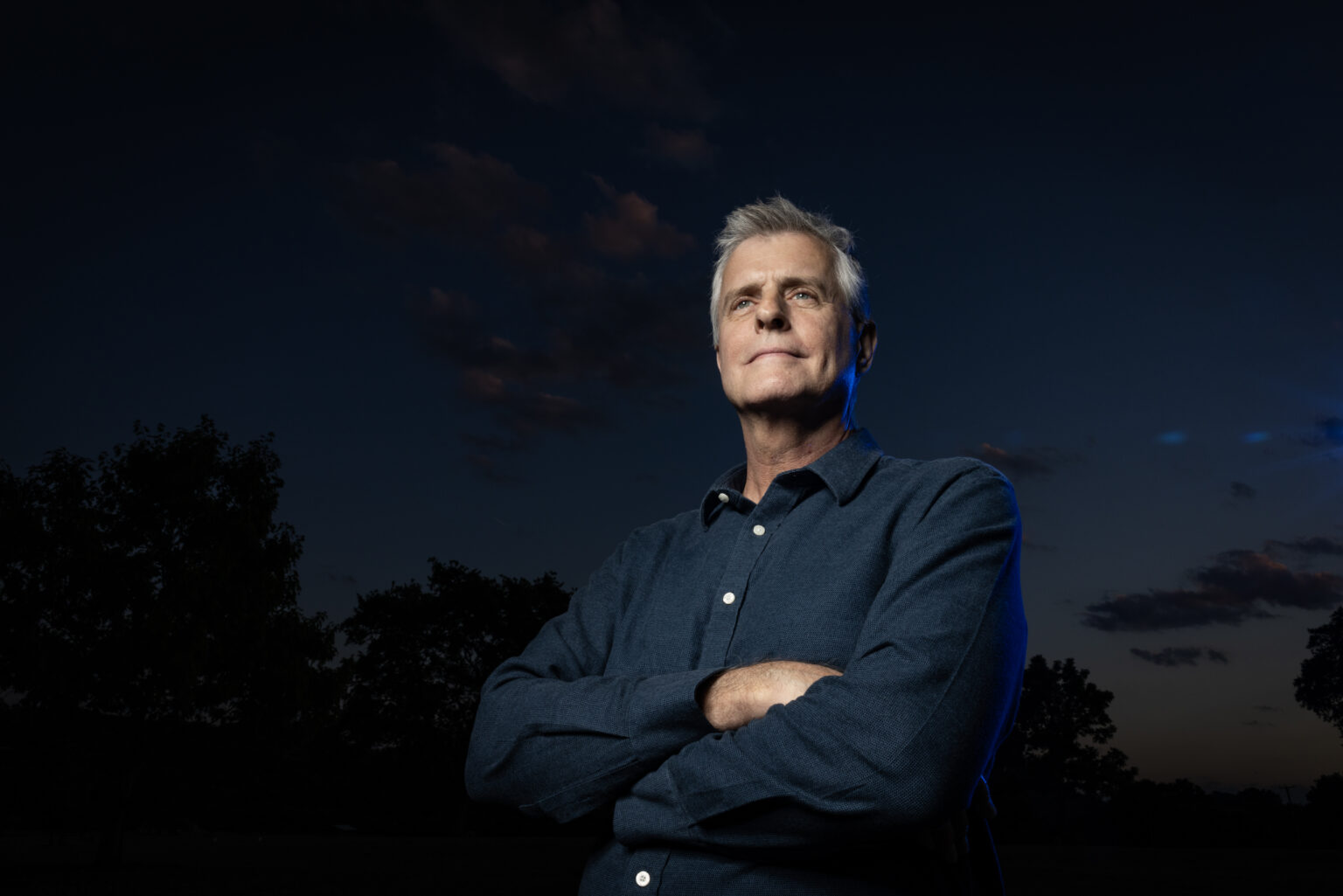
 Stephen Bruehl, PhD. (photo by Erin O. Smith)

Last year, pain researcher Stephen Bruehl, PhD, professor of Anesthesiology, experienced some unfamiliar trepidation as he prepared to do something he’s been doing regularly for decades — publish some new research. The studies in question were a departure unwarned of in Bruehl’s CV. They concerned UFOs, or what the U.S. government in recent years has come to call unidentified anomalous phenomena (UAP). While it’s slowly gaining some currency, Bruehl knew that the field of UAP studies may still strike some academicians as a wayward pursuit. When he scheduled time to broach his upcoming publications with the chair of Anesthesiology, Warren Sandberg, MD, PhD, Bruehl didn’t signal a purpose for the meeting request.
“I was concerned, because our department routinely does scrolls of the published literature to see things that the faculty have published, and I knew that these things would pop up on that search,” Bruehl said. “I did not want to get into a position of department leadership looking at these and going, ‘Holy crap — what is he doing these days.'”
Having recently given new rein to his interest in this scientific backwater, Bruehl had found untapped opportunities for applying statistical tools to UAP.
“Now, Warren is a very fair-minded person, but I was surprised when his response was essentially, ‘As long as you’re using regular scientific techniques to do this, I don’t see a problem.’ I said, well, I won’t use Vanderbilt’s name, and he said, ‘No, I think it’s fine to use it; this is legitimate science,’ and that was great to hear.”
Nights and weekends in space
Bruehl grew up in Nashville and his interest in UAP dates to 1973, when, as an 11-year-old, he was treated to reports of local sightings in the city’s newspapers and newscasts. That autumn brought a rash of sightings across the Midwest and Southeast.

“I have to admit, I liked ‘Star Trek.’ I liked science fiction,” he said, “and the fact that people were reporting seeing what seemed to be artificial objects and no one knew what they were, to me, was very intriguing.” He began reading books on the subject from the Nashville Public Library. “In retrospect, some of them were pretty terrible books.”
By the time he reached graduate school, his youthful interest in UAP was all but abandoned. But it would be decisively rekindled in 2017, when The New York Times reported the existence of a shadowy UAP program that had been launched by the Department of Defense in 2007, called the Advanced Aerospace Threat Identification Program (since absorbed by the Pentagon’s All-domain Anomaly Resolution Office). “My interest, honestly, has gone up and gone down over the years, and prior to 2017, I had kind of gotten bored with it and didn’t really pay much attention to it. But the report in The New York Times got me thinking again. I started reading more recent books that have been published, and there are some good ones. There’s also a lot of garbage. That’s when I realized that nobody’s really studying this scientifically.
“I want to be clear that this is work that I’m doing nights and weekends. I still have a regular day job doing medical research at Vanderbilt.” Bruehl’s work on chronic pain includes long-standing interest in complex regional pain syndrome and the influence of psychosocial factors and endogenous opioids (natural modulators of pain, reward, stress responses and emotion produced by the body).
Thousands of points of light
Mushroom clouds and flying saucers reverberated through pop culture in the United States of the 1950s, becoming as inescapable as saddle shoes and poodle skirts.

In two studies published last October, Bruehl journeys back to the intersection of nuclear bomb tests, UAP sightings, and data from the first Palomar Observatory Sky Survey, or POSS-I, which ran from November 1948 to April 1958. He returns with intriguing peer-reviewed findings. Bruehl’s work with Swedish astronomer Beatriz Villarroel, PhD, assistant professor at the Nordic Institute for Theoretical Physics in Stockholm, is a ’50s flashback that suggests new lines of inquiry in this exotic field.
Palomar Observatory is in San Diego County, California. It’s home to the 200-inch Hale Telescope, one of most powerful in the world.
POSS-I was funded by the National Geographic Society and conducted by the California Institute of Technology with Palomar’s 48-inch Samuel Oschin telescope. The survey used 14-inch-square glass photographic plates, each capturing a 6.5-degree-square portion of the night sky. The survey covered the sky from the northern pole to 27 degrees below the equator, with the final dataset consisting of 936 plate pairs (red sensitive and blue sensitive).
Villarroel has funding from the Swedish government expressly to study UAP. At a May 2024 conference in Huntsville, Alabama, sponsored by the Scientific Coalition for UAP Studies, Bruehl had listened to Villarroel present her work over a remote connection from Europe. The plates from POSS-I are riddled with thousands of apparent points of light that are missing from images taken before or after. Pointlike artifacts are known to bedevil photographic emulsion on glass plates, and astronomers studying digitized images from POSS-I are accustomed to discounting these anomalous starlike points altogether.
Villarroel’s presentation focused on how these points frequently align, and she mentioned that one of the most striking alignments coincided with the famous Washington, D.C., sightings [see sidebar].
It immediately occurred to Bruehl to systematically look for temporal associations between these points and UAP reports. And when he considered the abundant anecdotal accounts from the literature suggesting a potential link between UAP reports and atomic tests, he decided to test this association as well.
In their studies published in October 2025, Bruehl and Villarroel, while acknowledging that the plates are apt to be aswarm with artifacts, show that these points exhibit curious patterns: They sometimes align within narrow bands in a 50-minute photographic exposure; they’re missing in great numbers within the shadow cast by Earth; and they’re more frequent around nuclear bomb tests and UAP sightings. In astronomy, “transient” is a catchall for celestial events lasting from milliseconds to several years. The claim from Villarroel, Bruehl and co-authors is that some significant but unknown portion of POSS-I pointlike anomalies aren’t photographic or scanning defects and are in fact unexplained transients moving in near outer space, having qualities consistent with sunlight reflecting from artificial surfaces.
Worldwide interest in the research
These findings from pre-Sputnik sky survey data have drawn considerable interest. Both papers were covered by mainstream print media around the world, and there are podcast episodes and a Wikipedia page devoted to them. Altmetric, a service that tracks mentions of scholarly research, ranks both papers in the top 5% of all papers they’ve ever scored.

With Villarroel as first author, “Aligned, Multiple-transient Events in the First Palomar Sky Survey” was published Oct. 17, 2025, in Publications of the Astronomical Society of the Pacific (PASP). Bruehl is among this paper’s 15 authors. And with Bruehl as first author and Villarroel as the sole other author, “Transients in the Palomar Observatory Sky Survey may be Associated with Nuclear Testing and Reports of Unidentified Anomalous Phenomena” was published Oct. 20, 2025, in Scientific Reports.
- In the PASP paper, the team identified 83 candidate sets of three or more transients lined up along a narrow band on a single photographic plate, from which they highlight five cases with four or more aligned points. A proposal favored by the authors is that these aligned sets could be intermittent glints from flat sections of a single highly reflective surface, as a slowly rotating object in geosynchronous orbit moved in sunlight across a photographic exposure of between 45 and 50 minutes. The most statistically significant alignment had an estimated probability of occurring by chance of roughly 1 in 10,000 (this case occurred July 27, 1952, the second weekend of the D.C. sightings).
- They found a striking 39% deficit of transients in Earth shadow. “Plate defects do not know where the Earth’s shadow is and have no reason to avoid that region more than any other,” the authors wrote. The deficit was calculated by simulating the area covered by shadow across each plate at 42,164 kilometers, a geosynchronous orbit altitude. There are 167 transients per plate in the study, and the probability that a deficit of this size could occur by chance is vanishingly small.
- In the Scientific Reports paper, transients were 45% more likely to appear on dates within one day of an above-ground nuclear weapons test. The strongest association was with the day after a test. “When we found the nuclear association, that actually became really important evidence to strengthen Beatriz’s argument that these were actual objects in orbit,” Bruehl said.
- The number of transients showed a small but statistically significant correlation with the number of independent UAP witness reports logged on the same date. The team estimated that each additional UAP report on a given date was associated with an 8.5% increase in the number of POSS-I transients.
While characterizing their work as preliminary, the authors say their results are inconsistent with the common assumption that all POSS-I transients are plate or scanning defects.
The Pentagon takes an interest
At the Huntsville conference, Bruehl had also heard a presentation from UAP researcher Robert Powell, who had coded UAP witness reports and had curated a set of the most convincing reports from tens of thousands of reports available. Bruehl also saw these data as crying out for statistical analysis. He published this analysis Oct. 1, 2025, in World Futures.

Last August, as this study was nearing publication, Bruehl was invited to attend a Pentagon-sponsored meeting for discussions with UAP experts from the government and academia. Bruehl’s study applies a statistical pattern recognition technique called cluster analysis to a set of 216 exceptionally well-described UAP cases from the years 1947 to 2016. This first UAP study of its kind partitions anomalous flying craft into seven distinct functional types based on combinations of five selected variables: estimated size, hovering or not, electromagnetic effects or not (such as interfering with nearby machinery), making a sound or not, and shape — this last emerging as the primary distinguishing feature among what proved to be seven UAP clusters. Sound was associated with only two clusters. “What’s interesting is how these various categories fell out,” Bruehl said.
You’d think that, as with terrestrial craft, hovering and great speed would both be associated with sound. Bruehl cites an unheard-of phenomenon reflected in some clusters, described in the paper as “objects that can both silently hover and silently accelerate very rapidly to transonic speeds.”
The authors write that their results are proof that UAP witness reports can yield meaningful information.
Bruehl and Villarroel continue to work together. In hopes of replicating findings from the POSS-I transients study using data from other observatories, they’ve engaged a new partner who is digitizing photographic plates from an Eastern European sky survey from the 1950s. They are also working closely with another partner on a machine learning project that seeks to remove more plate and scanning defects from the POSS-I dataset. Finally, some investigators have independently begun trying to replicate their findings using different methodologies, with encouraging results recently posted as online preprints.