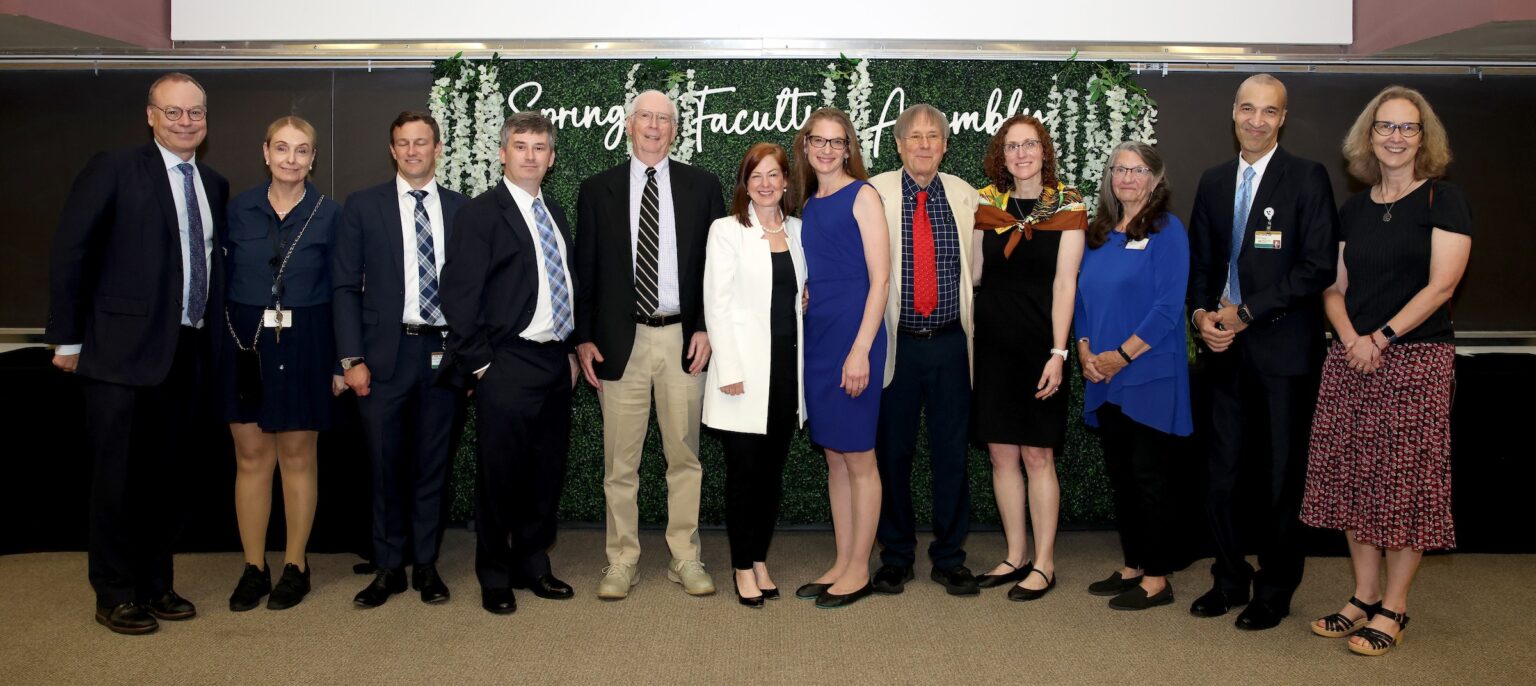
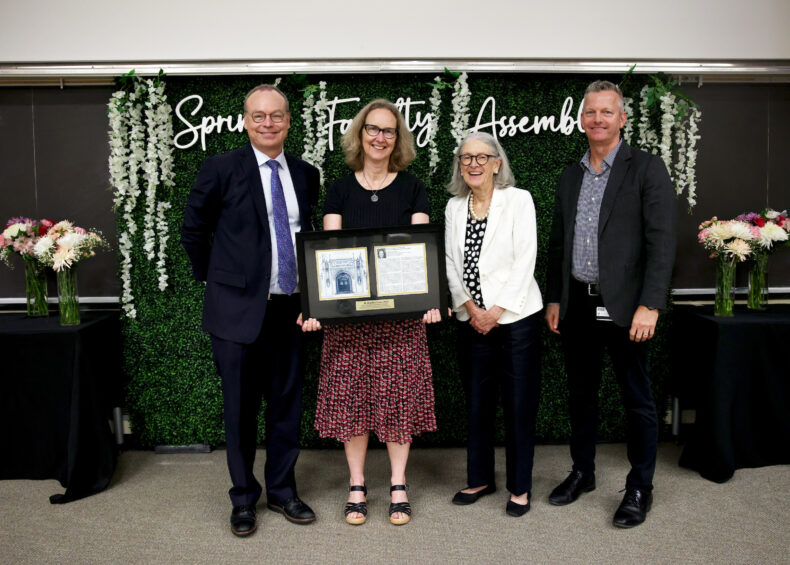
 Jeff Balser, MD, PhD (left), with the award winners at the Spring Faculty Assembly on May 29. (photo by Donn Jones)

Fourteen faculty members of Vanderbilt University School of Medicine were recognized for Excellence in Teaching, Extraordinary Performance of Clinical Service, and Outstanding Contributions to Research during the annual Spring Faculty Assembly on May 29.
In introductory remarks, Jeff Balser, MD, PhD, President and CEO of Vanderbilt Health and Dean of the School of Medicine, noted that Vanderbilt’s ranking as one of the nation’s top academic medical centers reflects its commitment to invest in medical research and train the next generation of health care leaders.
“I think that’s what we are, and why we’re successful, and what I hope to pass on,” said Balser, who will retire from both positions at the end of the year. A national search for a successor is underway.
The awardees and their achievements are:
For Excellence in Teaching
William Dupont, PhD, Professor of Biostatistics and Health Policy, recipient of the Robert D. Collins Award for Teaching Medical or Graduate Students or Practicing Physicians in the Lecture Setting.
Dupont, who is internationally known for statistical studies that have had a transformative impact on clinical practice, also has been integral to the success of Vanderbilt Health’s Biostatistics Graduate Program and Master of Public Health (MPH) program, He was inducted into Vanderbilt Health’s Academy for Excellence in Education in 2021.
Evon Batey Lee, PhD, Professor of Pediatrics, recipient of the Jacek Hawiger Award for Teaching Graduate Students and Postdoctoral Fellows in the Classroom, Lecture or Small Group Setting.
A well-regarded mentor, clinician and researcher with extensive experience in autism and other developmental disabilities, Lee serves as Training Director of the Vanderbilt Kennedy Center for Excellence in Developmental Disabilities, and as Program Director of the Vanderbilt Consortium LEND (Leadership Education in Neurodevelopmental and Related Disabilities).
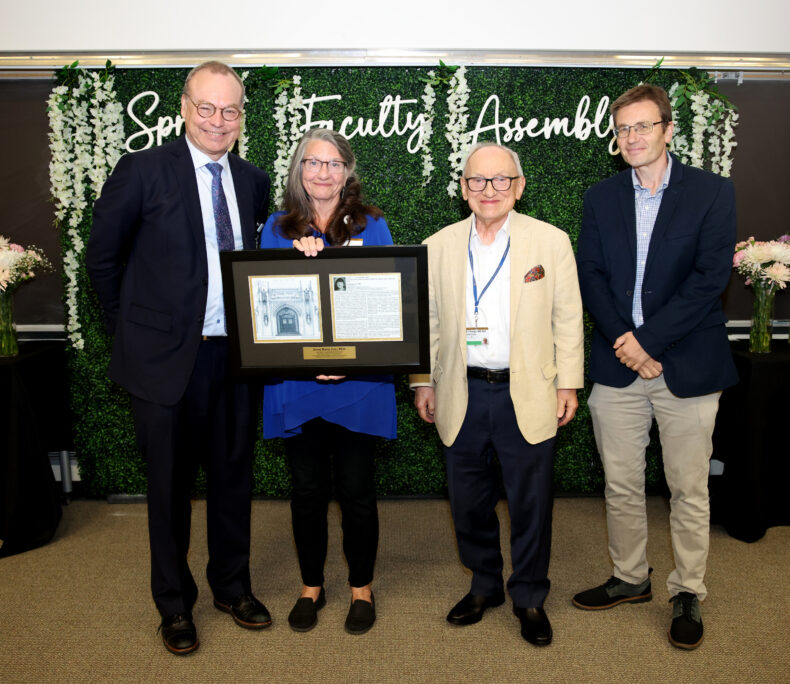
Marie Martin, PhD, MEd, Associate Professor of Health Policy, recipient of the Denis M. O’Day Award for Team-Implemented Curriculum Reform.
As Associate Dean of Global Health Education, Associate Vice President for Global Initiatives at Vanderbilt Health, and Associate Director for Education and Training in the Vanderbilt Institute for Global Health, Martin has contributed to collaborative curriculum reform in undergraduate, medical and public health education, both at home and in several African nations.
Brian Allen, MD, Professor of Anesthesiology, recipient of the R. Michael Rodriguez Award for Teaching Medical Students, Residents and/or Fellows in the Clinical Setting.
The recipient of numerous awards for excellence in education, Allen is Program Director of the Regional Anesthesia and Acute Pain Fellowship, and founder (and current vice president) of the Regional Anesthesiology Fellowship Directors Association. An innovative opioid education curriculum he helped develop reaches more than 1,000 Tennessee health care professionals annually.
Jennifer Sucre, MD, Associate Professor of Pediatrics and of Cell and Developmental Biology, recipient of the Elaine Sanders-Bush Award for Mentoring Graduate and/or Medical Students in the Research Setting.
A nationally recognized researcher and mentor, Sucre is founding Director of the Biodevelopmental Origins of Lung Disease (BOLD) Center, a hub for innovative investigations of lung development, injury and repair. She also contributes to the research training of Vanderbilt medical students and early-career Department of Pediatrics faculty through the Mentored Research Scholars Program.
For Extraordinary Performance of Clinical Service
Ryan Darby, MD, Associate Professor of Neurology, recipient of the W. Anderson Spickard Jr. Award for Clinical Excellence in a Cognitive Discipline.
Darby is Division Chief of Behavioral and Cognitive Neurology and Director of the Vanderbilt Frontotemporal Dementia (FTD) Clinic. His lab has developed novel neuroimaging methods and behavioral tasks to elucidate mechanisms leading to abnormal behaviors, with the goal of developing more effective interventions for FTD and other dementias.
Wael Alrifai, MD, MS, Associate Professor of Pediatrics and Biomedical Informatics, recipient of the Mildred T. Stahlman Award for Innovation in Clinical Care.
Alrifai, who is Associate Chief Medical Information Officer in HealthIT, has developed numerous applications aimed at improving maternal, fetal, neonatal and pediatric care that have become integral to daily clinical operations at Vanderbilt Health. His numerous contributions range from development of automated clinical databases to novel electronic health record-integrated workload assessment models.
Rondi Kauffmann, MD, MPH, Associate Professor of Surgery, recipient of the John L. Tarpley Award for Commitment to Care of Underserved Communities.
As Associate Program Director of Vanderbilt Health’s General Surgery Residency and Vice Chair of Global Surgery in the Section of Surgical Sciences, Kauffmann has spearheaded transformational initiatives and bidirectional partnerships with the Vanderbilt Institute for Global Health and Kenya’s AIC Kijabe Hospital. She works tirelessly to address barriers to care.
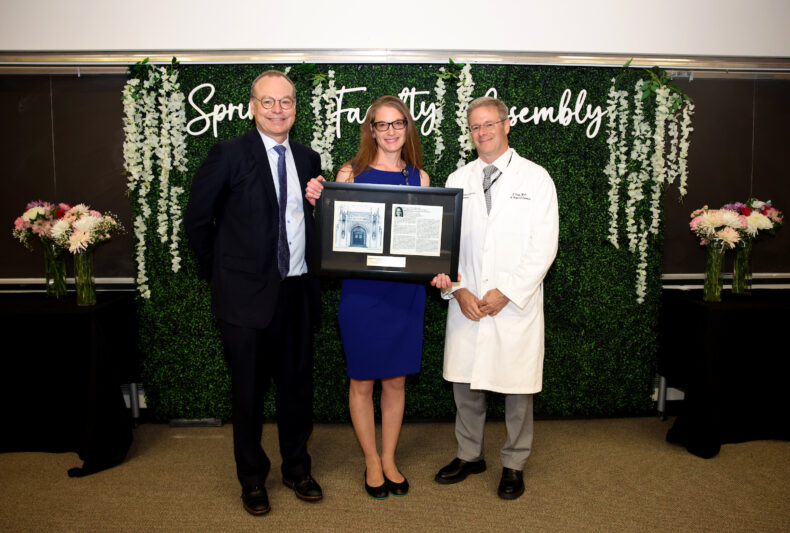
For Outstanding Contributions to Research
Ivelin Georgiev, PhD, the Louise B. McGavock Professor and Professor of Pathology, Microbiology and Immunology, Biochemistry, Biomedical Informatics, Chemical and Biomolecular Engineering, and Computer Science, recipient of the Stanley Cohen Award for Research Bridging Diverse Disciplines, such as Chemistry or Physics, to Solve Biology’s Most Important Fundamental Questions.
Georgiev, founding Director of the Computational Microbiology and Immunology program, and his colleagues have developed several transformational platform technologies for monoclonal antibody discovery. They are working on innovative technologies that help bridge the gap between computation and immunology, and which may lead to new antibody-based therapeutics and vaccines.
Borden Lacy, PhD, Professor of Pathology, Microbiology and Immunology and of Biochemistry, recipient of the Kathryn M. Edwards Award for Clinical and Translational Research Impacting Disease Prevention,
Lacy, holder of the Edward and Nancy Fody Chair in Pathology, is Director of the Center for Structural Biology. Discoveries from her laboratory have helped define how bacterial toxins produced by C. difficile and H. pylori cause gastrointestinal disease and have informed development of potential antibody therapeutics and a vaccine candidate.
Alan Brash, PhD, Professor of Pharmacology, recipient of the John H. Exton Award for Research Leading to Innovative Biological Concepts.
The discovery by Brash and his colleagues of a lipoxygenase and other previously uncharacterized enzymes in human skin solved a long-standing mystery — how the oxidation of dietary essential fatty acids by lipoxygenases to form certain lipid products maintains the skin’s barrier function and prevents loss of water through the skin.
Sunil Kripalani, MD, MSc, Professor of Medicine and Health Policy, recipient of the Kevin B. Johnson Award for Innovative Approaches Advancing Clinical Practice and/or Biomedical Research.
Kripalani is Director of the Vanderbilt Center for Health Services Research and Vice President for Health System Sciences at Vanderbilt Health. His contributions to implementation science, health services research, and learning health systems have helped improve health care delivery and health outcomes by optimizing quality, safety, value and patient-centered care.
Elizabeth Phillips, MD, Professor of Medicine, Dermatology, Pathology, Microbiology and Immunology, and Pharmacology, recipient of the Grant W. Liddle Award for Outstanding Contributions in Clinical Research.
Phillips, who holds the John A. Oates Chair in Clinical Research, is the founding Director of the Center for Drug Safety and Immunology and the Vanderbilt Drug Allergy Clinic. Her work has transformed severe adverse drug reactions from unpredictable idiosyncrasies into biologically determined, preventable conditions and has had worldwide impact.
Jerod Denton, PhD, Professor of Anesthesiology and Pharmacology, recipient of the Charles R. Park Award for Basic Research Revealing Insights into Physiology and Pathophysiology. Denton’s research focuses on the molecular pharmacology, physiology and therapeutic targeting of inward rectifier potassium ion channels, which are essential for kidney, cardiovascular, neural and epithelial function. It has informed the development of therapeutics for neuropsychiatric disorders, as well as inhibitors that can disrupt renal function in disease-transmitting mosquitoes.